Singapore’s food and beverage sector operates under some of the world’s strictest hygiene standards. The National Environment Agency (NEA) enforces rigorous requirements that protect public health while holding establishments accountable for operational excellence. For restaurant operators, facility managers, and F&B chain owners, passing NEA audits isn’t merely about regulatory compliance-it’s about safeguarding your brand reputation and ensuring customer trust.
The challenge? NEA audits evaluate far more than surface-level cleanliness. Inspectors assess your documented protocols, staff training effectiveness, and your ability to maintain consistent standards during peak operations. A single oversight in your cleaning procedures can result in demerit points, mandatory closures, or public disclosure of violations that permanently damage customer confidence.
According to SFA’s 2024 Food Statistics, Singapore recorded 22.8 foodborne illness cases per 100,000 population in 2024, with more than half involving catered food. These incidents triggered intensified enforcement actions and reminded operators that compliance isn’t optional-it’s existential for business survival.
This guide provides actionable frameworks for designing restaurant cleaning protocols specifically calibrated to meet NEA’s stringent audit criteria. We’ll explore how to structure your cleaning schedules, document procedures effectively, and implement verification systems that demonstrate compliance beyond any doubt.
Understanding NEA’s Restaurant Hygiene Framework
The NEA’s approach to restaurant hygiene assessment extends beyond visual inspection. Auditors evaluate your establishment through a comprehensive lens that examines both physical conditions and management systems. Working alongside the Singapore Food Agency (SFA), NEA enforces stringent standards across Singapore’s 52,000+ licensed food establishments. Understanding this framework is essential for designing protocols that address every compliance dimension.
Core Audit Focus Areas
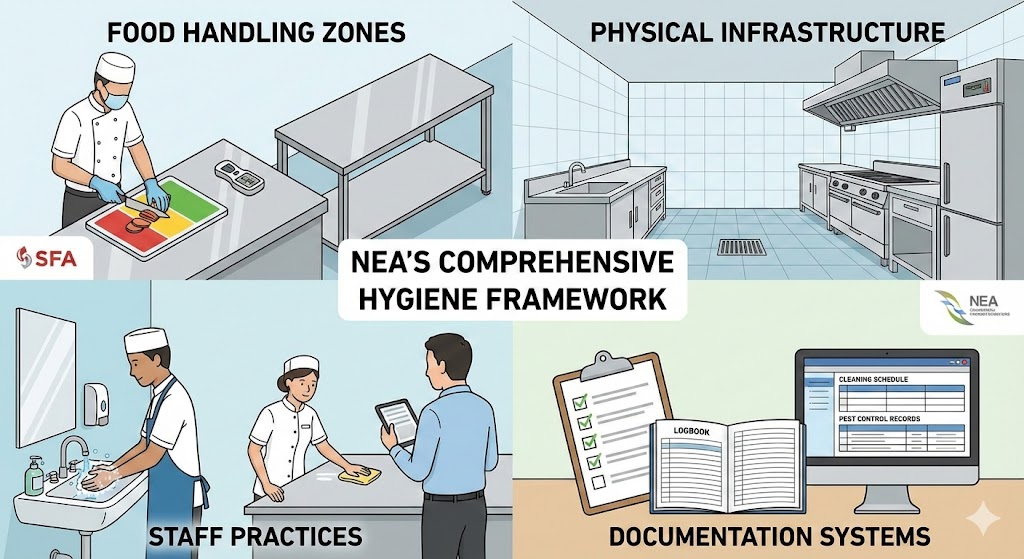
NEA inspections systematically evaluate four critical domains:
Food Handling and Preparation Zones: Auditors scrutinize all surfaces where food is processed, from preparation tables to cooking equipment. They assess cross-contamination risks, temperature control compliance, and the cleanliness of cutting boards, utensils, and food storage containers. Any residue, improper sanitization, or inadequate separation between raw and cooked food areas triggers immediate concern.
Physical Infrastructure and Equipment: This encompasses the structural condition of your kitchen, including walls, floors, ceilings, and drainage systems. NEA evaluates whether surfaces are smooth, non-absorbent, and easy to clean. Equipment must be maintained in good repair, with particular attention to refrigeration units, exhaust systems, and food contact surfaces. Grease accumulation in ventilation hoods or deteriorating floor tiles represent significant compliance gaps.
Operational Procedures and Staff Practices: Beyond physical cleanliness, NEA assesses your team’s adherence to proper hygiene protocols. This includes handwashing compliance, appropriate use of gloves and uniforms, and correct cleaning procedures. Auditors observe whether staff can articulate cleaning protocols and whether supervisors verify task completion.
Documentation and Verification Systems: NEA expects documented evidence of your cleaning schedule, temperature monitoring logs, pest control records, and corrective action reports. Missing documentation or inconsistent record-keeping suggests systemic failures in your hygiene management approach.
The Demerit Point System
NEA operates on a demerit point framework that assigns varying weights to different violations. Minor issues like improper storage of cleaning supplies might incur 2-4 points, while severe violations such as pest infestation or lack of proper waste disposal can result in 10-12 points. Accumulating 12 or more demerit points triggers mandatory closure until issues are rectified and verified.
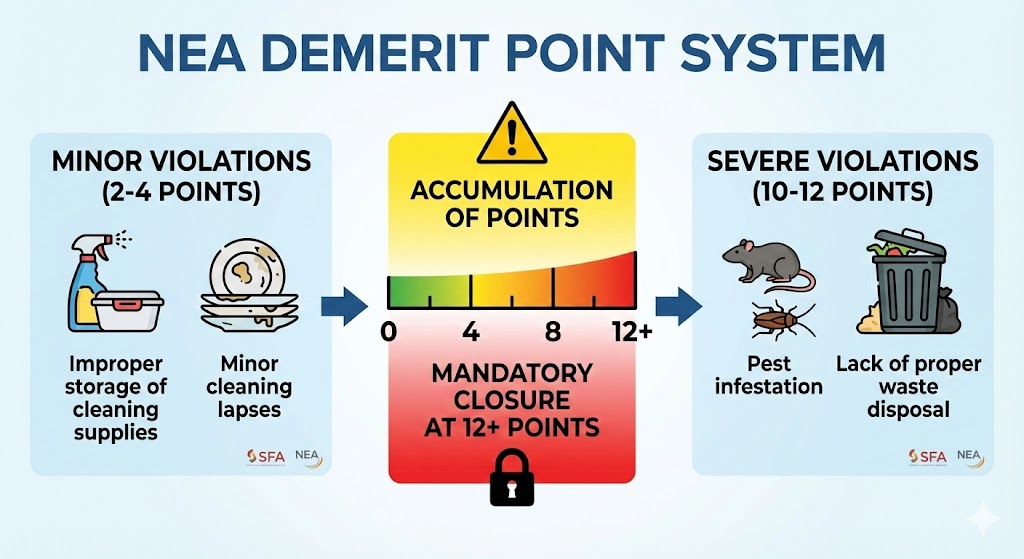
Understanding this weighted system helps prioritize your protocol design. High-risk areas that carry severe demerit penalties deserve proportionally greater attention in your cleaning schedules and verification procedures.
Common Protocol Failures in NEA Audits
Analyzing patterns in NEA enforcement actions reveals predictable failure points where restaurant cleaning protocols consistently fall short. Identifying these vulnerabilities allows you to design more robust systems from the outset.
Inadequate Coverage of Hidden Areas
The most frequent compliance failure involves neglecting spaces that aren’t immediately visible during daily operations. Grease accumulation behind cooking equipment, debris under fixed counters, and grime buildup on high shelving all indicate insufficient protocol coverage.
This failure typically stems from cleaning schedules that focus only on customer-visible areas and high-traffic zones. NEA auditors deliberately inspect these concealed spaces because bacterial growth, pest activity, and fire hazards often originate in neglected corners.
Effective protocols must explicitly assign responsibility for these hidden areas with specific frequencies. For instance, requiring monthly deep cleaning behind all cooking stations, documented with photographic evidence and supervisor verification.
Poor Drainage and Grease Management
Clogged floor drains and overflowing grease traps consistently appear in NEA violation reports. These issues create foul odors, attract pests, and pose contamination risks. The problem often arises from treating drainage maintenance as reactive rather than preventive.
Restaurants generate significant grease and food debris that gradually accumulate in drainage systems. Without scheduled deep cleaning and professional grease trap servicing, blockages become inevitable. By the time visible problems emerge, the underlying contamination is severe.
Compliant protocols establish proactive schedules for drain cleaning and grease trap maintenance, with service frequency calibrated to your kitchen’s volume. High-output kitchens may require weekly attention, while smaller operations might sustain monthly maintenance.
Incomplete Equipment Disassembly Cleaning
Complex equipment like meat slicers, mixers, and food processors contain components that trap food particles and moisture, creating bacterial breeding grounds. Many restaurants clean only external surfaces, leaving internal components contaminated.
This oversight occurs because proper cleaning requires partial disassembly, specialized knowledge, and additional time. Without explicit protocols detailing disassembly procedures and verification steps, staff default to superficial cleaning that satisfies visual inspection but fails microbiological standards.
Effective protocols include manufacturer-specified cleaning instructions for each piece of equipment, with step-by-step disassembly guides. These should specify cleaning frequency, required sanitizers, and verification methods to ensure thorough cleaning.
Documentation Inconsistencies
Even establishments with robust cleaning practices fail audits due to incomplete or inconsistent documentation. NEA requires verifiable evidence that protocols are consistently followed. Missing entries in cleaning logs, unsigned verification forms, or outdated procedures suggest management oversight failures.
This problem often reflects a cultural disconnect where cleaning is viewed as a task rather than a documented process. Staff may perform cleaning diligently but fail to record completion, leaving no audit trail.
Compliant systems integrate documentation directly into the workflow. Digital platforms can prompt real-time recording, require supervisor verification, and flag missing entries before they become audit liabilities.
Designing Your Restaurant Cleaning Protocol Framework
Building NEA-compliant cleaning protocols requires a systematic approach that translates regulatory requirements into executable daily operations. The following framework provides structure for designing protocols tailored to your establishment’s specific layout, equipment, and service model.
Step 1: Conduct a Comprehensive Cleaning Needs Assessment
Begin by mapping every surface, piece of equipment, and operational area in your establishment. This inventory forms the foundation for protocol design:
Create zone-based maps dividing your restaurant into functional areas: food preparation, cooking line, dishwashing, cold storage, dry storage, dining area, and waste management. For each zone, identify all surfaces requiring cleaning, from obvious countertops to overlooked areas like wall-mounted equipment fixtures and electrical outlets.
Document equipment-specific requirements by reviewing manufacturer specifications for each piece of machinery. Many violations occur because operators use inappropriate cleaning methods that damage equipment or fail to address manufacturer-identified contamination risks. Refer to SFA’s Guidelines for Licensed Food Retail Premises for specific equipment standards.
Assess contamination risk levels for each area. High-risk zones involving raw food handling or intensive cooking require more frequent and rigorous cleaning than low-risk areas. This risk stratification ensures resources focus where they deliver maximum food safety impact.
Step 2: Establish Frequency-Based Cleaning Schedules
NEA compliance demands that cleaning occurs at intervals appropriate to contamination risk. Structure your schedules across four frequency tiers:
Continuous Cleaning (During Service): Food contact surfaces used for raw meat, immediate spill cleanup, handwashing compliance. These protocols require real-time execution during operational hours.
Daily Cleaning (End of Shift): All food preparation surfaces, cooking equipment exteriors, floor mopping, dishwashing area sanitization, waste disposal. Daily protocols establish baseline cleanliness.
Weekly Cleaning (Scheduled Deep Clean): Equipment disassembly and internal cleaning, refrigeration unit interiors, floor drain sanitization, ventilation filter cleaning. Weekly protocols address accumulation that daily cleaning misses.
Monthly Cleaning (Intensive Maintenance): Exhaust system deep cleaning, wall and ceiling washing, grease trap servicing, behind-equipment access areas. Monthly protocols target hidden contamination reservoirs.
Hong Ye Group recently worked with a restaurant chain in Singapore’s CBD to redesign their cleaning frequency model. By implementing a risk-stratified schedule that increased deep cleaning frequency for high-volume kitchen zones while optimizing lower-risk areas, the chain reduced NEA audit findings by 70% while maintaining the same labor budget through improved efficiency.
For each task, specify exact procedures, required cleaning agents, contact times for sanitizers, and verification methods. Vague instructions like clean thoroughly create interpretation gaps that lead to inconsistent execution.
Step 3: Develop Standard Operating Procedures (SOPs)
Transform your cleaning schedule into detailed SOPs that any staff member can follow consistently. Effective SOPs include:
Task Decomposition: Break complex cleaning activities into sequential steps. For example, Clean the meat slicer becomes: (1) Unplug equipment, (2) Disassemble blade and guard, (3) Pre-rinse components, (4) Wash with designated detergent, (5) Sanitize for specified contact time, (6) Air dry completely, (7) Reassemble and verify function.
Specific Product Requirements: Identify approved cleaning chemicals, dilution ratios, and application methods. Specify NEA-approved sanitizers for food contact surfaces and appropriate concentrations for different materials.
Safety Protocols: Include personal protective equipment requirements, ventilation needs, and safe handling procedures for cleaning chemicals. NEA evaluates staff safety as part of overall hygiene management.
Visual Aids: Incorporate photographs or diagrams showing proper cleaning technique, especially for equipment disassembly. Visual guides reduce training time and minimize execution errors.
Step 4: Implement Documentation and Verification Systems
NEA auditors require evidence that cleaning occurs as scheduled. Design documentation systems that capture:
Task Completion Logs: Daily checklists signed by the staff member who performed cleaning and countersigned by supervisors. Include timestamps to demonstrate schedule adherence.
Deep Cleaning Records: Detailed reports for weekly and monthly tasks, including before/after photographs, chemical products used, and any issues identified during cleaning.
Equipment Maintenance Logs: Track professional servicing for exhaust systems, grease traps, and refrigeration units. Retain service provider certificates and invoices as verification.
Corrective Action Documentation: Record any cleaning deficiencies discovered through inspections, the corrective measures taken, and follow-up verification. This demonstrates active management oversight.
Digital documentation systems offer advantages over paper logs, including automated reminders, photographic evidence capture, and instant accessibility during audits. However, ensure any digital system maintains data integrity and provides audit-ready reports.
Step 5: Establish Training and Competency Verification
Protocols mean nothing if staff lack knowledge or skills to execute them properly. Develop a training program that ensures competency:
Initial Onboarding Training: New staff must complete comprehensive hygiene training covering handwashing, cross-contamination prevention, proper equipment use, and cleaning protocols before handling food or cleaning duties. All food handlers must complete the WSQ Food Safety Course Level 1 as mandated by SFA.
Task-Specific Training: Provide hands-on instruction for complex cleaning procedures, particularly equipment disassembly and sanitization protocols. Require trainees to demonstrate competency before performing tasks independently. NEA’s Food Handler’s Handbook provides comprehensive guidance on proper hygiene practices.
Refresher Training: Schedule periodic training updates to reinforce protocols, introduce new equipment, or address identified performance gaps. Quarterly refreshers help maintain high standards.
Documentation of Training: Maintain records showing who received training, dates completed, and competency assessments. NEA may review training documentation to verify that staff possess necessary knowledge.
Critical Cleaning Areas Requiring Special Attention
Certain areas represent disproportionate compliance risks due to their complexity or vulnerability to contamination. Your protocols must address these zones with heightened rigor.
Kitchen Exhaust and Ventilation Systems
Grease-laden vapors from cooking create deposits throughout exhaust systems. This accumulated grease poses severe fire hazards and violates NEA requirements for clean, functional ventilation.
Your protocol must include:
Monthly filter removal, degreasing, and sanitization for all accessible components. Filters should be soaked in commercial degreaser, scrubbed to remove residue, and air dried before reinstallation.
Quarterly professional hood and duct cleaning by certified contractors. DIY approaches cannot adequately address interior ductwork accumulation. Professional services like Hong Ye Group specialize in comprehensive exhaust system maintenance for Singapore’s F&B sector, using high-pressure water jet technology and industrial degreasers that meet NEA fire safety standards. Retain detailed service reports and certifications from your chosen provider.
Weekly visible inspection of hood surfaces and immediate cleaning of any grease drip accumulation. Don’t wait for scheduled deep cleaning if buildup becomes apparent.
Floor Drainage Systems
Clogged drains create standing water that harbors bacteria and attracts pests. Your protocol should establish:
Daily end-of-service drain flushing with hot water to prevent debris accumulation. Staff should verify water flows freely from all floor drains.
Weekly drain cover removal, trap cleaning, and sanitization. This requires physically removing covers, clearing debris, and using enzymatic cleaners designed for drain maintenance.
Monthly professional grease trap servicing. Grease traps require specialized pumping and cleaning that in-house staff cannot adequately perform. Schedule service before trap reaches capacity to prevent overflow emergencies.
Refrigeration and Cold Storage Units
Temperature control failures and contamination in cold storage represent critical food safety risks. Protocols must address:
Daily temperature monitoring with documented logs showing all units maintain proper ranges. Any deviation requires immediate corrective action and documentation.
Weekly interior cleaning of shelving, walls, and door seals. Remove all stored items, clean surfaces with food-safe sanitizer, and organize properly before restocking.
Monthly condenser coil cleaning to maintain cooling efficiency. Dirty coils force units to work harder, increasing energy costs while compromising temperature stability.
Quarterly professional inspection and maintenance. Refrigeration systems require technical expertise to verify proper function and address potential failures before they compromise food safety.
Dishwashing and Sanitization Areas
Improper dishwashing allows contaminated serviceware to reach customers. Your protocol must ensure:
Continuous monitoring of dish machine temperatures and chemical concentrations. Install visible temperature gauges and provide test strips for chemical verification.
Daily cleaning of machine interiors, spray arms, and drain screens. Food debris accumulation reduces cleaning effectiveness and creates contamination sources.
Weekly deliming of dish machines to prevent mineral buildup that compromises spray pressure and temperature. Use manufacturer-approved deliming agents at specified concentrations.
Proper three-compartment sink protocols for manual washing. Maintain wash water temperature above 43°C, sanitizer concentration within approved ranges, and ensure adequate air drying time.
Building a Culture of Cleaning Compliance
Technical protocols alone don’t ensure NEA compliance. Success requires fostering organizational culture where hygiene becomes an ingrained value rather than a checkbox activity.
Management Accountability and Leadership
Cleaning standards ultimately reflect management priorities. Leaders must demonstrate commitment through:
Regular Inspection Presence: Managers should conduct daily walk-throughs using the same criteria NEA auditors apply. This visible engagement signals that cleanliness matters at the highest level.
Resource Allocation: Provide adequate staffing time, professional-grade cleaning supplies, and proper equipment. Expecting staff to maintain high standards without sufficient resources guarantees failure.
Performance Recognition: Acknowledge and reward consistent adherence to cleaning protocols. Public recognition of exemplary cleaning reinforces desired behaviors across the team.
Accountability for Failures: Address cleaning deficiencies promptly through retraining or corrective action. Tolerating shortcuts or incomplete cleaning communicates that protocols are optional.
Empowering Staff Ownership
Staff closest to daily operations often identify practical improvements to cleaning protocols. Create mechanisms for their input:
Establish regular feedback sessions where team members can suggest protocol modifications, report equipment issues, or highlight areas needing additional attention. Many compliance improvements emerge from frontline observations.
Assign zone ownership where specific staff members take responsibility for particular areas. This creates personal investment in maintaining standards and increases attention to detail.
Provide authority to halt operations if critical cleaning cannot be completed safely. Staff should feel empowered to address hygiene concerns without fear of negative consequences for service delays.
Integrating Cleaning into Operational Flow
The most sustainable protocols integrate seamlessly into service patterns rather than competing with operational demands:
Schedule intensive cleaning during naturally slower periods. Avoid assigning major deep cleaning tasks during peak service when staff face conflicting pressures.
Build cleaning time into labor scheduling. Allocate dedicated hours for protocol completion rather than expecting staff to find time during regular shifts.
Use prep periods strategically. Morning prep shifts can complete specific cleaning tasks before service begins, distributing workload more evenly.
Leveraging Professional Partnerships for Complex Requirements
Certain aspects of NEA compliance require specialized expertise beyond in-house capabilities. Strategic outsourcing enhances compliance while allowing your team to focus on core operations.
When to Engage Professional Cleaning Services
Consider professional partnerships for:
Exhaust System Maintenance: Kitchen hood and duct cleaning requires specialized equipment, safety training, and technical knowledge. Professional services provide certified cleaning that meets NEA requirements and insurance standards.
Grease Trap Servicing: Proper grease trap maintenance involves pumping, cleaning, and waste disposal that requires licensed contractors. Attempting DIY approaches risks environmental violations and incomplete cleaning.
Deep Floor Restoration: Periodic tile deep cleaning, grout restoration, and floor resealing exceed typical daily maintenance capabilities. Professional services deliver results that refresh your facility’s appearance while addressing embedded contamination.
Pre-Audit Preparation: Engaging professional inspection services before scheduled NEA audits identifies potential issues while time remains for correction. Hong Ye Group offers comprehensive pre-audit assessments that evaluate your establishment using NEA’s exact criteria, providing detailed gap analysis and remediation support to ensure audit success. This investment in third-party assessment significantly reduces surprise violations.
Selecting Quality Service Providers
Not all cleaning contractors deliver NEA-compliant results. Evaluate potential partners carefully:
Verify relevant certifications and licensing for specialized services. Exhaust cleaning contractors should hold appropriate certifications, while grease trap servicers require waste disposal licenses.
Request references from similar F&B establishments. Contact references directly to assess service quality, reliability, and audit performance.
Review service documentation and reporting procedures. Quality contractors provide detailed cleaning reports, photographic evidence, and certificates suitable for NEA audit presentation.
Ensure adequate insurance coverage. Professional cleaning involves liability risks; contractors should carry comprehensive insurance protecting your establishment.
Establishing Service Schedules and Documentation
Once engaged, integrate professional services into your compliance framework:
Schedule recurring services at intervals appropriate to your operational volume. High-volume kitchens may require monthly exhaust cleaning, while moderate operations sustain quarterly schedules.
Obtain detailed service reports after each visit. Documentation should specify work performed, areas addressed, products used, and any concerns identified.
Maintain a central file of all professional service records. These certificates provide critical evidence of compliance during NEA audits.
Include service schedules in your master cleaning calendar. Professional services should complement rather than duplicate your in-house protocols.
Pre-Audit Preparation and Self-Assessment
Proactive preparation significantly improves audit outcomes. Implement systematic self-assessment procedures that identify issues before NEA inspectors arrive.
Conducting Internal Mock Audits
Schedule quarterly internal audits using NEA criteria:
Use official NEA inspection checklists as assessment tools. These public documents provide exact criteria auditors will apply during actual inspections.
Assign a manager not directly responsible for cleaning oversight to conduct assessments. Fresh perspectives identify issues that daily operators might overlook.
Document findings with the same rigor expected during actual audits. Photograph deficiencies, record observations, and create corrective action plans.
Set a deadline for addressing all identified issues and schedule follow-up verification. Mock audits only improve compliance if findings drive genuine corrections.
Creating a Pre-Audit Deep Clean Schedule
When NEA audits are scheduled, intensify cleaning protocols:
Conduct comprehensive deep cleaning of all areas two weeks before the audit date. This provides time to identify additional issues requiring attention.
Focus special attention on areas with historical violations or known vulnerabilities. Previous audit reports highlight where your establishment tends to fall short.
Schedule professional services for exhaust systems, grease traps, and other specialized maintenance immediately before audits. Fresh service documentation demonstrates commitment to compliance.
Verify all documentation is current, complete, and organized for easy auditor access. Missing records undermine otherwise excellent physical conditions.
Day-of-Audit Preparations
On audit day, ensure optimal presentation:
Conduct a morning walk-through addressing any overnight issues. Verify all areas meet standards before inspectors arrive.
Ensure all cleaning supplies are properly stored, labeled, and organized. Misplaced or improperly stored chemicals create immediate violations.
Brief staff on appropriate responses to auditor questions. Team members should know where cleaning logs are kept and understand current protocols.
Designate a management representative to accompany auditors throughout the inspection. This person can provide context, retrieve documentation, and note any issues raised for immediate follow-up.
Maintaining Compliance Between Audits
NEA compliance isn’t a periodic event tied to scheduled inspections. Sustainable excellence requires ongoing commitment to protocol adherence and continuous improvement.
Establishing Continuous Quality Monitoring
Implement daily, weekly, and monthly verification systems:
Daily Supervisor Checks: Designate closing supervisors to verify completion of all scheduled cleaning tasks before releasing staff. This real-time verification prevents task skipping.
Weekly Management Audits: Managers should conduct thorough inspections of different zones each week, rotating to cover all areas monthly. Document findings and corrective actions.
Monthly Cross-Departmental Review: Engage staff from different areas to audit zones outside their normal responsibility. Fresh perspectives identify overlooked issues.
Quarterly Trend Analysis: Review documentation to identify patterns in cleaning deficiencies or recurring issues. Systematic problems require protocol modifications rather than repeated corrections.
Responding to Identified Deficiencies
When gaps emerge between audits, respond systematically:
Immediate Correction: Address the specific deficiency promptly, documenting corrective action taken.
Root Cause Analysis: Investigate why the issue occurred. Was it insufficient training, unclear protocols, inadequate resources, or staff shortcut-taking?
Protocol Modification: If the same issue recurs, modify protocols to prevent recurrence. This might involve increased cleaning frequency, clearer instructions, or additional training.
Verification Follow-Up: Schedule specific follow-up inspection to confirm the issue remains resolved. Don’t assume initial correction proves sustainable.
Staying Current with Regulatory Changes
NEA periodically updates requirements based on emerging food safety research and incident investigations. Maintain awareness of regulatory evolution:
Monitor NEA’s official communications channels and subscribe to industry updates from Singapore’s Restaurant Association or other trade groups. The GoBusiness portal provides centralized access to all licensing requirements and regulatory updates.
Participate in NEA-organized workshops and training sessions. These programs provide insights into enforcement priorities and best practices.
Network with other F&B operators to share compliance insights and learn from peers’ experiences. Industry collaboration strengthens overall sector performance.
Engage food safety consultants periodically to review your protocols against current best practices. External expertise identifies improvement opportunities internal teams might miss.
The Business Case for Exceeding Minimum Standards
While this guide focuses on meeting NEA requirements, establishments that exceed minimum standards gain significant competitive advantages.
Enhanced Brand Reputation
Consistent inspection excellence becomes a marketing differentiator. Displaying A ratings prominently signals commitment to customer wellbeing that builds trust and loyalty.
Positive health inspection records generate favorable media coverage and online reviews. Food safety excellence attracts customers who prioritize hygiene in dining decisions.
Operational Efficiency Gains
Well-designed cleaning protocols improve overall operational flow. Clean, organized workspaces enhance staff productivity and reduce equipment downtime from maintenance issues.
Preventive cleaning reduces costly emergency repairs. Regular maintenance extends equipment lifespan and prevents expensive breakdown during peak service periods.
Risk Mitigation
Strong hygiene systems dramatically reduce foodborne illness risks that can destroy businesses overnight. The reputational and financial cost of even a single incident far exceeds investment in prevention.
Documented compliance provides legal protection if incidents occur. Demonstrable adherence to recognized standards mitigates liability exposure.
Staff Satisfaction and Retention
Employees prefer working in clean, well-maintained environments. Strong hygiene standards improve staff morale and reduce turnover in an industry plagued by staffing challenges.
Professional work environments attract higher-quality candidates during recruitment. Job seekers increasingly evaluate workplace conditions when selecting employers.
Conclusion: Building Sustainable Compliance Systems
Passing NEA audits requires more than last-minute preparation or cosmetic improvements. Sustainable compliance emerges from well-designed protocols, committed leadership, and a culture where hygiene excellence becomes operational identity.
The frameworks outlined in this guide provide structured approaches to designing restaurant cleaning protocols that meet NEA’s rigorous standards. By conducting thorough needs assessments, establishing frequency-based schedules, documenting procedures systematically, and fostering organizational accountability, you create systems that withstand scrutiny while protecting public health.
Remember that cleaning protocols serve a purpose beyond regulatory compliance. They safeguard your customers’ wellbeing, protect your brand reputation, and contribute to operational excellence that distinguishes successful establishments in Singapore’s competitive F&B landscape.
The investment in robust hygiene systems pays dividends through enhanced customer trust, improved operational efficiency, and the peace of mind that comes from knowing your establishment consistently meets the highest standards of food safety.
Your next NEA audit shouldn’t be a source of anxiety-it should be an opportunity to demonstrate the excellence that defines your operation.
Ready to elevate your restaurant’s cleaning protocols to consistently pass NEA audits? Hong Ye Group specializes in customized commercial cleaning solutions designed specifically for Singapore’s F&B sector. Our team understands NEA requirements inside and out, and we provide both comprehensive deep cleaning services and protocol consultation to help your establishment achieve and maintain compliance excellence.
Contact Hong Ye Group today for a complimentary cleaning needs assessment and discover how professional partnership can transform your hygiene management system.