
Office cleaning cost in Singapore comes down to a wage floor with a margin sitting on top of it. From 1 July 2026 the Progressive Wage Model set the entry floor for a Group 1 office cleaner at S$2,080 a month, up 8.9 per cent in one step. Work outward from that number and you get the per square foot and per deployed head figures below, priced the way Hong Ye Group prices commercial cleaning and hygiene work.
What does office cleaning actually cost in Singapore in 2026?
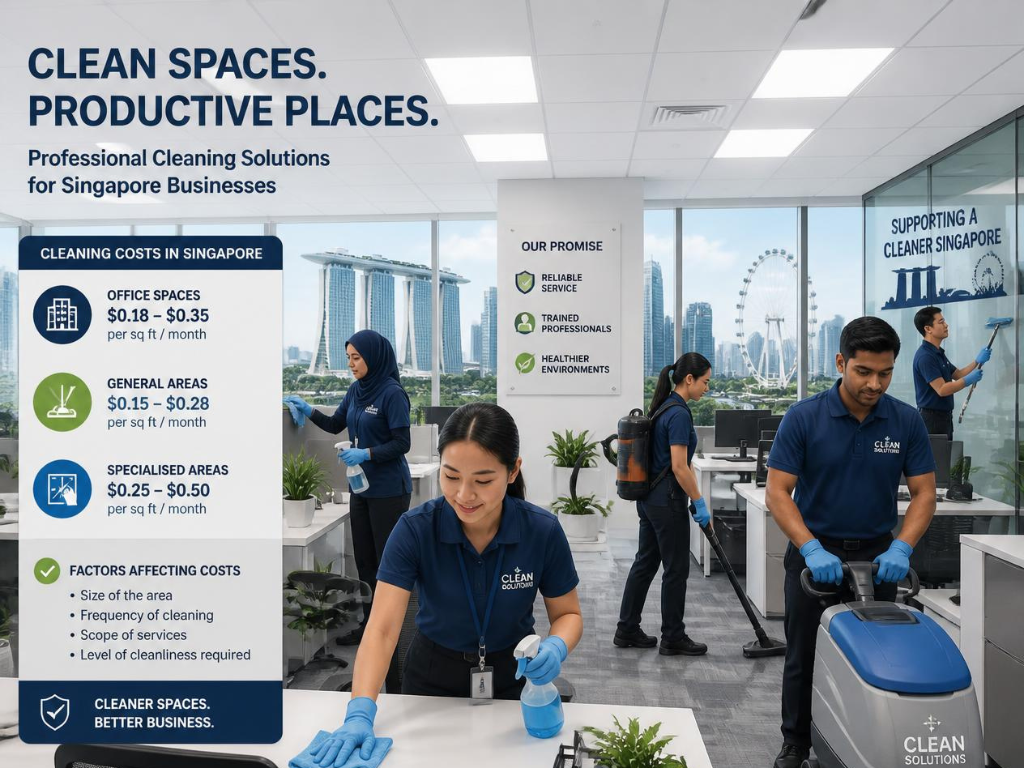
Between S$0.30 and S$0.45 per square foot per month for a standard daily office scope, or roughly S$3,400 to S$3,700 per deployed full-time cleaner per month. Both numbers describe the same thing from different ends.
Nobody surveyed the market for those figures. They are built up: start from the statutory floor, add the statutory on-costs, add supervision at a realistic ratio, add equipment, consumables and overhead, then add a margin consistent with a sector that runs thin. The arithmetic sits in the sections below so you can rerun it against your own floorplate.
A 10,000 square foot single-tenant office with two washroom blocks, one pantry and a reception typically resolves to one deployed cleaner, which puts it near S$0.35 per square foot per month. A 25,000 square foot floorplate with four washroom blocks needs two cleaners plus supervisor attendance and lands closer to S$0.30, because coverage improves with scale until washroom count catches up with it.
Scope moves the number more than any other variable, and it moves it before the rest matters. A contract covering only the office floor prices differently from one covering the office floor, the pantry deep clean, the quarterly carpet extraction and the bin centre. Establish what commercial cleaning covers before you compare a single dollar figure.
Why do three quotes for the same office come back so different?
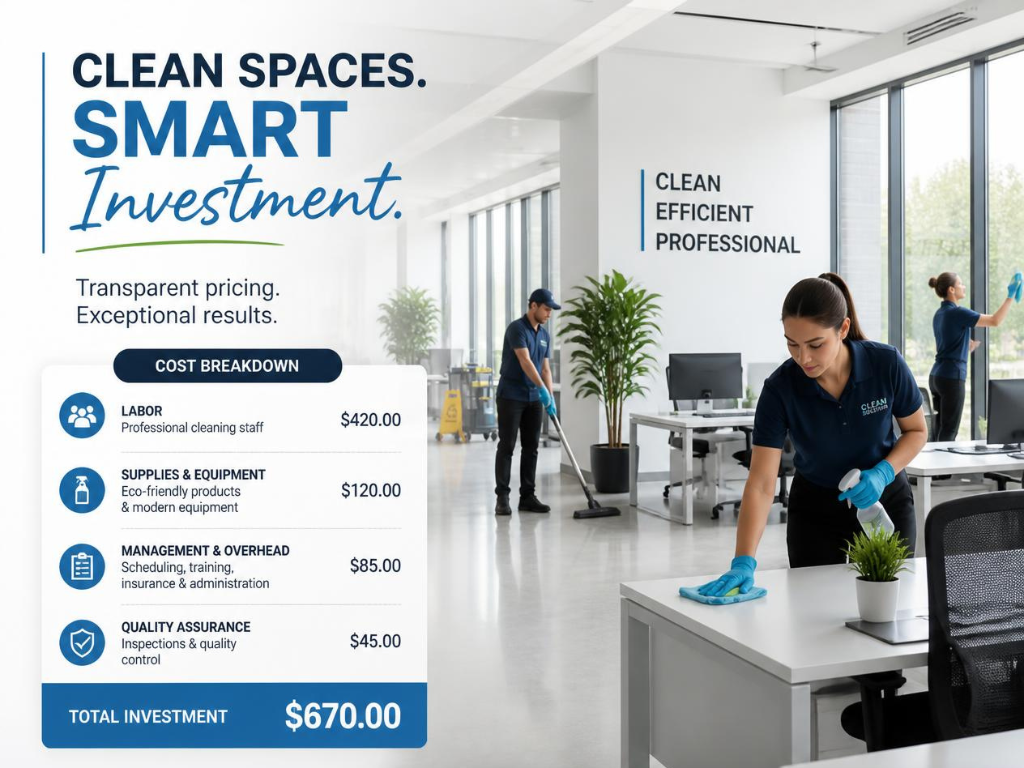
Because they are almost never quoting the same thing. In practice, the spread between the highest and lowest bid on an office cleaning tender says more about the specification than about the bidders.
Four variables explain most of the gap. Deployed hours is the first, and the low bidder shortens them. Job level is the second: a quote assuming a general cleaner at S$2,080 undercuts one assuming a multi-skilled cleaner at S$2,700. Periodic works is the third, which the low bidder either excludes or stretches. Consumables is the fourth, and the low bidder leaves those with you.
A fifth variable is harder to see. Some bidders price the first year as an acquisition cost and recover it at renewal. That gives you a headline discount you repay in year two.
The fix is on your side of the table. Issue a specification that fixes deployed hours, job level, periodic frequency and consumables ownership, and the quotes become comparable by construction. Most tenders that produce a wild spread were written as a scope of areas rather than a scope of work, and scoping an office cleaning programme properly is what closes it. Once the specification is fixed, comparing cleaning contractors becomes a question of capability instead of arithmetic.
How does per square foot pricing work, and where does it break?
It divides a monthly fee by net lettable area, which makes it easy to benchmark across buildings and unreliable inside any one of them. Per square foot pricing assumes cleaning effort scales with floor area. It does not.
Washrooms break the assumption first. A washroom block consumes 45 to 75 minutes a day regardless of how much office floor sits around it, so two identical 10,000 square foot floors with two and four washroom blocks carry materially different labour. Cellular offices break it second, because 40 individual rooms take longer than one open floor of the same area. Pantries, wet areas and staff density break it after that.
Use per square foot as a cross-check on the contract, not as the basis of it. It answers “is this quote in the right postcode” in about thirty seconds, which is exactly what it is good for.
The model does hold in multi-tenant buildings with repeating floor plates, which is why landlords price common area services this way. Lobbies, lift lobbies and shared corridors have consistent effort per unit area and predictable traffic, so public area cleaning demands translate into a per square foot rate with far less distortion than a tenanted floor does.
How does per headcount pricing work?
It prices the deployment instead of the space. You agree a number of cleaners at a stated job level, on stated shifts, for a stated number of hours, and the monthly fee follows from that.
Build it from the floor. A resident general cleaner at the Group 1 PWM floor of S$2,080 a month costs S$24,960 in basic wages over a year. Add the mandatory PWM bonus of at least two weeks’ basic wage, roughly S$1,040, for S$26,000. Add employer CPF at 17 per cent for an employee aged 55 and below, roughly S$4,420. Annual employment cost lands near S$30,420, or about S$2,535 a month.
That is what the person costs. The service costs more. Add supervision at one supervisor per twelve cleaners, which at the S$2,870 supervisor floor adds roughly S$291 per cleaner per month. Add equipment, consumables, uniform, insurance and training at 10 to 15 per cent of labour. Add administration and overhead at 8 to 12 per cent. Add a margin that a sector operating close to break-even can actually sustain, which lands in single digits, well short of the 20 to 30 per cent buyers often assume.
The total lands between S$3,400 and S$3,700 a month for one day-shift resident general cleaner on a standard office scope. Divide by the 190.7 working hours in a 44-hour week and you get an effective S$17.80 to S$19.40 an hour, which is why contracted office cleaning deployment prices below ad hoc hourly work. One-off jobs carry idle time, travel between sites and no utilisation guarantee, so they price higher per hour and always will.
Which pricing model should you ask for?
Per headcount as the contract basis, with per square foot as a cross-check. Asking for it the other way round hands the bidder control of the one variable you most need visible.
A per square foot quote tells you what you pay and leaves out who does the work: how many people will be in your building, at what job level, for how long. When service slips, you have no unit to argue from. A per headcount contract gives you a deployment table you can hold against an attendance record, and it converts cleanly into a per square foot figure for benchmarking whenever you want one.
Run the conversion yourself. Divide the monthly fee by your net lettable area and check the result against the S$0.30 to S$0.45 band. Outside it in either direction, the specification explains the difference, and asking which of the four variables moved is a better question than asking for a discount.
Outcome-based contracting sits above both models and works for buyers with the capacity to inspect outcomes. Tony Chooi, President of the Environmental Management Association of Singapore, has committed the association to “share best practices such as outcome-based contracting” with member companies under the Environmental Services Industry Transformation Map. The caveat from the field holds: outcome specifications only work where the buyer runs a scored inspection. Without one, headcount pricing is the enforceable option.
How much of the price is the statutory wage floor?
Roughly 70 to 75 per cent of a standard office cleaning contract is labour, and the statutory floor sets the bottom of that. On the S$3,400 to S$3,700 monthly figure, the S$2,535 employment cost is about 70 per cent before supervision, and closer to 78 per cent with it.
That ratio is the most useful single number here, because it tells you where a discount can come from. A bidder offering 20 per cent below the derived floor cannot be trimming overhead, since overhead is nowhere near 20 per cent of the contract. The reduction has to come out of deployed hours, job level or periodic works, and one of those three will show up on your floor within a quarter.
MOM’s Progressive Wage Model for the cleaning sector publishes the full Group 1 ladder: S$2,080 for a general or indoor cleaner, S$2,495 for a restroom, outdoor or healthcare cleaner, S$2,700 for a multi-skilled cleaner or machine operator, and S$2,870 for a supervisor, all effective from 1 July 2026 to 30 June 2027. Check which level your specification actually requires. A contract that includes machine scrubbing prices at the machine operator level, and a bidder quoting the general cleaner floor for that work is selling you a compliance problem.
Relief cover is the line most often stripped out of a cheap quote. A provider carrying a real relief pool prices it in. A provider without one shows you the saving today and the gap on the first day someone calls in sick. The structural reasons behind cover for absent cleaners are worth understanding before you treat that line as padding.
Why did your 2026 renewal quote go up?
Three statutory changes landed inside one quarter. Any contractor renewing a 2024 or 2025 contract in the second half of 2026 absorbed all three at once.
The NEA Cleaning Business Licence fee rose from S$130 to S$180 for applications submitted from 1 April 2026. That one is small and mostly symbolic. The PWM Group 1 floor for a general cleaner rose from S$1,910 to S$2,080 on 1 July 2026, an 8.9 per cent step in a single move, and it carries employer CPF and the PWM bonus up with it. On the same date the Local Qualifying Salary rose from S$1,600 to S$1,800, with the part-time hourly equivalent moving from S$9.00 to S$10.50, which tightened the foreign worker quota headroom of every contractor with local staff sitting between the old and new thresholds.
Work the increase through. If labour is 72 per cent of contract value and the wage floor moved 8.9 per cent, the arithmetic supports about a 6.4 per cent increase on the contract. A renewal quote at 6 to 7 per cent is defensible. One at 15 per cent is repricing a contract that was underpriced to begin with, and that is a separate conversation worth having openly.
One increase does not apply. The CPF Ordinary Wage ceiling rose to S$8,000 in 2026, and a contractor citing it as a cost driver at cleaner wage levels is citing something that does not bite anywhere near S$2,080.
What should consumables cost, and who should carry them?
Bundle them into the monthly fee with a stated consumption assumption. Consumables run roughly 5 to 9 per cent of a standard office cleaning contract, and unbundling them saves less than the administration it creates.
Two models exist. Client-supplied means you buy hand soap, toilet rolls, hand towels and bin liners and the contractor draws from your store. Contractor-supplied means it sits inside the fee. The unbundled model turns a facilities manager into a stock controller and gives the contractor an incentive to under-order, which shows up as an empty dispenser on a Monday morning.
If you bundle, write the assumption into the contract: rolls per cubicle per week, litres of soap per dispenser per month, liners per bin point per day. Reconcile quarterly against actual draw and adjust the fee if headcount changed. That single clause converts a recurring argument into a data review.
Chemical volume belongs in the same clause. Buyers running sustainability reporting now need dilution ratios, product lists and monthly volumes as a proper data return, and providers who supply consumables and chemical reporting in that form are the ones whose numbers survive an audit.
How much does periodic works add to the monthly figure?
Between 8 and 15 per cent of annual contract value when bundled, depending on floor finish and traffic. Carpeted floors sit at the top of that band and vinyl at the bottom.
The works themselves are predictable: hot water carpet extraction quarterly in high-traffic zones and semi-annually elsewhere, hard floor scrub and recoat every three to four months with a full strip and seal every 12 to 18 months, high-level dusting of vents and light fittings, internal glass and partitions, and pantry appliance deep cleaning.
Bundle them at a stated annual frequency instead of quoting them per event. An unbundled periodic schedule is the first thing to slip in a tight month, and the cost of skipping carpet extraction is invisible for about a year and then permanent, because soil that reaches the backing abrades the fibre from below.
Ask for the periodic calendar as twelve dated entries at tender stage. A list of services commits nobody to a date, and a bidder who supplies the list without the calendar has given you an intention with a price attached.
Does night or weekend cleaning carry a legal premium?
Singapore has no statutory night-shift premium. Night pricing reflects recruitment difficulty, transport and supervision cost, and no law requires any of it, so buyers who accept a “night rate” as a compliance fact are paying for something that was never owed.
The premium is still real, and it typically runs 10 to 20 per cent above an equivalent day deployment. Night crews are harder to recruit and harder to retain, transport at 11pm costs more than an MRT ride at 8am, and remote supervision needs either a working supervisor or a verification system.
Overtime is a separate question with a statutory answer. Under Part IV of the Employment Act 1968, overtime is payable at not less than 1.5 times the hourly basic rate to non-workmen earning up to S$2,600 in basic monthly salary, which covers a cleaner at the S$2,080 Group 1 floor. Work on rest days and public holidays carries its own prescribed rates. A properly structured night contract avoids overtime entirely by rostering the shift rather than extending the day.
The split shift is where this falls apart. A four-hour morning plus three-hour evening deployment looks efficient on paper and costs more in practice, because you are paying two travel legs and creating a roster nobody wants to hold. Price it, compare it against a single continuous shift, and take the continuous one unless the building genuinely cannot accommodate it.
What should the contract escalation clause say?
Index it to the published PWM ladder, applied to the labour share of the contract. CPI indexing is the industry default and the wrong instrument, because the cost that actually moves is a legislated wage step and CPI does not track it.
The ladder is published years ahead. A Group 1 general cleaner floor of S$2,080 from July 2026 becomes S$2,250 from July 2027 and S$2,420 from July 2028, steps of 8.2 and 7.6 per cent. Neither party has to guess.
Write the formula and let the outcome fall out of it. State the labour share of the contract at signing, for example 72 per cent. State that the labour share adjusts each 1 July by the published percentage change in the applicable PWM job level. State that the non-labour share adjusts by CPI or stays flat. On the 2027 step, that produces roughly 5.9 per cent, computable by both sides months in advance.
Two protections belong alongside it. The first is a clause requiring evidence of compliance, meaning the contractor’s Progressive Wage Plan and payslip records on request, because an escalation paid for wages that never reached the cleaner is a cost with no benefit. The second is a review trigger where the specification itself changes, so a headcount reduction does not travel through the escalation formula untouched.
The short version
Price is downstream of specification. Fix deployed hours, job level, periodic frequency and consumables ownership, and the three quotes on your desk become the same question asked three ways. Leave any of those four open and you are comparing a number against a different number. The statutory floor does the rest of the work for you: at roughly 72 per cent labour, a contract cannot absorb a double-digit discount anywhere except in the hours someone actually spends in your building.
Send Hong Ye Group your floor plan, washroom count, current cleaning schedule and existing monthly fee, and get back a deployment table with hours by zone and job level, a dated periodic calendar, a per square foot cross-check against your net lettable area, and an escalation formula indexed to the published wage ladder.
Frequently asked questions
What is a fair hourly rate for a commercial cleaner in Singapore?
Around S$17.80 to S$19.40 an hour for contracted deployment, derived from the S$2,080 PWM Group 1 floor plus bonus, employer CPF, supervision and overhead across 190.7 hours a month. Ad hoc and one-off work prices higher, because the provider carries travel and idle time with no utilisation guarantee.
Is it cheaper to hire a part-time cleaner directly?
Rarely, once compliance is priced in. A resident part-timer must be paid a pro-rated PWM wage, which works out to about S$10.91 an hour at the S$2,080 Group 1 floor, and employer CPF applies from the first dollar above S$50 a month. You also absorb recruitment, relief cover and workplace safety liability.
How much does a one-off office deep clean cost?
Price it in crew-hours. A deep clean deploys a larger crew for a shorter window with machines, so a 10,000 square foot office typically needs a four to six person crew for one shift. Quote it against the same S$17.80 to S$19.40 hourly base plus equipment and a mobilisation charge.
Does GST apply to commercial cleaning contracts in Singapore?
Yes. GST has been 9 per cent since 1 January 2024 and applies to cleaning services supplied by a GST-registered contractor. Confirm whether a quotation is stated before or after GST, since a 9 per cent difference is large enough to reorder a shortlist of three bidders.
How often should you retender an office cleaning contract?
Every two to three years, aligned to the contractor’s two-year NEA Cleaning Business Licence cycle so licence class, bizSAFE status and training records get re-verified at the same review. Annual retendering costs more than it saves, because mobilisation and crew turnover consume the discount within a quarter.