
Production floor deep cleaning in Singapore is a waste handling job with a cleaning task attached. MOM put the manufacturing sector at an all-time low fatal and major injury rate of 28.8 per 100,000 workers in 2025, and most of that floor gets cleaned during shutdown. This blog walks you through degreasing, residue removal and the downtime arithmetic, using how Hong Ye Group runs industrial and specialist cleaning services.
What does production floor deep cleaning actually cover?
Five workstreams: high-level dust and debris removal from structures and services, degreasing of machine bases and surrounding floor, mechanical floor scrubbing and residue removal, drainage channel and sump clearing, and removal of the recovered waste to a compliant disposal route.
The last is the workstream buyers forget to scope and the one carrying the most regulatory weight. A deep clean does not destroy contamination. It concentrates it, moves it into a drum or an interceptor, and hands you a disposal obligation you did not have that morning.
Machine cleaning sits alongside rather than inside this scope. The exterior of a press, its guarding and its base is production floor work; inside the machine envelope is maintenance work under isolation, and it belongs in the maintenance scope even when the same crew does it.
A contractor offering heavy-duty degreasing and washing should be able to tell you, before mobilising, what contaminant it expects to recover, in what volume, and which route it will take off site. If it cannot, it is quoting labour and hoping the drums are somebody else’s problem.
How is deep cleaning different from general industrial cleaning?
General cleaning removes what has landed since yesterday. Deep cleaning removes what has bonded since the last deep clean, which is a different task requiring different chemistry, mechanical energy and downtime.
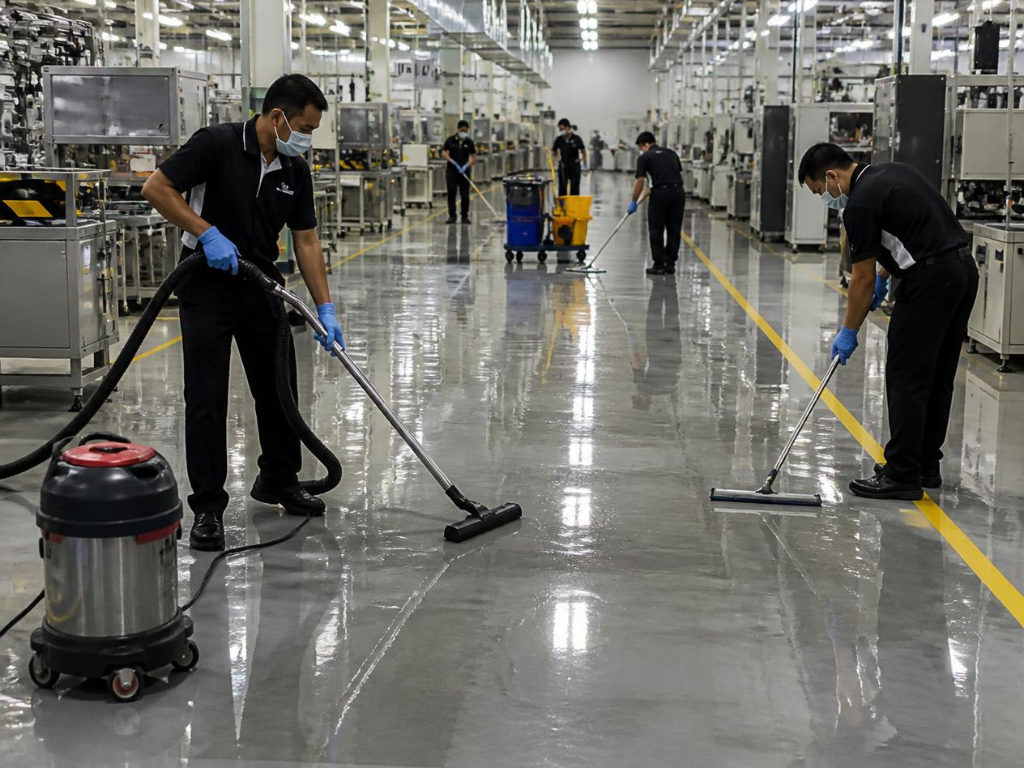
Housekeeping runs during production: sweeping walkways, clearing swarf bins, wiping accessible surfaces. It needs no isolation and no downtime. Deep cleaning attacks polymerised oil films, carbonised residue on machine bases, compacted swarf in floor joints and years of settled dust on roof structures. None of that responds to a mop.
Three differences follow. Deep cleaning needs the line stopped, because dwell times and wet floors are incompatible with a running process. It needs machinery isolated and locked out, because the crew reaches into places guarding was designed to keep people out of. And it generates a recoverable waste stream that housekeeping does not.
Housekeeping runs daily; a full production floor deep clean runs once or twice a year on most Singapore manufacturing sites, pegged to a planned shutdown. The broader deep cleaning service types differ mainly in chemistry and recovery method rather than labour.
How do you choose a degreasing agent for a production floor?
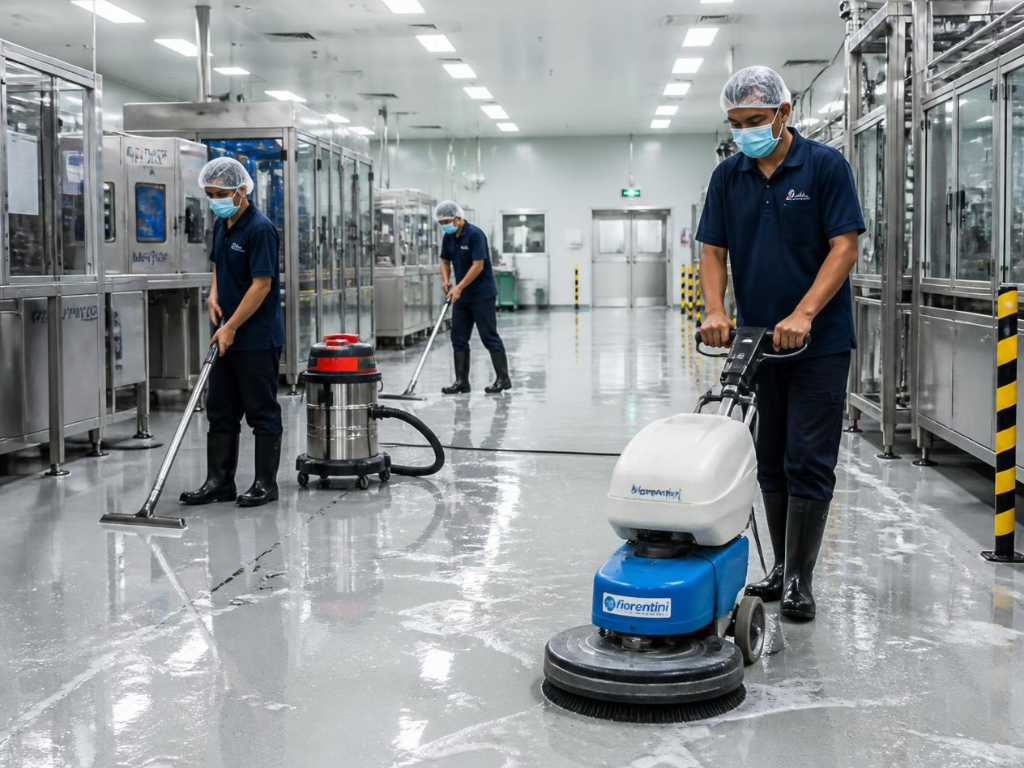
By matching pH and solvency to the contaminant and the substrate, in that order. Picking the strongest available degreaser is how floors get damaged and how effluent limits get breached.
Mineral oil and cutting fluid respond to an alkaline emulsifying degreaser, typically pH 10 to 12, applied at working dilution rather than neat. Carbonised residue on machine bases needs a solvent-based or high-alkaline product with longer dwell. Light general soiling on a coated floor needs a neutral cleaner at pH 7 to 9 and nothing stronger.
Two constraints bound the choice: the substrate, which sets the upper pH limit before the coating suffers, and the effluent route, because a solvent-loaded rinse cannot simply go down a floor drain.
Dilution discipline matters more than product selection. A degreaser dosed at double strength does not clean twice as fast; it leaves residue needing a second rinse and raises the organic load in the effluent. Keep the dilution ratio, safety data sheet and monthly volume on file, because buyers increasingly expect chemical volume reporting as data rather than assurance.
What does oil and swarf residue do to a production floor?
Oil softens and undercuts coatings; swarf abrades them. Together they take a floor from a cleaning problem to a capital repair, usually over about three to five years of deferred deep cleaning.
Mineral oil penetrates uncoated concrete and stays there, which is why an old machine base shows a dark halo no surface clean removes. On coated floors, oil sitting in a coving joint or a coating pinhole works underneath the film and lifts it, and the edge then chips outward from a point you could have cleaned.
Swarf does mechanical damage. Metal fines trapped under a pallet truck wheel become a grinding tool, and the wear track holds more oil, which accelerates the next failure. In practice the floor around a CNC cell degrades three to four times faster than an adjacent storage bay carrying the same traffic.
The economic case for frequency sits here rather than in appearance. An industrial floor coating recoat runs into five figures for a moderate bay and takes the area out of service, while an annual deep clean is a fraction of that and runs inside a shutdown you were taking anyway.
How should epoxy and resin floors be cleaned without damaging them?
With pH-controlled chemistry, soft abrasion and short dwell. Epoxy tolerates far less than people assume, and most coating failures blamed on wear were caused by cleaning.
Keep routine cleaning neutral, in the pH 7 to 9 range, and reserve alkaline degreasers for scheduled deep cleans with a controlled dwell of 5 to 10 minutes rather than an hour. Avoid strong acids entirely on epoxy and polyurethane systems. Use red or blue soft pads on a scrubber rather than black stripping pads, which burnish and dull the finish. Rinse fully, because alkaline residue left to dry leaves a film that both dulls the surface and reduces slip resistance.
Mechanical settings matter as much as chemistry. Excessive down-pressure on a walk-behind scrubber removes coating rather than soil, and on a resin floor with a broadcast aggregate finish it strips the aggregate providing grip.
Ask the coating manufacturer for the chemical resistance chart and give it to the contractor as part of the specification. Where this breaks down is when a contractor selects chemistry from its own range without seeing what the floor is made of.
Where does the wash water go after degreasing?
Into the public sewerage system as trade effluent, and that is a regulated discharge rather than a drain-and-forget step.
Discharge into the public sewerage system falls under the Sewerage and Drainage (Trade Effluent) Regulations, administered by PUB under the Sewerage, Drainage and Coastal Protection Act. Prior PUB permission is required to discharge trade effluent containing BOD or total suspended solids above 400 mg/L, or COD above 600 mg/L. Under the Trade Effluent Fee scheme, higher loads are permitted against payment, with ceilings of 6,000 mg/L for BOD, 6,000 mg/L for TSS and 10,000 mg/L for COD, and a COD to BOD ratio below 3. The regulations also cover grease trap installation as pre-treatment.
A degreasing rinse is exactly the kind of discharge those thresholds were written for. Emulsified oil, suspended fines and dissolved surfactant all raise organic load, and a whole-floor degrease concentrated into one evening produces a slug rather than a steady flow.
Three controls handle it. Recover heavy contamination mechanically before wet work, so the rinse carries less. Stage the rinse rather than releasing it all at once. And confirm what your site’s existing PUB approval permits before a contractor discharges anything unusual into it. Drainage reaching a watercourse rather than a sewer is a separate NEA regime with tighter limits.
What happens to the sludge from drains and sumps?
It goes to a collector licensed under the Environmental Public Health (Toxic Industrial Waste) Regulations. Sludge from oil interceptors is a controlled toxic industrial waste, and so are oil sludge, spent oil water emulsions such as used metalworking coolant, and spent solvents.
That single fact reorganises how a shutdown clean should be procured. Clearing a floor channel or pumping out an interceptor produces material your general waste collector cannot legally take, and NEA maintains a published list of licensed toxic industrial waste collectors that was last updated on 3 February 2026. Under the regulations, the waste generator has to give the collector the information it needs to handle the waste properly, which means you supply the material description, not the cleaning crew.
Ask three questions before award. Which licensed collector takes the sludge. What documentation comes back, since consignment records are your evidence of compliant disposal. And who pays, because disposal by volume is a variable cost a fixed quote often excludes.
Worth noting: drainage and sump work should be sequenced after floor degreasing but before the final rinse, so the interceptor is emptied of what the degrease loosened rather than being refilled by it.
How do you clean high-level structures without recontaminating the floor?
Top down, always, and before any floor work starts. Roof structures, cable trays, pipe runs, light fittings and extraction ductwork carry years of settled dust, and dislodging it after the floor is clean means doing the floor twice.
Method depends on what the dust is. Vacuum extraction with filtered units for general settled dust. Compressed air blow-down only where the dust is inert, the area is sheeted and ventilation supports it, since blow-down aerosolises everything it removes. Damp wiping near electrical equipment. Combustible dust needs a method statement written for that hazard rather than a general one.
Access drives cost and schedule. Mobile elevated work platforms need floor space, clear routes and a trained operator; scaffold needs erection and dismantling time inside your window. Either way the controls are those governing any working at height safely task, applied indoors: a fall protection plan, an exclusion zone below, and a dropped-object method.
Sequence the exclusion zone into the plan. High-level work stops floor work beneath it, so a crew ignoring the overlap either works unsafely or loses hours waiting.
How long a downtime window does a deep clean actually need?
Longer than the permit block plus the labour hours, because chemical dwell sets a floor that crew size cannot compress. Degreaser dwell runs 5 to 15 minutes per pass, heavy contamination needs two passes, and rinse and dry-off follow both.
Work an example. A 2,000 square metre machining hall with isolation and permits complete needs a high-level pass, two degreasing passes with dwell, mechanical scrubbing with recovery, drain and sump clearing, a final rinse and dry-off. Adding crew shortens the labour-bound steps and does nothing to the dwell-bound ones, which is why a genuine deep clean on that floor area does not compress below one full night, and why most Singapore plants schedule it into a year-end or mid-year planned shutdown rather than a weekend.
Plan the window backwards from handback rather than forwards from line stop. Handback is fixed by production; everything before it flexes.
Multi-night shutdowns add a continuity problem. A crew that changes composition each night relearns the layout and repeats induction, so specify a named crew and check that the provider can hold it. Crew continuity across shifts is worth more on a five-night shutdown than a slightly lower rate, and it is a fair question to raise when vetting an industrial contractor.
What recommissioning checks should happen before the line restarts?
A residue check, a slip check, a drainage check and a permit closure, in that order, all documented. A visual inspection is not a recommissioning check, because the failure mode here is a floor that looks clean and is not safe.
Test the rinse water at the last pass and confirm it has returned to neutral. Alkaline residue dulls the coating and reduces grip, invisibly. Walk the area dry and check for tackiness underfoot before anyone brings a pallet truck through, and reinstate any anti-slip markings the clean removed.
Confirm the drains run and the interceptor is refilled to its working level where the design requires it, since an empty interceptor does not separate. Check every access cover lifted during the clean is back and secured, the most common outstanding item at handback.
Close the permits formally and file them, then hand back in writing with the waste consignment documentation attached. The paperwork is not administrative overhead; it is the evidence that the occupier discharged its duty, and it is the first thing anyone asks for if something goes wrong on the first shift back.
Where this leaves you
A deep clean is judged on what leaves the site, not on how the floor looks at handback. The rinse water is a regulated discharge, the interceptor sludge is controlled toxic industrial waste, and the dwell time on the degreaser sets a downtime floor no crew size can compress. Scope those three before you scope the labour, and the shutdown stops being a negotiation about hours and becomes a plan with a fixed shape.
Send Hong Ye Group your floor plan, coating type, contaminant profile and planned shutdown dates, and get back a sequenced method statement, a dwell-based downtime schedule with realistic cleaning hours per window, a named toxic industrial waste disposal route, and a recommissioning checklist you can sign at handback.
Frequently asked questions
How often should a production floor be deep cleaned?
Once or twice a year for most Singapore manufacturing sites, pegged to a planned shutdown. Machining, metalworking and food production run at the higher frequency because oil, swarf and organic residue accumulate faster. Between deep cleans, daily housekeeping handles surface soil but does nothing to polymerised residue in floor joints.
Can deep cleaning be done without stopping production?
No, not for the degreasing and floor components. Chemical dwell times, wet floors and machinery isolation are incompatible with a running line. Bay-by-bay cleaning during a partial shutdown works where the layout allows isolation of one cell, and high-level work in non-production zones can sometimes run alongside production with an exclusion zone.
What is year-end shutdown cleaning?
A full production floor deep clean scheduled into the planned year-end plant shutdown, typically the last two weeks of December for Singapore manufacturers. It bundles high-level dust removal, degreasing, floor scrubbing, drain and sump clearing and waste disposal into a window production has already conceded, which is why it prices better than an unscheduled clean.
Will degreasing damage my epoxy floor?
Not if the pH and dwell are controlled. Keep routine cleaning between pH 7 and 9, limit alkaline degreaser dwell to 5 to 10 minutes, avoid strong acids entirely, and use soft pads rather than black stripping pads. Get the coating manufacturer’s chemical resistance chart and give it to the contractor before mobilisation.
Who is liable if the floor is slippery after cleaning?
Both the contractor and the occupier, under the Workplace Safety and Health Act 2006, which places concurrent duties on employers and occupiers. Slips, trips and falls remained a top cause of workplace major injuries in MOM’s 2025 statistics. Document the dry-and-walk check at handback so the control is evidenced rather than assumed.