Cleaning Services

Commercial Deep Cleaning Frequency Singapore: 2026 Guide

Commercial Deep Cleaning Frequency Singapore: 2026 Guide
Commercial deep cleaning frequency in Singapore is the cycle for periodic works daily cleaners cannot do, such as carpet extraction, floor stripping, high-level dusting and washroom descaling, set by footfall, contaminant and available downtime. NEA’s 2026 schedule closes 106 of the 123 hawker centres it manages for cleaning four times a year. Below, we set out the cycle for each property type, based on how we schedule our specialist commercial cleaning services.
What is the difference between deep cleaning and general cleaning?

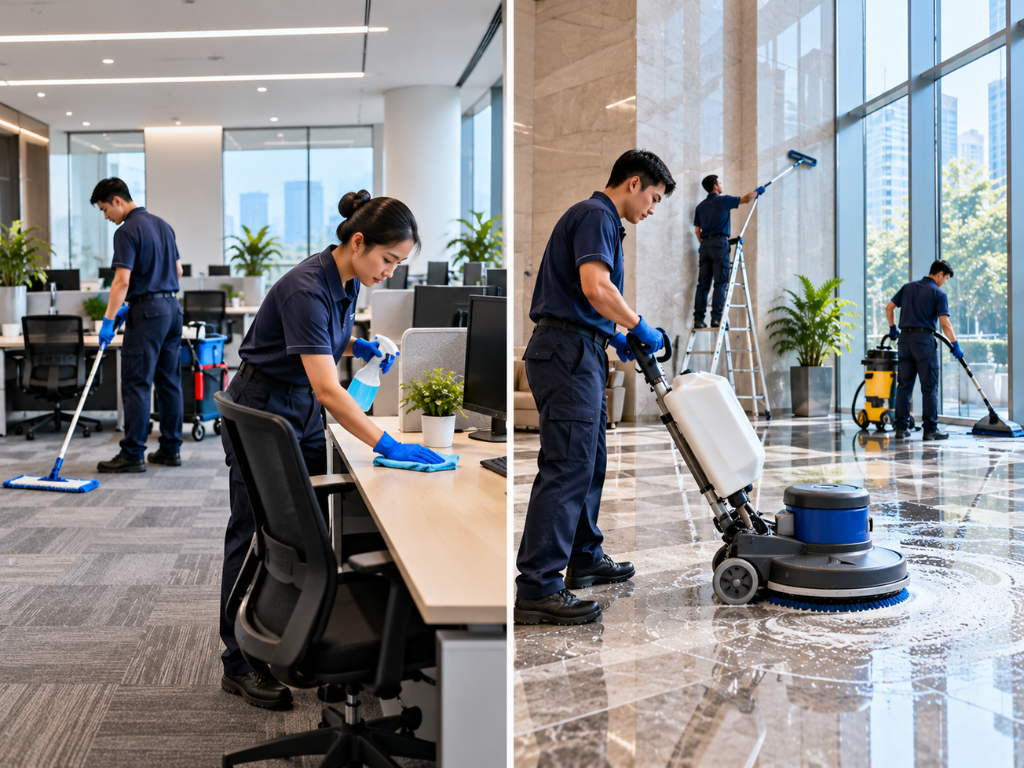
General cleaning removes what builds up in a day; deep cleaning removes what builds up over weeks or months and needs machinery, chemicals or downtime. A daily cleaner vacuums traffic lanes. A deep clean extracts the soil that vacuuming leaves in the carpet backing. The split shows up in contracts as the daily scope and the periodic works calendar. Periodic works typically covers hot water carpet extraction, hard floor scrubbing, stripping and sealing, high-level dusting of vents, light fittings and beams, washroom descaling, internal glass and partitions, and upholstery. These jobs need a multi-skilled cleaner or machine operator, a floor machine or extractor, and an area that can be taken out of use for hours. That is why they are scheduled, priced and verified separately. The trouble starts when a contract bundles periodic works into a monthly fee without a calendar: the cycle quietly stretches, and nobody notices until the floor finish fails. What is the difference between deep cleaning and general cleaning?

How often should commercial premises be deep cleaned in Singapore?

Most commercial premises in Singapore need a full deep clean at least twice a year, with high-traffic zones on a quarterly cycle and food, dust or grease areas more often. No single Singapore regulation sets one interval for all premises, so the cycle follows three drivers: footfall, the contaminant and the downtime the property can give. The table below sets the baseline by property type. It draws on the IICRC S100 carpet cleaning standard’s traffic bands, manufacturer guidance, NEA’s hawker centre schedule and the WSH Council’s 2025 combustible dust guidelines.
Property type Full deep clean High-traffic zones Main driver Best window
Office, general floors Twice a year Quarterly carpet extraction in traffic lanes Foot traffic, carpet soil Year-end, school holidays
Factory production floor Once or twice a year By dust or grease accumulation limit Contaminant build-up Planned shutdown
Factory admin block Twice a year Quarterly carpet extraction Production dust migration Weekends
Hotel guest rooms Each room once a quarter, on rotation Corridors and lift lobbies quarterly Occupancy Low-occupancy weeks
Shopping mall Twice a year for back-of-house Entrances and food courts monthly Very heavy footfall Before opening hours
F&B and food centres Quarterly Kitchens and drains between cycles Grease, pests 1 to 3 day closure

How often should an office be deep cleaned?

An office should get a full deep clean twice a year, with carpet extraction every quarter in traffic lanes and every six months elsewhere. Hard floors need a scrub and recoat every three to four months and a full strip and seal every 12 to 18 months. Foot traffic is the measure that matters. The IICRC S100 standard, as reproduced in Interface’s carpet tile maintenance guide, sets restorative cleaning at 1 to 2 times a year below 500 foot traffics a day, 2 to 4 times at 500 to 1,000, and 3 to 6 times between 1,001 and 2,500. A lift lobby on a 30-storey tower sits in the heavy band or above; a private office sits in the lightest one. Treating the whole floor to one cycle wastes money on quiet rooms and fails the corridors. Hybrid work mainly shifts the timing. Midweek attendance peaks, so the Monday and Friday lull is when an extraction crew can work a floor without moving people. The office cleaning contract scope sets out how that periodic works calendar should be written in.

How often should a factory or production floor be deep cleaned?

A production floor needs a full deep clean once or twice a year, pegged to a planned shutdown, while high-level dust in combustible dust areas is cleaned whenever it reaches the limit set in the site’s dust hazard analysis. The factory office next door runs on a separate, office-style cycle. The WSH Council’s Guidelines on Combustible Dust, published in November 2025, ask the dust hazard analysis to define the maximum allowable layer thickness and the surface area it can cover, and to set a housekeeping frequency from that. They also rule out dry sweeping and compressed air where combustible dust is present, in favour of wet methods or explosion-proof vacuums. The US benchmark in NFPA 654 treats accumulations above 0.8 mm as a hazard area. Richard W. Prugh, a principal process safety engineer at Chilworth Technology, called limiting dust accumulation “critically important in the prevention of primary and secondary dust explosions.” Factory high-level dusting therefore follows measured accumulation. The floor itself follows the production floor deep cleaning cycle, and admin blocks beside production need carpet extraction quarterly, because dust tracked in at every shift change is abrasive. The factory office cleaning scope covers that split.

How often should hotel rooms and public areas be deep cleaned?

Each hotel guest room should be deep cleaned once a quarter on a floor-by-floor rotation, with carpet extraction in rooms and corridors four times a year and ballrooms twice a year. Rotation keeps the rest of the inventory sellable while each floor is worked. Shaw Contract’s commercial carpet chart places hotel rooms in the heavy-traffic band at four hot water extractions a year and ballrooms in the moderate band at two. A 300-room hotel on a quarterly rotation deep cleans about 23 rooms a week, which fits inside normal housekeeping if the extra hours are planned. Public areas follow footfall: the lobby and lift landings sit in the same heavy band as the rooms. Tie the rotation to the occupancy forecast, pulling floors out on low-occupancy weeks and pausing during peak periods such as the Formula 1 weekend. Whether that work sits with an in-house team or a contractor changes who carries the planning, which is the core of the in-house vs outsourced housekeeping decision.

How often should shopping malls and retail premises be deep cleaned?

Shopping mall entrances, travelators and food courts need deep cleaning monthly, and back-of-house areas twice a year. Very heavy footfall compresses every cycle. IICRC S100 puts floors above 2,500 foot traffics a day at 6 to 24 restorative cleanings a year, and a main mall entrance on Orchard Road clears that before lunch. Washroom descaling belongs in the monthly cycle too, because constant use leaves urine scale on urinals and fittings that daily cleaning does not shift. Deep cleaning in malls has one fixed constraint, the hours before opening, so crews work in short overnight windows and a full floor takes several nights. Hong Ye Group’s ION Orchard cleaning project shows the scale of a mall scope. Zone the mall by footfall and give each zone its own cycle, so the main entrance gets monthly extraction while the service corridors wait for the half-yearly pass. [HYG input needed: one real periodic works cycle from a mall contract, with zones and frequencies.]

What does NEA’s hawker centre schedule tell us about F&B deep cleaning?

NEA’s schedule shows that food premises in Singapore are deep cleaned quarterly, with a closure of about two days each time. NEA publishes the schedule a year ahead, which makes it the clearest public benchmark for a deep cleaning cycle in Singapore. We analysed NEA’s 2026 hawker centre closure dataset on data.gov.sg. Of 123 markets and hawker centres, 106 are scheduled for four cleaning closures in 2026. The 466 closures average 2.07 days, and 428 of them, or 92%, start on a Monday. Starts cluster in March, June, September and December, lining up with school holidays when footfall drops. Each centre loses about eight days a year to cleaning. Private F&B operators rarely close for two days, but the logic transfers. Kitchens, grease traps and drains need attention between quarterly deep cleans, and the quarterly clean itself should land on the slowest trading day of the week.

When should you schedule a deep clean in Singapore?

Schedule a deep clean in the lowest-occupancy window the property has: school holidays for offices and food premises, planned shutdowns for factories, low-occupancy weeks for hotels, and overnight for malls. For most businesses the year-end window from mid-December is the main annual slot. Chinese New Year shapes the calendar. In 2027 it falls on 6 and 7 February, with Monday 8 February a public holiday. Pre-CNY demand for deep cleaning runs from mid-December to late January, so book a year-end or pre-CNY deep clean by October. Contractors fill those weeks first, and a slot in the first week of February 2027 will be scarce. The June and September school holidays are the undervalued windows. NEA uses them for the same reason offices should: fewer people in the building means fewer areas to work around. Factories should lock their deep clean to the shutdown calendar at the start of the year, because a missed shutdown pushes the next chance back six months.

What should a periodic cleaning schedule include?

A periodic cleaning schedule should list each task, the area, the frequency, the method and the month it is due, so both parties can check it was done. A schedule that says “carpet cleaning: periodic” is unenforceable. A working schedule covers carpet extraction by traffic zone, hard floor scrub and recoat, strip and seal, high-level dusting, washroom descaling, internal glass and upholstery, each with a named month on a quarterly cycle. Any change to floor area, tenancy or use goes through a scope variation, so the cycle does not shrink quietly when the building changes. Completion evidence matters as much as the schedule; Hong Ye Group records periodic tasks through Smart iClean task verification. [HYG to confirm Smart iClean covers periodic works.]

Why do deep cleaning quotes cost more in 2026?

Deep cleaning quotes cost more in 2026 because the Progressive Wage Model sets a higher wage floor for the machine operators who do the work. From 1 July 2026, MOM’s Progressive Wage Model for the cleaning sector requires at least S$2,700 a month for a multi-skilled cleaner or machine operator at office and commercial sites, against S$2,080 for a general cleaner. The machine operator floor was S$1,749 in 2022, a 54% rise in four years. A contractor quoting deep cleaning at general cleaner rates is either underpaying or under-scoping.

Set the cycle by use, then hold it

NEA’s quarterly closures for food centres, the WSH Council’s 2025 dust limits and IICRC’s traffic bands all point to the same practice. Set the cycle zone by zone and write each task into the contract by month. Then check it was done. Book a periodic works review with Hong Ye Group. The team maps each zone by traffic and contaminant, then returns a 12-month deep cleaning calendar with the 2027 year-end and pre-CNY slots reserved. Request a periodic works review.

Frequently asked questions

Is deep cleaning required by law in Singapore? 

No single law sets a deep cleaning interval for commercial premises. Specific duties apply instead: factories handling combustible dust must set a housekeeping frequency under the WSH Council’s 2025 guidelines and SS 667, and NEA runs its own quarterly cleaning closures for hawker centres. Contracts set the frequency for everyone else.

How long does a commercial deep clean take? 

A food centre deep clean averages about two days, based on NEA’s 2026 schedule of 466 closures. An office floor of 10,000 square feet usually needs one or two nights or a weekend for carpet extraction and floor care, with carpets needing several hours to dry before furniture goes back.

Can deep cleaning be done during business hours? 

Some of it can. High-level dusting over closed zones and washroom descaling in rotation work during the day, but carpet extraction, floor stripping and sealing need the area empty and dry. In Singapore offices, Friday evenings and weekends suit those tasks because hybrid attendance is lowest then.

When is the best time for a year-end deep clean in Singapore? 

Mid-December to early January is the best window, after offices wind down and before pre-Chinese New Year demand peaks. Chinese New Year 2027 falls on 6 and 7 February, so any deep clean needed before it should be booked by October 2026 to secure a slot.
To top