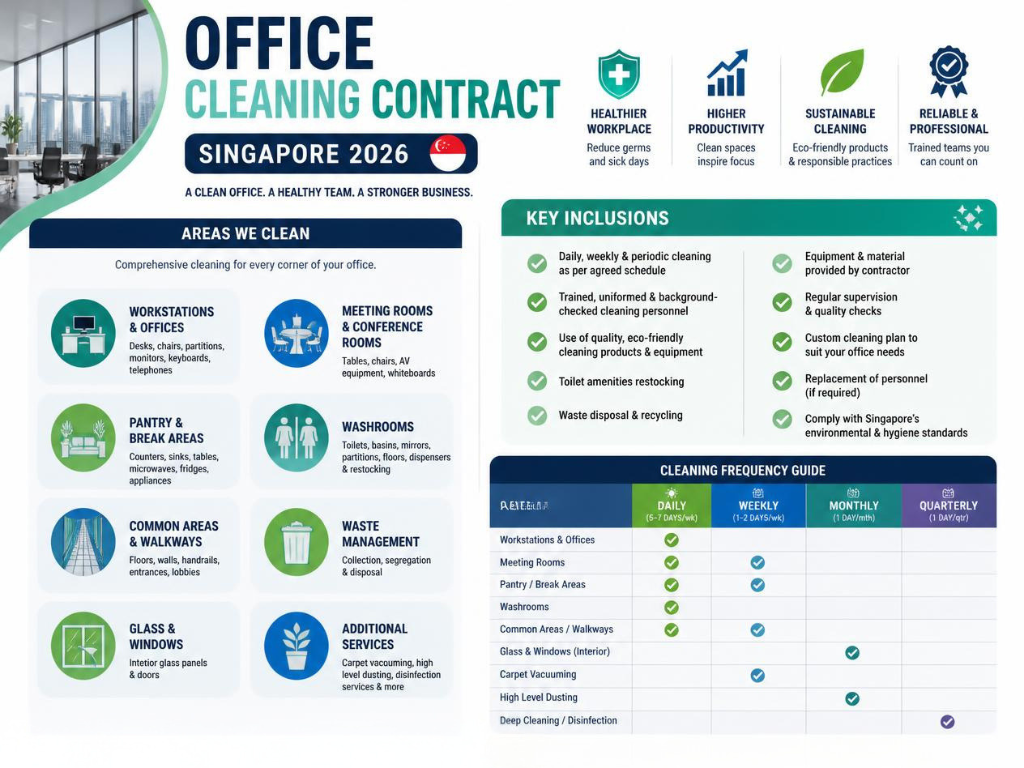
An office cleaning contract in Singapore lives or dies on its schedule. JLL put CBD Grade A gross effective rents at S$12.19 per square foot per month in Q2 2026, and cleaning runs at about two per cent of that. Below is what sits behind that number: the daily scope, the periodic works and the deployment hours, set out the way Hong Ye Group schedules specialist cleaning and hygiene services.
What does a standard office cleaning contract in Singapore actually include?
An office cleaning contract in Singapore covers four things: a daily scope listing tasks by area and frequency, a periodic works calendar for cyclical deep cleaning, a manpower deployment schedule stating hours and headcount by shift, and a consumables arrangement naming who supplies and pays for washroom and pantry stock. Anything missing from those four becomes a variation order later.
The commercial structure is usually a fixed monthly fee against a stated deployment, with periodic works either bundled at an annual frequency or quoted separately per event. Both models work. The bundled model gives you budget certainty and removes the temptation to skip a quarterly carpet extraction to save S$800 in a tight month. The unbundled model gives you flexibility and a lower headline rate, and in practice it produces a floor that has not been extracted in fourteen months.
Buyers often assume the contract also covers pest control, façade cleaning and landscaping. It does not. Those sit under separate regulatory regimes with separate risk profiles, and bundling them into an office cleaning fee obscures what you are paying for each. If you are still deciding which scopes your site needs, work from the commercial cleaning service categories available before you write frequencies against them.
A contract that names four areas, twelve tasks and one number is a quotation with a signature block.

What belongs in the daily scope, and what belongs in periodic works?
Daily scope covers what degrades within 24 hours. Periodic works covers what degrades over weeks or months and needs machinery, chemicals or downtime.
Daily scope on a typical Singapore office floor runs to washroom servicing and replenishment, pantry wipe-down and dishwashing area clearing, waste and recycling collection from every bin point, vacuuming of traffic lanes and meeting rooms, dust mopping and damp mopping of hard floors, wiping of reception counters, lift landing doors and glass entry panels, and high-touch point disinfection covering door handles, lift buttons, light switches and shared equipment. Desks are the common ambiguity. Most office contracts cover clear desks only, meaning the cleaner wipes what is not covered in paper. Write that in, or you will hear about it.
Periodic works runs on a calendar: carpet extraction, hard floor scrub and recoat, high-level dusting of ceiling vents and light fittings, internal glass and partition cleaning, upholstery cleaning for soft seating, and pantry appliance deep cleaning including microwave interiors and refrigerator shelves.
The split matters because periodic works is where contractors compete on price by quietly stretching the cycle. Ask for the periodic calendar as a dated twelve-month schedule at tender stage. A list of services commits nobody to a date. The fundamentals of scoping this sit in office cleaning management basics, but the contract is where they become enforceable.

How often should an office be cleaned in 2026?
Unevenly, and weighted toward midweek. Office attendance stopped being flat years ago, and cleaning schedules written before 2020 are still pretending otherwise.
CBRE’s 2026 Workplace and Occupancy Benchmarking data has roughly 73 per cent of organisations naming Tuesday as their highest-attendance day, with Wednesday at 23 per cent, Thursday at 3 per cent, Friday at 1 per cent and Monday at zero. JLL’s Global Occupancy Planning Benchmark Report 2026, drawn from 84 organisations covering 716 million square feet, puts actual utilisation at 56 per cent against a 74 per cent target, with 55 per cent of employees now in the office three to four days a week, up 19 percentage points in a single year. Dr Paul Morgan, global COO of real estate management services at JLL, framed the shift plainly: “The structured hybrid model has moved from experiment to expectation.”
Translate that into a schedule. Washrooms and pantries stay daily regardless, because they degrade on use and a Monday skip is visible by 10am. Vacuuming, meeting room resets and high-touch disinfection should be weighted toward Tuesday, Wednesday and Thursday. Monday and Friday can drop to a reduced scope covering washrooms, pantries, waste and reception. On a five-day contract that redistribution costs nothing and buys you roughly 20 to 30 per cent more cleaning effort on the days people are actually in the building.
The counter-argument is that a variable scope is harder to supervise. That argument only holds while the buyer has no way to verify which scope ran on which day, and verification is a solvable problem.
What does washroom and pantry servicing cover, and who pays for consumables?
Washroom servicing means checking, restocking and cleaning at a stated frequency per day, not once in the morning. Pantry servicing means clearing, wiping and sanitising the sink, counter and appliance exteriors, with dishwashing explicitly in or out.
For a floor with 60 to 80 occupants, two washroom service rounds a day is the working minimum: a full clean before occupancy and a mid-afternoon check covering restock, bowl and urinal wipe, mirror and basin, and floor spot mop. High-traffic floors and client-facing levels need three. Write the round times into the SLA, because “as required” is unenforceable and both sides know it.
Consumables cause more monthly disputes than anything else in office cleaning. Two models exist. Client-supplied means you buy the toilet rolls, hand towels, soap and bin liners and the contractor draws from your store. Contractor-supplied means it is bundled into the monthly fee. Bundle it. An unbundled consumables line invites the contractor to under-order and you to over-scrutinise, and it turns a facilities manager into a stock controller.
If you bundle, state the consumption assumption in the contract: rolls per cubicle per week, litres of hand soap per dispenser per month, liners per bin point per day. Reconcile quarterly against actual draw. That single clause converts a recurring argument into a data review. Reception, lift lobbies and shared corridors need the same treatment. In a multi-tenant building, lobby and washroom coverage often sits with the landlord. Confirm that before you pay for it twice.
How does the carpet and floor care cycle work?
Floor care runs on a cycle tied to surface type and footfall, and it is the single largest driver of how long your floor finish lasts.
Carpet on a general office floor needs daily vacuuming of traffic lanes, spot treatment on demand within 24 hours, encapsulation cleaning on traffic lanes every two to three months, and hot water extraction quarterly in high-traffic zones with semi-annual extraction elsewhere. Skipping extraction does not show for about a year, then shows permanently, because soil that reaches the backing abrades the fibre from below.
Vinyl and homogeneous tile needs daily dust mopping and damp mopping, a scrub and recoat every three to four months, and a full strip and seal every 12 to 18 months depending on traffic. Marble and granite in reception needs daily dust mopping with a treated pad, and diamond polishing or crystallisation on a quarterly to annual cycle set by footfall. Wet mopping polished stone with a general-purpose alkaline cleaner is how lobbies lose their finish, and it is the most common single error in low-cost office contracts.
Chemical selection belongs in the contract too. Product safety data sheets, dilution ratios and pH suitability by surface should be on file and available on request. Buyers running sustainability reporting will need this anyway, since chemical volume and water use are the two cleaning inputs that surface in ESG reporting from cleaning contracts.
How many deployment hours does your office actually need?
Start from floorplate and washroom count. Headcount tells you less than you would expect. In practice, one cleaner covers 8,000 to 12,000 square feet of open-plan office on a daily scope across an eight-hour shift, and washroom-heavy or cellular floors pull that toward the lower end.
A 10,000 square foot single-tenant floor with two washroom blocks, one pantry and a reception typically resolves to one full-time deployed cleaner, or a split deployment of four morning hours and three evening hours if you want the floor serviced outside working time. A 25,000 square foot floorplate with four washroom blocks needs two deployed cleaners plus periodic supervisor attendance. Above roughly 40,000 square feet or across multiple floors, a working supervisor stops being optional.
Deployment hours belong in the contract as a table listing shift, start and end time, headcount, job level and zone. A line saying cleaning services will be provided daily commits nobody. A schedule you can hold against an attendance record is the difference between a service and a promise, which is why daily and scheduled office cleaning is quoted against deployment rather than against square footage alone.
Run the cost check. One resident general cleaner at the Group 1 PWM floor of S$2,080 a month works out to roughly S$2,535 a month in total employment cost once you add the mandatory PWM bonus of two weeks’ basic wage and employer CPF at 17 per cent. Across 10,000 square feet that is S$0.25 per square foot per month, against JLL’s Q2 2026 CBD Grade A gross effective rent of S$12.19. Cleaning is about two per cent of what the space costs you.
Should you deploy a part-time or full-time office cleaner in Singapore?
Full-time, in most cases, and the reason has nothing to do with cleaning quality.
Under the Employment Act 1968, a part-time employee works under 35 hours a week. MOM’s Progressive Wage Model for the cleaning sector requires resident cleaners below that threshold to be paid a pro-rated PWM wage. Apply MOM’s hourly basic rate formula to the S$2,080 Group 1 floor at 44 hours a week and the floor works out to S$10.91 an hour. Any part-time office cleaner quoted to you at S$10 an hour is non-compliant.
The mechanic buyers never see sits one layer down. From 1 July 2026 the Local Qualifying Salary rose to S$1,800 a month, with the part-time hourly equivalent moving from S$9.00 to S$10.50. A local employee earning at least S$1,800 counts as one full local headcount toward the contractor’s Work Permit and S Pass quota. Between S$900 and S$1,799 they count as half. Below S$900 they do not count at all. A cleaner deployed three hours a day at S$11 an hour earns roughly S$700 a month and contributes nothing to the contractor’s local headcount, which shrinks the foreign quota it needs to staff every other site in its portfolio under the 35 per cent Services sector Dependency Ratio Ceiling.
That is why a contractor will quote you a full-time cleaner for an office that needs four hours of work. It is also why the honest answer to a genuinely small requirement is a shared cleaner covering two or three sites in the same building, deployed full-time by the contractor and split across clients. Ask for that structure by name. Most bidders will not offer it unprompted, and it is one of the questions worth raising early when choosing an office cleaning contractor.
What happens when your cleaner calls in sick?
Whatever the contract says, which in most cases is nothing. Relief cover is the most commonly omitted clause in Singapore office cleaning contracts and the most commonly experienced failure.
Three arrangements exist. The first is a named relief cleaner assigned to your site and briefed on the layout. The second is a relief pool drawn from the contractor’s roving team, which is the industry standard and works when the pool is real. The third is no cover at all, where the contractor absorbs the absence and the scope quietly halves that day. The third is more common than any bidder will admit at tender.
Write in the response standard. A workable clause states that a replacement will be on site within a stated window, that the replacement holds the same PWM job level and WSQ training as the absent cleaner, and that unfilled deployment hours are credited back at the contracted hourly rate. The credit clause does the real work. A contractor that pays for absence finds relief cover.
Ask one diagnostic question at tender: how many roving relief cleaners does the contractor employ, and across how many sites. A firm with 40 contracts and two relief staff is running your continuity on hope. The structural causes of this, and what a properly staffed relief model looks like, are covered in more depth in the analysis of absenteeism in cleaning teams.
How do contract variations work when your office changes?
Through a variation clause with pre-agreed unit rates, signed at the start of the contract rather than negotiated when you need it.
Offices change constantly. You take an adjacent unit, add 20 desks, convert a meeting room into a wellness room with a shower, or give back a floor. Each of those changes the cleaning requirement, and each is an opportunity for a contractor to reprice the whole agreement instead of the increment.
Fix three unit rates at signing: cost per additional deployed cleaner-hour, cost per additional washroom block per month, and cost per 1,000 square feet of additional floorplate on the standard daily scope. Add a threshold below which no variation applies, usually a floorplate change under five per cent, so neither side raises paperwork over a store cupboard. State how many working days’ notice a variation needs, with 14 days being reasonable for a headcount change and 30 for anything requiring recruitment.
Michael Glancy, Country CEO for Singapore and Southeast Asia at JLL, described the current market as one where “the flight-to-quality narrative has evolved from a trend into a structural reality”. Tenants moving into better space change floorplates more often, which makes a working variation clause more valuable than a slightly lower monthly rate.
What cleaning applies at tenant handover?
Handover cleaning is a separate scope with a separate price, and it should never sit inside the monthly fee.
Two events get confused here. Post-renovation cleaning follows a fit-out and deals with construction dust, adhesive residue, paint spots, protective film removal and the fine particulate that settles in ceiling voids and ventilation grilles for weeks afterward. Reinstatement or exit cleaning follows the end of a lease and is measured against the landlord’s condition report, covering carpet extraction, floor restoration, wall marks, and the removal of signage adhesive and cable runs.
The commercial risk sits with reinstatement. Landlords assess against the original condition schedule, and a failed assessment costs more than the clean would have. Book the exit clean after the fit-out contractor demobilises and before the landlord’s inspection, with at least five working days between the three so a re-clean is possible without missing the handover date.
For incoming tenants, the sequence that works is a post-renovation clean, then a snag inspection, then a second detail clean before staff occupy. Skipping the second clean is a false economy that shows up as dust on every horizontal surface in week one.
How do you verify the daily scope was actually completed?
By logging task completion at the point of work rather than signing a checklist at the end of a shift. A paper checklist signed in the store cupboard at 6pm proves that someone had a pen.
Digital task verification changes what a buyer can audit. Hong Ye Group runs a proprietary system, Smart iClean, that digitally records cleaning tasks, verifies completion and provides real-time quality assurance across deployed sites. The practical value shows up at month end. Instead of arguing about whether the third-floor washroom was serviced twice on Tuesday, you look. Washroom feedback panels, QR-scanned task points and photo-logged periodic works all produce the same effect, which is an evidence trail that survives a change of facilities manager.
Layer a scored monthly joint inspection on top of it, walked with the site supervisor and scored by zone against the contracted scope. Digital logs prove a task was performed. An inspection score proves it was performed to standard. You need both, and any contractor arguing that one substitutes for the other is arguing against the more inconvenient of the two.
Set the consequence in advance. Rectification at the contractor’s cost within a stated window for a first failure, a service credit for a repeat, and a documented step toward termination for a pattern. Monitoring without a consequence is a complaint log with better formatting.
Where this leaves you
The contract does the work that supervision cannot. A daily scope written by area and task, a dated twelve-month periodic calendar, a deployment table with hours and job levels, pre-agreed variation rates and a relief cover credit clause will outperform a cheaper contractor with a better sales deck every time. Each of those clauses removes a decision that would otherwise be made in your absence, by someone with an incentive to make it cheaply.
Send your current floor plan, washroom count and existing cleaning schedule to Hong Ye Group and get back a deployment table with hours by zone and shift, a dated periodic works calendar, and a scope you can lay beside your incumbent’s line by line.
Frequently asked questions
Does a small office need an NEA-licensed cleaning company?
Yes. The NEA Cleaning Business Licence applies to general cleaning at any non-domestic premises regardless of contract size or frequency. A service buyer engaging an unlicensed provider faces a maximum fine of S$10,000 plus S$1,000 for each continuing day. Check the company against NEA’s published list of licensed cleaning businesses before signing.
How much does office cleaning cost per month in Singapore?
One deployed resident cleaner costs roughly S$2,535 a month in employment cost alone at the July 2026 PWM Group 1 floor of S$2,080, before supervision, consumables, equipment and margin. Across a 10,000 square foot floorplate that works out to about S$0.25 per square foot per month, roughly two per cent of CBD Grade A rent.
Can I ask the cleaner to do tasks outside the contracted scope?
Not without a variation. Ad hoc requests to deployed cleaners displace contracted tasks, because the deployment hours are already allocated. Route extra work through the variation clause at the pre-agreed cleaner-hour rate. Hong Ye Group and most established contractors price additional scope in blocks instead of reopening the monthly fee.
Who supplies the vacuum cleaners and floor machines?
The contractor, in almost every commercial office contract. Machines stay on site as contractor property and are maintained at contractor cost. Name the equipment list in the contract, including the scrubber, extraction unit and vacuum specification, so a machine breakdown does not become a reason the quarterly carpet extraction slipped by six weeks.
How much notice is needed to change the cleaning schedule?
Fourteen working days for a shift timing or headcount change, and 30 days where the contractor needs to recruit or redeploy. Shorter notice is possible on a shared deployment but not on a dedicated one, since a cleaner’s employment terms under the Employment Act 1968 cannot be rewritten at a week’s notice.