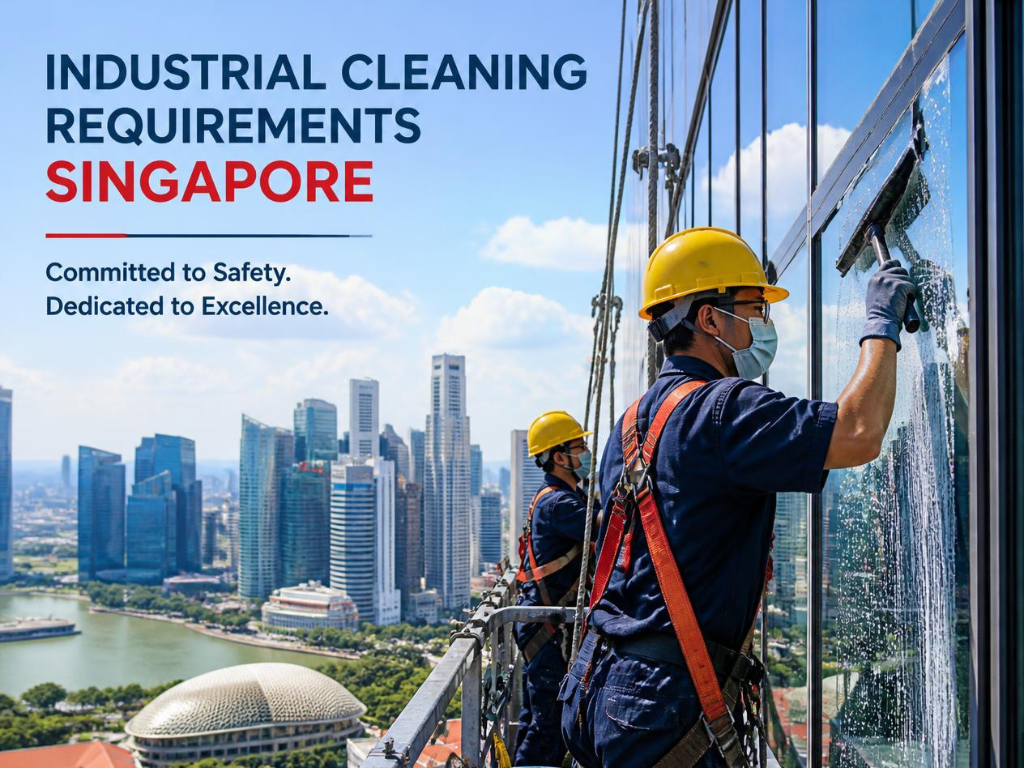
Industrial cleaning requirements in Singapore start with the Workplace Safety and Health Act. The cleaning contract comes second. MOM reported the manufacturing sector at an all-time low fatal and major injury rate of 28.8 per 100,000 workers in 2025. Below is what sits behind that number: the WSH duties, the permit sequencing and the shutdown planning, set out the way Hong Ye Group runs industrial and commercial cleaning services.
What does the WSH Act require of a cleaning contractor working in a Singapore factory?
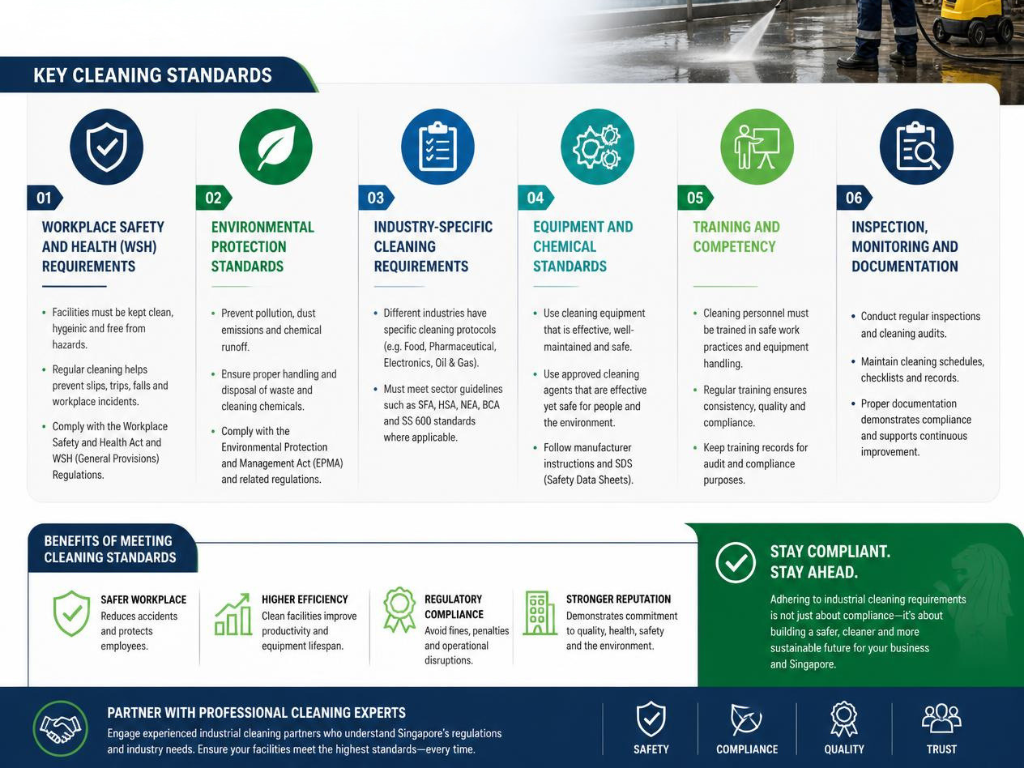
The same thing it requires of any other party performing work at that workplace: a documented risk assessment for every task, control measures that are reasonably practicable, trained and supervised workers, and safe work procedures that match the actual hazards on the floor instead of a generic cleaning method statement.
The Workplace Safety and Health Act and its subsidiary regulations cover all workplaces, and a cleaning crew inside a running factory is exposed to that factory’s hazards, not to the hazards on a cleaning company’s standard form. Degreasing a machine base puts a cleaner within reach of stored energy. Scrubbing a production aisle puts them in a forklift route. High-level dusting over a conveyor puts them above a moving line. None of those risks appear in a standard office cleaning risk assessment, which is what many contractors submit when they tender for industrial work.
Ask for the task-level breakdown at tender stage. A credible submission separates general housekeeping from degreasing, from high-level cleaning, from tank and pit cleaning, and assigns a different control set to each. The scope categories in types of commercial cleaning work will tell you what a contractor covers. The risk assessment tells you whether it understands where it is covering it.
Factory office and canteen areas sit inside the same contract but under a different risk profile, and they are usually scheduled on the office model. The scheduling logic for those zones follows managing office cleaning schedules, while the plant floor runs on shutdown logic.
Who is liable if the cleaning contractor has an accident on your factory floor?
You are, alongside the contractor. The WSH Act assigns concurrent duties to occupiers, principals and employers, on the principle that whoever creates or controls a risk carries responsibility for it. Engaging a contractor does not transfer your duty as occupier of the premises.
The numbers are large. A corporate body faces fines up to S$500,000 for a first general-duty offence and up to S$1,000,000 for repeat offences. Individuals, including directors and managers, face up to S$200,000 and two years’ imprisonment. On 1 June 2024 the maximum fine for breaches of subsidiary legislation capable of causing serious harm rose from S$20,000 to S$50,000, which put risk assessment and permit failures into a materially more expensive bracket.
In practice, the occupier’s exposure crystallises in one specific place: the moment a contractor performs work on your premises under a risk assessment you never read. Requesting it is the cheapest control available to a factory, and it costs an email.
Build the check into procurement. Vetting a cleaning contractor properly means asking for the risk assessment, the safe work procedures, the bizSAFE certificate and the training records before award, while the contract is still unsigned.
What has to be in the risk assessment before cleaning starts?
Every cleaning task, assessed by a competent person, with hazards identified, risk evaluated and controls assigned in that order. Under the WSH (Risk Management) Regulations, records are kept for at least three years and the assessment is reviewed at least once every three years, and immediately after any incident or any change to the process, equipment or personnel.
The three-year review clause is where industrial cleaning risk assessments quietly rot. Factories change constantly. A new line goes in, a solvent gets substituted, a mezzanine gets racked out, and the cleaning risk assessment still describes the layout from 2023. The change is what triggers the review. The calendar is only a backstop.
A workable industrial cleaning risk assessment names the specific plant it works around. It names the press, the extraction hood, the conveyor and the tank. It names the degreaser, its dilution ratio and the surface it contacts. It names the gantry, the access method and the fall protection. Entries that say “machinery”, “chemicals” and “working at height” survive an audit and fail a floor.
The contractor writes it, the factory reviews it, and both sign. If only one party has read it, what you have is filing.
When does factory cleaning count as confined space work?
When the space is enclosed or partially enclosed, not designed for continuous human occupancy, has restricted entry or exit, and carries a risk from atmosphere, engulfment or other recognised hazards. Storage tanks, silos, hoppers, pits, ducts, mixing vessels and some extraction plenums qualify. A tight equipment enclosure with an open face usually does not.
The WSH (Confined Spaces) Regulations 2009 attach hard numbers to the decision. An atmosphere is hazardous where oxygen falls outside 19.5% to 23.5% by volume, where flammable gas or vapour reaches 10% or more of its lower explosive limit, or where toxic substances exceed the permissible exposure levels listed in the First Schedule to the WSH (General Provisions) Regulations. A confined space safety assessor tests the atmosphere and endorses the application. An authorised manager issues the confined space entry permit only once those conditions are satisfied. An attendant stays at the opening throughout.
Both directions of misclassification cost money. Treating a tank clean as ordinary cleaning is the dangerous error, and it is the one MOM prosecutes. Treating every duct as a confined space is the expensive error, and it stalls jobs that a proper assessment would have cleared in an hour. The way out of both is to have the classification done once, in writing, space by space, and appended to the contract as a register.
What does a permit to work actually control?
A permit controls the sequence. It records that isolation is done, that the atmosphere or the energy state has been verified, that the right people know the work is happening, and that someone with authority has accepted the risk before anyone starts.
Four permit types cover most industrial cleaning. Confined space entry applies to tanks, pits and vessels. Hot work applies wherever a cleaning method produces a spark or flame, including some scarifying and cutting operations. Work at height covers gantry, ductwork and high-level structural cleaning. Energy isolation, meaning lockout and tagout, applies wherever cleaning brings a person into a machine’s danger zone.
The permit fails in the same two ways on every site. It gets raised by the contractor and rubber-stamped by a site engineer who has not walked the space. Or it gets raised once for a five-night shutdown and treated as valid across all five, when the conditions that justified it changed on night two. Re-verify after every break in work and after any change in the space. A permit describes a moment, and the moment expires.
Keep the closed permits. They are the evidence trail that shows a factory discharged its duty as occupier, and they are the first thing an investigator asks for.
How do you clean around machinery without exposing anyone to it?
By isolating the energy source and proving it is isolated before a cleaner enters the danger zone. Guarding protects an operator standing at a machine. It does not protect a cleaner reaching behind it.
MOM’s WSH Report 2025 shows why this deserves more attention than it usually gets. The manufacturing sector reached an all-time low fatal and major injury rate of 28.8 per 100,000 workers in 2025, and the improvement was driven by metalworking, where the rate fell 22% from 46.4 in 2024 to 36.0 in 2025 following targeted enforcement operations focused on machinery safety and noise hazards from 2024 onward. Enforcement moved the number. Cleaning crews work against exactly those hazards, usually at night, usually with fewer people around.
The sequence is fixed: shut down, isolate every energy source including electrical, pneumatic, hydraulic and stored gravitational, lock and tag at the isolation point, verify zero energy by attempting a start, then clean. The cleaner holds a lock or works under a permit that names who holds it. Nobody cleans a machine that could start.
Degreasing, equipment cleaning and high-pressure washing all belong under this sequence. A contractor quoting heavy-duty industrial cleaning scope without describing its isolation procedure is quoting the labour and ignoring the method.
What chemical handling rules apply to industrial cleaning?
Every product on site needs a safety data sheet available at the point of use, a documented dilution ratio, a compatible container and a named storage location. Industrial degreasers and acid descalers are not office cleaning products, and the crew using them needs training specific to the product in their hands.
Three failures recur. The first is decanting into unlabelled bottles, which turns a controlled product into an unknown one. The second is mixing incompatible products, most often an acidic descaler with a chlorine-based sanitiser, which generates chlorine gas in a poorly ventilated wash bay. The third is using a strong alkaline degreaser on a surface it attacks, which converts a cleaning job into a plant repair.
Ventilation is the control buyers forget to specify. A degreasing task that is safe in an open bay becomes a respiratory exposure in an enclosed one, so the risk assessment has to name the ventilation condition it assumes.
The reporting side has caught up. Chemical volume, dilution efficiency and waste stream separation are now audited inputs, which is why chemical and waste reporting from a cleaning contractor increasingly arrives as data. Ask for the chemical inventory as a list with product names, concentrations and monthly volumes.
What PPE should a cleaning crew wear in a factory?
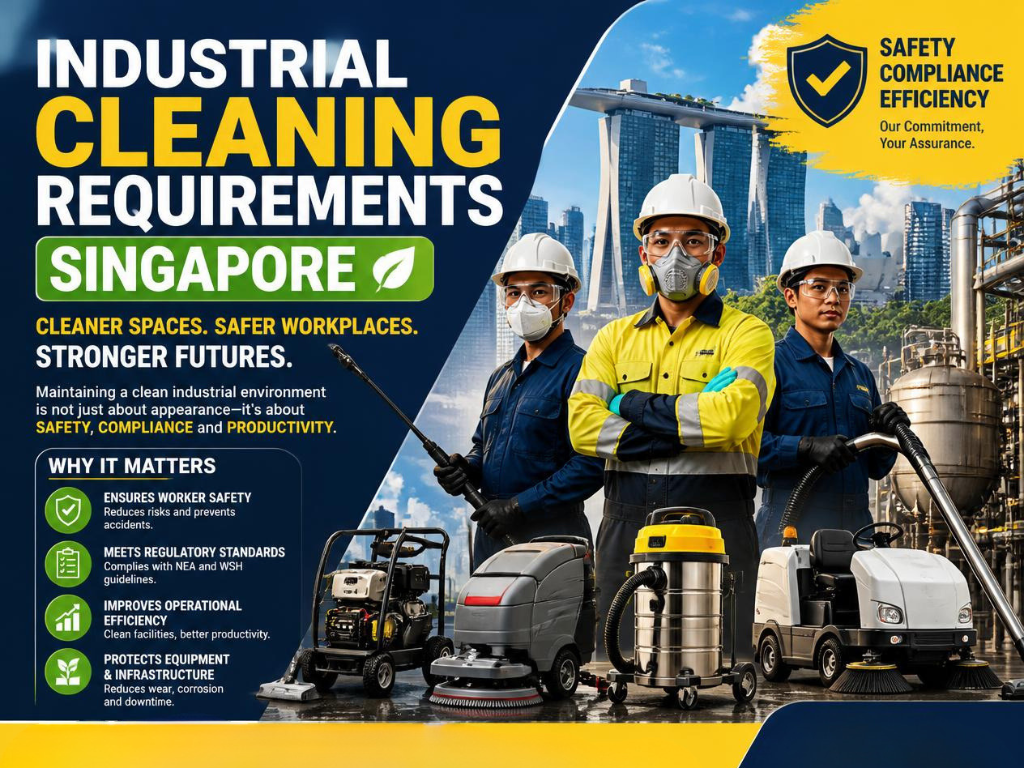
Whatever your own production staff wear in that zone, plus the PPE the cleaning task adds. A cleaner in a hearing protection zone needs hearing protection. A cleaner in an eye protection zone needs eye protection. The task then adds chemical-resistant gloves, splash goggles, respiratory protection for aerosolised degreasers, and a harness for anything at height.
Zone-based PPE beats task-based PPE in a factory, because a cleaner crosses zones during a single shift in a way an operator does not. Map the PPE requirement to the floor plan and issue it at the induction, so no cleaner has to work it out from signage.
The two items most often missing on cleaning crews are respiratory protection with the correct cartridge for the chemical in use, and cut-resistant gloves for anyone clearing swarf, trim or broken glass. Both are cheap. Both show up in injury records.
High-level cleaning changes the picture entirely. Cleaning above a production line means fall protection, an exclusion zone below, and a method statement covering dropped objects. The controls come from the same family used for work at height cleaning on building exteriors, applied to internal gantries, ductwork and racking.
How do you plan a shutdown window that delivers actual cleaning hours?
Back-plan from the moment the permit is issued. Production stop only starts the setup clock, and the gap between those two points is where most shutdown cleans lose their schedule.
Run the sequence honestly. Production stops. Plant cools or de-pressurises. Energy sources are isolated, locked and tagged, and isolation is verified. Where a confined space is involved, the atmosphere is tested and the entry permit is issued. Only then does cleaning start. In practice those steps consume 90 to 150 minutes of an eight-hour window before a cleaner touches a surface, and a four-hour shutdown clean therefore delivers closer to two hours of cleaning. Contractors who quote a four-hour window at face value are quoting a fiction that both parties will discover at 2am.
Three planning rules follow. Size the crew to the permit-cleared window, not the total window. Sequence tasks so that non-permit work runs during the isolation period. And schedule re-verification points into multi-night shutdowns, because the permit does not carry over.
Crew continuity decides whether night three runs as well as night one. A shutdown crew that changes composition each night re-learns the layout each night, and the induction burden repeats. The mechanics of crew stability and absence cover matter more on a five-night shutdown than on any daily contract, and the named-crew clause is worth insisting on at tender.
What belongs in a contractor induction and access control process?
The factory runs the induction. That follows from the occupier’s duty, which cannot be delegated to the party being inducted.
A working induction covers the site-specific hazards by zone, the location of isolation points and emergency stops, the chemical inventory and where the safety data sheets live, muster points and evacuation routes, the permit process and who raises it, the PPE standard by zone, and the incident reporting line. It ends with a signed acknowledgement and a photo pass in the individual’s name.
Access control is the enforcement mechanism. Log pass-in and pass-out by name. Tie access to high-risk zones to a specific permit. Escort anyone entering a production area for the first time. Where cleaning runs unsupervised at night, add a lone-worker check-in interval.
The clause that matters most is the one contractors resist: no substitution without induction. A relief cleaner sent at short notice to cover an absence has not seen your isolation points, does not know your muster point, and is the single most common unrecorded risk on a factory cleaning contract. Write it in, and require 24 hours’ notice of any crew change so the induction can run before the shift.
How is cleaning different in food production and GMP-adjacent areas?
The standard shifts from visual cleanliness to verified hygiene, and the documentation becomes part of the product record rather than the facilities file.
Food production and pharmaceutical-adjacent areas run on defined cleaning and sanitation procedures with specified contact times, approved chemical lists, colour-coded equipment segregation by zone, and verification steps such as ATP swabbing or visual inspection sign-off before a line restarts. Cleaning equipment does not cross zones. Cloths, mops and squeegees are colour-coded and stored separately, and a mop that has been in a drain area never enters a production zone.
The operational consequence for scheduling is that cleaning sits on the critical path to restart. The line resumes when the verification passes, so the swab result sits on that critical path alongside the cleaning itself. Build the verification step and its turnaround time into the shutdown window from the start.
Crew training has to be specific here. General industrial cleaning competence does not cover allergen segregation, sanitiser contact times or the reason a rinse step exists. Ask what proportion of the proposed crew has worked in a regulated food or pharmaceutical environment before, and ask for the number rather than the assurance.
Where this leaves you
Industrial cleaning in Singapore is procured as a service and regulated as work. The gap between those two framings is where factories get caught, because the contract negotiates price and scope while the WSH Act assigns duties that no contract clause moves. Mr Abu Bakar Mohd Nor, Chairman of the WSH Council, put the direction of travel plainly at the May 2026 national campaign launch, calling on the industry to “go beyond systems and processes” toward safety as a shared responsibility. A cleaning contractor is part of that shared responsibility from the moment it enters your gate.
Send Hong Ye Group your process layout, chemical inventory and planned shutdown dates, and get back a task-level risk assessment, a space classification register, a permit sequence with realistic cleaning hours per window, and a crew induction plan.
Frequently asked questions
Does a cleaning contractor need bizSAFE to work in a factory?
Yes in practice, and often by contract. bizSAFE Level 3 is a condition of NEA’s Class 1 and Class 2 Cleaning Business Licence, so any licensed commercial cleaning contractor holds it. Most Singapore factories set bizSAFE Level 3 as a prequalification floor, and higher-risk sites specify bizSAFE Star, which requires a WSH management system certified to ISO 45001.
Can industrial cleaning be done during production hours?
Some of it. General housekeeping, walkway cleaning and washroom servicing run during production with the right controls. Machine cleaning, tank entry, high-level work and degreasing require isolation or a permit, which means downtime. Splitting the scope into in-production and shutdown-only tasks at tender stage prevents the schedule argument later.
Who supplies the PPE, the factory or the cleaning contractor?
The contractor supplies task PPE for its own workers, since the employer’s duty under the WSH Act sits with them. The factory supplies or specifies zone PPE where its standard exceeds the contractor’s, such as hearing protection in a designated noise zone. Write the split into the contract with the zone map attached.
What happens if MOM inspects while a cleaning crew is on site?
Inspectors ask for risk assessments, permits, training records and safe work procedures, and they can issue a stop-work order where they judge imminent danger. MOM conducted more than 3,000 workplace safety inspections in the first half of 2025 alone. A contractor that cannot produce a current risk assessment on site creates exposure for the factory as well as for itself.
How much notice does a factory shutdown clean need?
Fourteen days minimum for a single-night clean and 30 days for a multi-night shutdown involving confined space entry. The lead time goes on the risk assessment, the space classification, the permit preparation and the induction of any crew member who has not been on your site before. Finding the crew is the easy part.