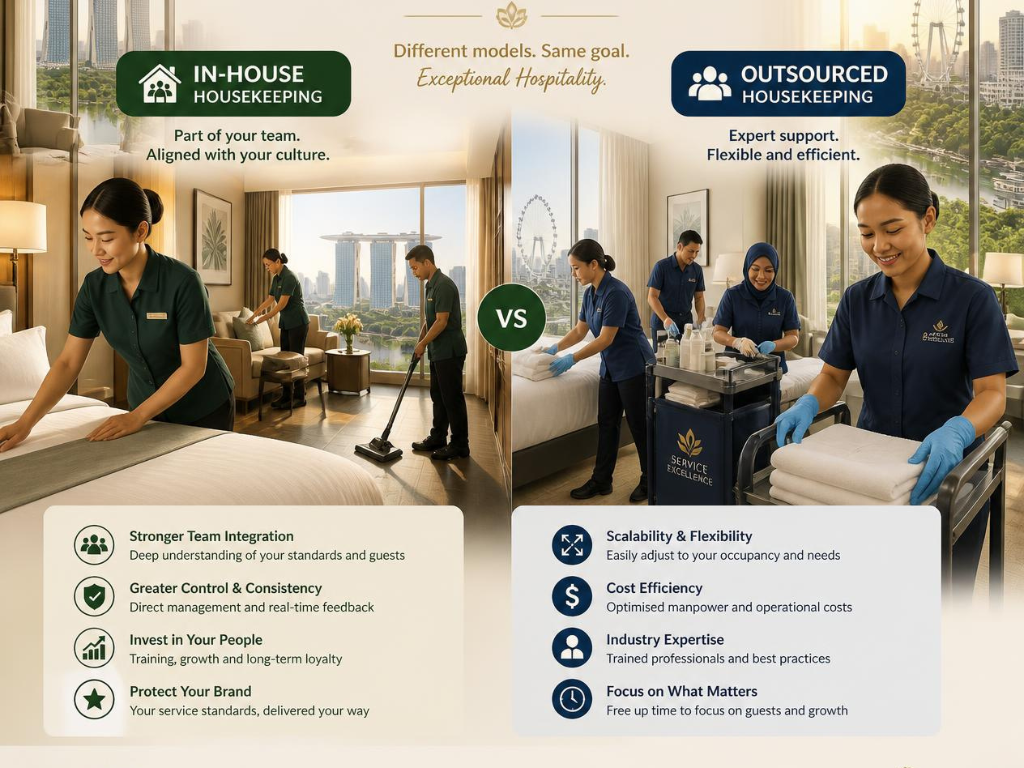
The in-house vs outsourced hotel housekeeping decision in Singapore usually turns on labour access, with cost a close second. STB recorded average occupancy at 81.9% in 2025 against an average room rate of S$273.56, across roughly 73,358 rooms. What follows is the cost per occupied room, the manpower rules and the consistency trade-offs, structured the way Hong Ye Group runs hotel housekeeping and hygiene services.
What actually changes when a hotel outsources housekeeping?
The employment relationship moves, and almost nothing else moves automatically. Room attendants become employees of a licensed cleaning business instead of the hotel. Standards, room status flow, the linen chain and the guest experience stay where they were unless the contract moves them deliberately.
A hotel that outsources without rewriting its standard operating procedures has changed its payroll and left its operating model alone. The provider inherits an undocumented set of expectations and then gets measured against them.
Three things stay with the hotel: the brand standard, guest recovery, and room release authority. A contractor cleans and reports; the hotel decides when a room goes back on sale. Contracts that hand room release to the provider create a conflict between throughput and standard, and the standard loses. What moves is recruitment, roster construction and relief cover, which is why housekeeping is the most commonly outsourced rooms division function in Singapore. When you look at the commercial cleaning scope categories a provider offers, the question that matters is whether its hotel and hospitality capability covers guest room work or stops at public areas.
Which model costs less per occupied room?
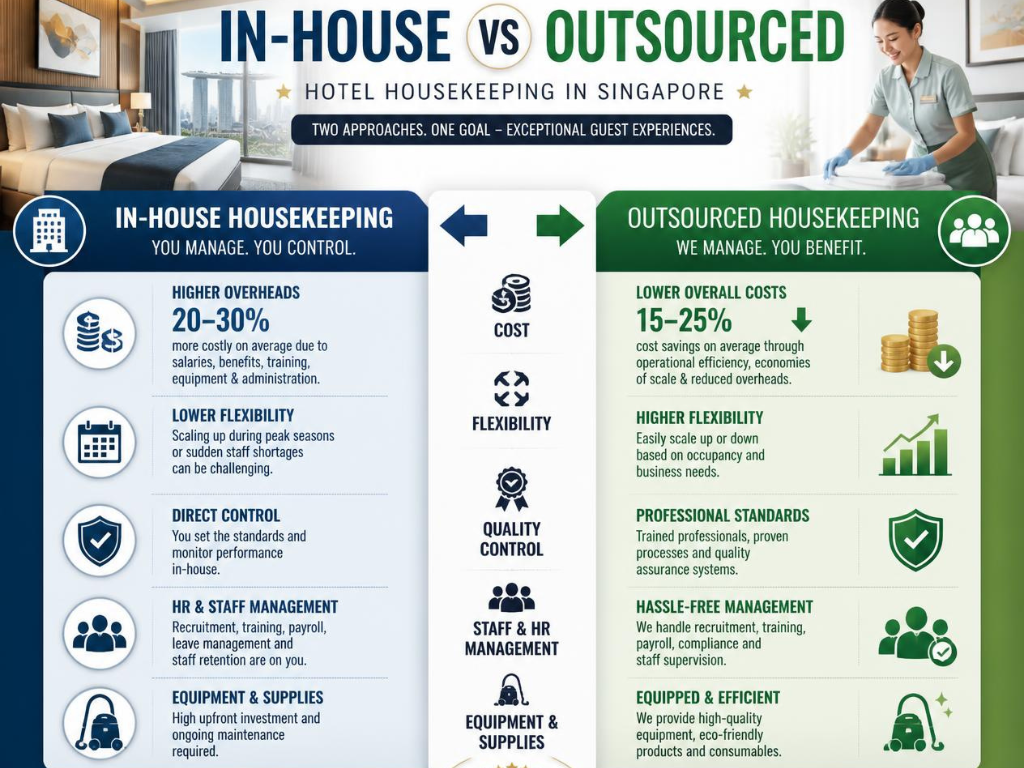
Neither, at the wage floor. Both models pay the same statutory minimum for resident staff, so the real cost difference sits in supervision layers, overhead recovery and how much idle capacity each model carries.
Work the floor upward. A resident room attendant on the PWM Group 1 general cleaner floor of S$2,080 a month costs roughly S$2,535 in total employment cost once you add the mandatory bonus of two weeks’ basic wage and employer CPF at 17 per cent. At 14 rooms per attendant per eight-hour shift across 22 shifts, that is about 308 rooms a month, or S$8.23 of attendant labour per occupied room. Add a supervisor at the S$2,870 floor covering 12 attendants and you add roughly S$0.95. Against STB’s 2025 average room rate of S$273.56, housekeeping labour lands near 3 per cent of room revenue before linen, amenities, equipment and margin.
That number is the benchmark both models have to beat. A quote materially below it is either running thinner coverage than your standard requires or absorbing a first-year loss. A quote materially above it is charging you for overhead you could carry yourself. Compare it against the fully loaded in-house cost including recruitment spend, uniform, training hours, statutory leave, medical, and covering absence at short notice. Most hotels compare a contractor’s invoice against their payroll line and miss four of those six. Building the full picture is the first step in evaluating a housekeeping provider on anything beyond headline rate.
How should you compare productivity between the two models?
In credits. Rooms per attendant is the number everyone quotes and the number that settles nothing, because a departure room and a stayover room are different jobs.
A departure takes full linen strip, bathroom deep clean, amenity reset and a full vacuum. A stayover takes a make-up and a bathroom refresh. Time them on your own floors and the departure runs closer to double, so any comparison priced in rooms flatters whichever party got the easier mix that week.
The credit system fixes it. Assign each room type and status a credit value, with a stayover standard room at 1 credit, a departure at 1.5, a suite departure at 2 or higher, and a deep clean or checkout with a rollaway priced separately. Set the shift target in credits. In practice, 15 to 17 credits per attendant per eight-hour shift is a defensible target on a full-service property, and anything above 20 is a standard problem waiting to surface in guest feedback.
Price the contract the same way. A per-credit rate makes the provider indifferent to mix and removes the monthly argument about why last week’s productivity dropped. It also gives you one number to benchmark in-house performance against.
Why can a hotel hire foreign housekeepers when its contractor cannot?
Because the Non-Traditional Source Occupation List gives that access to licensed hotels specifically. The cleaning companies that serve them fall outside it.
MOM added housekeepers and porters to the NTS Occupation List with effect from 1 September 2023, in consultation with STB, and the concession runs to hotels licensed by the Hotel Licensing Board. Employers using it work within a sub-quota of 8 per cent of total workforce excluding Employment Pass holders and a fixed monthly salary of at least S$2,000, and the Work Permit holder may only perform the occupation named on the permit. Cleaners are a different occupation. MOM confirmed in a February 2024 parliamentary reply that healthcare cleaners were absent from the list and would only be considered at the regular three-year review.
Margaret Heng, Executive Director of the Singapore Hotel Association, welcomed the 2023 inclusion on the grounds that “recruitment of suitable talents has become increasingly difficult” for these roles. That difficulty has not gone away, and it is the reason the asymmetry matters.
Read the consequence carefully, because it cuts both ways. In-house gives you a labour channel your contractor cannot use, capped at 8 per cent of your workforce. Outsourcing gives you access to a provider’s resident and Work Permit pool spread across many sites, under the Services sector Dependency Ratio Ceiling of 35 per cent, which flexes without touching your own quota at all. Hotels running close to their own DRC ceiling often outsource for exactly that reason.
Which model handles occupancy swings better?
Outsourcing, and volatility drives that far more than occupancy level does. A fixed in-house establishment is sized to a forecast. A contracted establishment is sized to a schedule you can vary.
Singapore’s average occupancy rate reached 81.9 per cent in 2025, up from 81.4 per cent in 2024. That is a narrow, stable band, and stability is the case for in-house. A hotel running a predictable 80 per cent with a tight arrival pattern is paying an outsourcing margin for flexibility it never uses.
The picture inverts on event-driven properties. A hotel whose occupancy moves 25 points across a MICE calendar carries idle in-house capacity for most of the year to cover a handful of peak weeks. Outsourcing converts that fixed cost into a variable one, provided the contract carries a variable component instead of a flat monthly fee.
Write the flex into the contract. A base deployment covering forecast low-season occupancy, a per-credit rate above it, and a surge notice period matched to your booking window. Fourteen days is workable for a MICE block booked months ahead. Forty-eight hours is not, and a provider promising it is either carrying expensive bench capacity or planning to send people who have never seen your property.
Does outsourcing hurt service consistency?
Only where the hotel never wrote the standard down. Consistency is a function of documented SOPs, training and inspection frequency, and none of those three belongs to the employment model.
The failure mode is real, though, and it is specific. An in-house team carries institutional knowledge informally: which rooms have the stiff balcony door, which floor’s trolley lift is slow, how the GM likes the turndown. That knowledge evaporates at transition, and the first 90 days of an outsourced contract are where reputations get made or lost. Put a documented handover in the mobilisation plan and cost the hours into it.
Three controls hold the line. The first is a written SOP per room type with a photographic standard, so “clean” is defined rather than felt. The second is a daily supervisor inspection at a stated sample rate, with a monthly joint inspection walked by the hotel’s executive housekeeper. The third is a defect trend review that tracks repeat failures by attendant, floor and room type, which total complaint counts will never show you.
Guest-facing standards are where the specification has to be tightest, and the distinction between adequate and exceptional guest room cleanliness standards shows up in the inspection criteria long before it shows up in a review score. The reporting burden has grown alongside it. By the end of 2025, 73 per cent of Singapore’s hotel room stock held international sustainability certification, beating the 60 per cent target under the Hotel Sustainability Roadmap, which pulls linen reuse rates, chemical volumes and water use into the housekeeping specification. Ask a provider for those figures as a monthly data return, and see whether the answer comes back as numbers.
What happens to turnover under each model?
It moves off your books without necessarily going down, and hotels that outsource expecting a turnover fix are solving the wrong problem.
Turnover is driven by wage level, physical load, shift pattern and progression, and outsourcing changes only who administers those. A provider running the same wage floor and credit target sees the same attrition. What changes is who absorbs the recruitment cycle, the induction cost and the coverage gap on the day someone does not appear.
That absorption is the actual value. A hotel losing an attendant carries a vacancy until it recruits. A provider losing an attendant redeploys from another site the same week, if it has the bench. Ask for the bench: how many roving relief attendants the provider employs and across how many hotel contracts. Three relief attendants across eight hotel accounts will not cover a Saturday in December.
The pattern behind hospitality staffing gaps is consistent across property types. Absence clusters around long weekends and public holidays, exactly when occupancy peaks. Build the relief expectation around that curve instead of an annual average, and put an unfilled-shift credit into the contract so the provider carries the cost of its own gaps.
Should public areas be outsourced before guest rooms?
Yes, for most hotels testing the model. Public area work carries no linen chain, no PMS room status dependency and no in-room guest contact, which makes it the lowest-risk scope to contract first.
A Common Area Attendant works lobbies, lift lobbies, corridors, public washrooms, back of house and F&B outlet perimeters on a rotation set by footfall, so arrivals and departures do not drive it. If the provider cannot hold a lobby to standard through a Saturday afternoon, you have learned what you needed to know without putting a stranger in a guest room. Coverage runs on continuous presence, which is why it is priced in deployed hours and why it scales for an event without renegotiating the whole contract.
Hotels that phase this way typically contract common area attendant coverage first, add night-shift guest rooms second, and move day-shift guest rooms last if at all. Plenty of Singapore properties stop at stage two permanently, and that is a defensible end state.
What does a hotel housekeeping contract need to specify?
Credits, coverage, standards, and who owns what. Contracts that specify a headcount and a monthly fee generate a dispute within two quarters.
Specify the productivity basis as credits per shift with the conversion table attached. Specify the deployment as a table of shifts, headcount and job level by area, with a named base establishment and a variable band above it. Specify the standard as SOPs per room type with photographic references appended to the contract, and the inspection regime as a sample rate with a scoring method.
Ownership needs its own clause. Linen and amenities stay with the hotel, since they sit on its P&L and its brand agreement. Trolleys, vacuums and floor machines sit with the provider. Chemicals sit with the provider against an approved product list countersigned by the hotel, because a brand-approved surface finish and an unapproved acid cleaner is an expensive combination.
Two clauses do disproportionate work. The first is an unfilled-shift credit at the contracted rate, which makes the provider pay for its own gaps. The second is a no-substitution rule requiring induction before any new attendant works a floor, because a relief worker who has never seen your key control process is a security exposure as much as a service one.
Making the call
The employment model is a lever on labour access and cost variability. Quality comes from somewhere else: a written standard, a credit-based productivity target and an inspection regime that produces trend data. Singapore’s stable 81.9 per cent occupancy argues for in-house on a predictable property. Event-driven volatility and a tight Dependency Ratio Ceiling argue for outsourcing. Most hotels land somewhere between, with public areas and night shifts contracted and day-shift guest rooms held in-house.
Send Hong Ye Group your room inventory, room type mix, twelve-month occupancy curve and current housekeeping establishment, and get back a credit conversion table for your property, a deployment schedule with base and variable bands, and a cost per occupied room you can lay against your current payroll line.
Frequently asked questions
Should hotels outsource housekeeping in Singapore?
Hotels with volatile occupancy or a tight foreign worker quota should. Hotels running a predictable occupancy band close to Singapore’s 2025 average of 81.9 per cent usually keep guest rooms in-house and contract public areas. The deciding variable is how far occupancy swings across the year, and the annual average tells you very little on its own.
Can a hotel outsource only the night shift?
Yes, and it is a common first step after public areas. Night-shift guest room coverage, turndown and public area maintenance contract cleanly because the scope is bounded and guest contact is minimal. Hong Ye Group and most hospitality providers price night deployment in hours instead of credits, since throughput is not the driver.
Does a contractor need an NEA licence to clean hotel rooms?
Yes. Any business providing general cleaning at non-domestic premises needs a valid NEA Cleaning Business Licence under the Environmental Public Health Act 1987. A hotel engaging an unlicensed provider faces a maximum fine of S$10,000 plus S$1,000 for each continuing day. Check the entity name on the licence against the entity on the contract.
How long is a typical hotel housekeeping contract in Singapore?
Two to three years, with a formal review at twelve months. Shorter terms churn attendants and reset the property knowledge that takes a full season to build. Align the term with the provider’s two-year NEA licence cycle so licence class, bizSAFE status and training records get re-verified at the same review.
Who owns the linen and amenities under an outsourced model?
The hotel, in almost every case. Linen and guest amenities sit on the hotel’s P&L and inside its brand agreement, so the provider draws from hotel stock against a stated par level. Write the par level and the monthly reconciliation into the contract, or linen loss becomes an unresolved argument by month three.