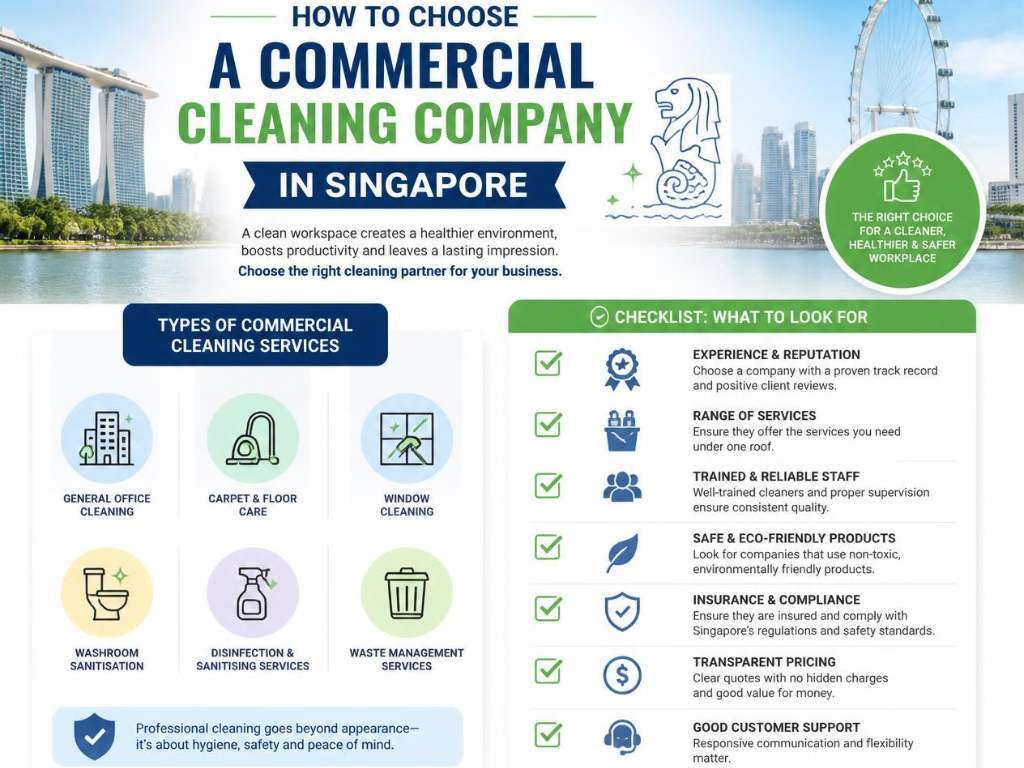
Choosing a commercial cleaning company in Singapore starts with a licence check. Price comes later. In November 2023 NEA counted more than 1,480 licensed cleaning businesses and 54,500 cleaners, spread across three licence classes that mean very different things. Below are the certifications, manpower models and contract terms that separate them, measured against how Hong Ye Group scopes commercial cleaning and hygiene services.
What licences must a commercial cleaning company in Singapore hold in 2026?
Every business providing general cleaning at non-domestic premises must hold a valid Cleaning Business Licence issued by the National Environment Agency under the Environmental Public Health Act 1987. The liability runs both ways. A service buyer who engages an unlicensed provider faces a maximum fine of S$10,000, plus S$1,000 for every day the offence continues.
The licence runs for two years. The application fee rose from S$130 to S$180 for applications submitted from 1 April 2026, and NEA processes a complete submission within 14 working days. Renewal can be filed up to 12 months before expiry, which matters when you are timing a tender against a contractor’s licence cycle.
One change from 1 January 2024 catches buyers out. Businesses that supply cleaning manpower to other cleaning businesses now need their own licence. If your contractor tops up a night shift with agency bodies, that agency must be licensed too.
Verification takes about four minutes. NEA publishes the full list of licensed cleaning businesses with class and expiry. Check the entity name on the licence against the entity name on the quotation. They differ more often than you would expect, usually because a group holds the licence under one subsidiary and tenders under another.
What do Class 1, Class 2 and Class 3 licences actually tell you about a contractor?
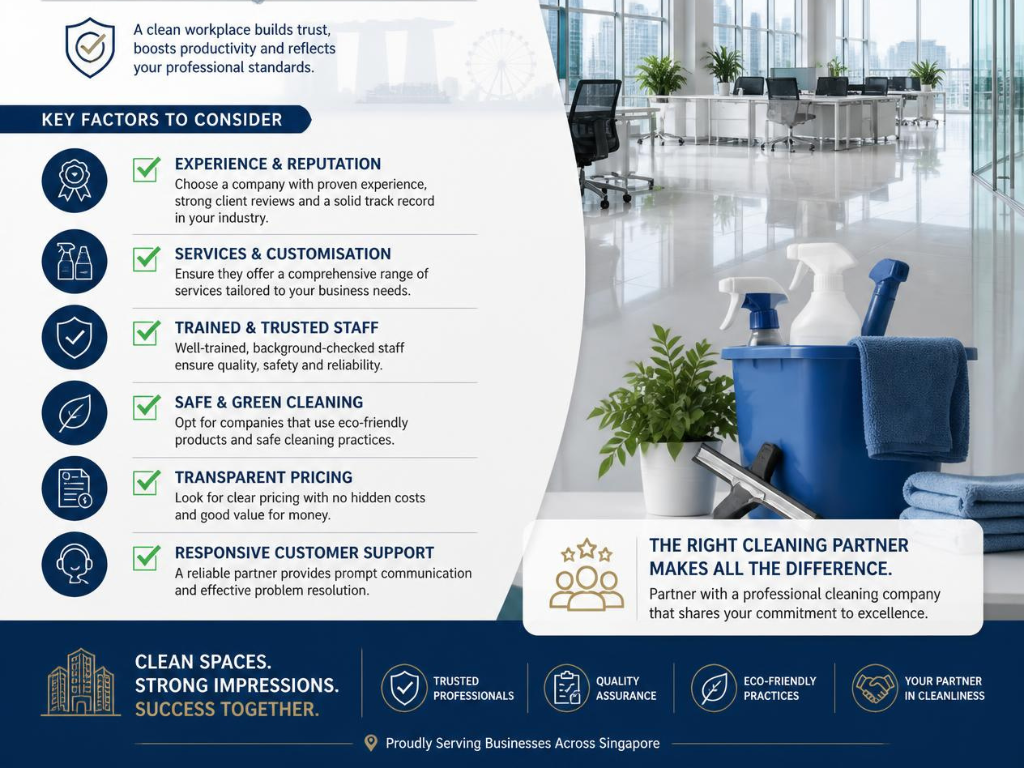
The three classes encode financial capacity, safety maturity and how deeply the workforce is trained.
Class 3 is available to new cleaning businesses only, carries no paid-up capital or bizSAFE requirement, and cannot be renewed. It buys a firm two years to build capability before it must move up. Class 2 requires paid-up capital or net worth of at least S$25,000, a valid bizSAFE Level 3 certification maintained throughout the licence period, and cleaners trained in two modules: one Workplace Safety and Health module and one core module.
Class 1 is the enhanced tier. It requires paid-up capital or net worth of at least S$250,000, bizSAFE Level 3, cleaners trained in three modules rather than two, at least one cleaning contract ongoing or completed in the preceding 12 months, and a clean record over the previous 24 months across the Environmental Public Health Act 1987, the Employment Act 1968, the Employment of Foreign Manpower Act 1990, the Workplace Safety and Health Act 2006 and the Central Provident Fund Act 1953.
For a multi-tenant commercial building, a factory running two shifts, or a hotel with 24-hour public area coverage, treat Class 1 as the minimum you will consider. The compliance-history condition alone screens out firms with recent employment or safety convictions, which no amount of tender scoring will surface on its own.
Key elements of the Enhanced Clean Mark Accreditation Scheme were folded into this licensing framework on 1 January 2024. Tender templates still asking bidders for Clean Mark Gold are specifying a signal that now sits inside the Class 1 requirements.
Which certifications matter beyond the NEA licence, and which are just logos?
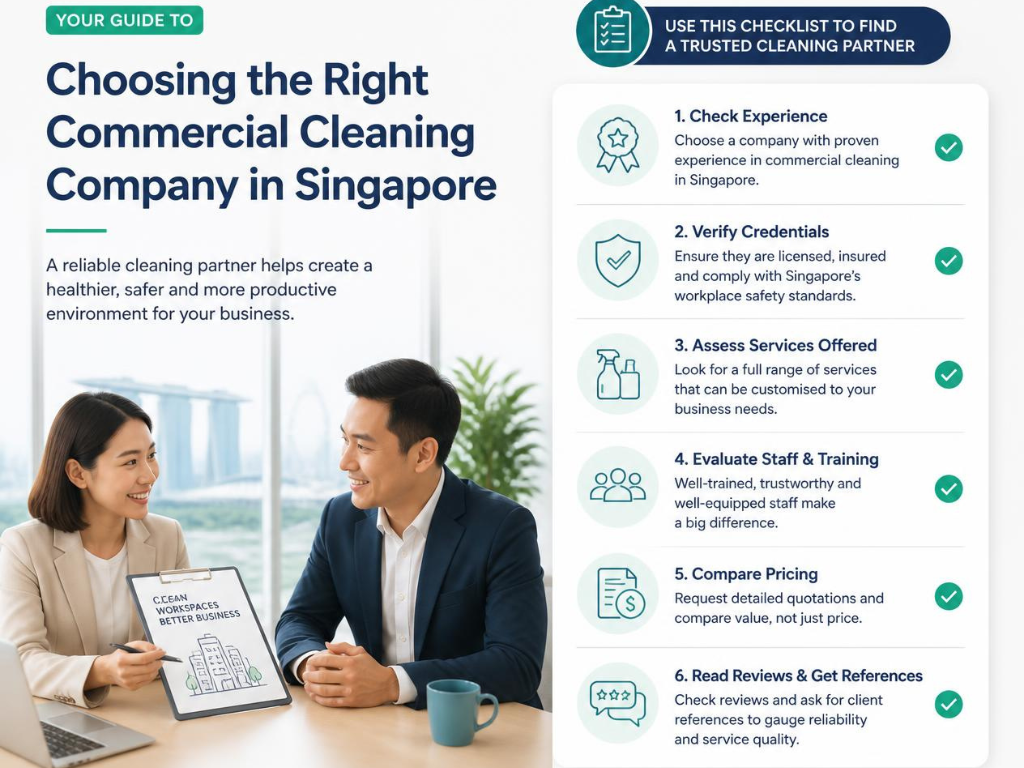
Three certifications carry weight in commercial cleaning. Buyers misread one of them regularly. bizSAFE Level 3 is a licence condition for Class 1 and Class 2 holders, so every licensed contractor at those tiers already has it. bizSAFE Star is the one that separates firms. Star requires a Workplace Safety and Health Management System certified to ISO 45001:2018 or SS 506 by a certification body accredited by the Singapore Accreditation Council, supported by a valid risk management implementation audit report. Level 3 and above stay valid for three years, and Star status collapses the moment the underlying ISO 45001 certificate lapses.
ISO 9001:2015 tells you the contractor has documented method, corrective action and a complaint trail. That matters on the day you want to know why a cleaning failure happened and what changed afterwards. ISO 14001:2015 governs chemical selection, dilution control, waste segregation and water use, and it is the certificate your sustainability team will ask for when it starts pulling scope 3 data from cleaning vendors and ESG reporting becomes a board-level line item.
The Progressive Wage Mark, administered through the Singapore Business Federation, is the underused one. It accredits firms that pay progressive wages across the whole workforce, cleaners and non-cleaners alike.
A wall of logos on a bid deck proves very little. Ask which certificate is a licence condition, which is voluntary, who accredited the certifier, and when each expires. Three of those four answers are checkable in a browser.
Why doesn’t the NEA cleaning licence cover façade cleaning?
Because façade cleaning is classified as excluded cleaning work. The Environmental Public Health (Excluded Cleaning Work) Notification 2014 places façade cleaning alongside cleaning of domestic premises and swimming pools, outside the licensing regime entirely. A Class 1 licence tells you nothing about a contractor’s competence 40 metres up the side of your building.
What governs façade work instead is the Workplace Safety and Health Act 2006 and the Work at Heights regulations: a documented fall protection plan, permit-to-work systems, trained supervisors, and certified access equipment, whether that is a gondola, a boatswain’s chair or rope access. MOM’s national statistics recorded 36 workplace fatal injuries in 2025, with falls from height among the top three causes. Vehicular incidents, falls from height and collapse or failure of structures together accounted for 78 per cent of them.
Demand for this work comes from regulation. BCA’s Periodic Façade Inspection regime took effect on 1 January 2022 and applies to buildings more than 13 metres tall once they pass 20 years of age, with inspections every seven years. BCA expects more than 4,000 buildings to be inspected annually under the regime, and inspection findings routinely generate cleaning and rectification scopes.
Hong Ye Group scopes façade cleaning as risk management and prices it separately from the daily cleaning contract. When you evaluate a bidder for façade work, ask for the fall protection plan, the equipment certification and the supervisor’s training records. The cleaning licence is the wrong document.
Should you keep cleaning in-house or outsource it?
Outsourcing transfers recruitment, relief cover, workplace safety liability and equipment capital. The wage floor stays where it is.
Most in-house versus outsourced comparisons miss that. PWM wage and training requirements cover all Singapore citizens and permanent residents employed as cleaners in licensed cleaning businesses, and also in-house cleaners at firms that hire foreign workers. Bringing cleaning in-house to escape the floors does nothing if you employ any foreign manpower elsewhere in the business.
An in-house team cleaning only your own premises does not need an NEA licence. The moment you clean for another legal entity, including a related company in the same building, you do.
In practice, in-house works when the site is single-use, single-shift, and small enough that one absence does not collapse the coverage. Somewhere under six deployed heads, direct employment is often cheaper and gives you control over who walks through a secure area. Above that, the maths turns. You are then running a recruitment pipeline, a relief pool, a chemical store, a machine maintenance schedule and a WSH management system for a function that has nothing to do with your business. Most facility teams work this out at the first extended medical leave. Press a bidder on absenteeism and relief cover before you press them on rate.
How do you know if a cleaning quote is realistically priced?
Work up from the published wage floor. Every quote has a legal minimum embedded in it, and you can calculate it in five minutes.
For 1 July 2026 to 30 June 2027, MOM’s Group 1 ladder (offices, schools, hospitals, clinics, condominiums) sets these monthly basic wage floors for full-time outsourced cleaners:
| Job level | Monthly basic wage floor |
| General cleaner / indoor cleaner | S$2,080 |
| Restroom, outdoor or healthcare cleaner | S$2,495 |
| Multi-skilled cleaner / machine operator | S$2,700 |
| Supervisor | S$2,870 |
Take one resident general cleaner. Twelve months at S$2,080 is S$24,960. Add the mandatory PWM bonus of at least two weeks of basic monthly wages, roughly S$1,040, for S$26,000. Add employer CPF at 17 per cent for an employee aged 55 and below, roughly S$4,420. The annual employment cost lands near S$30,420, about S$2,535 a month, before supervision, relief cover, machines, consumables, insurance, transport, administration or margin.
Scale it. Five general cleaners plus one supervisor at the floor costs roughly S$16,170 a month in employment cost alone. If a bidder quotes S$14,000 a month for that deployment, one of four things is true: fewer bodies will appear than the schedule promises, the headcount leans on Work Permit holders where a levy applies instead of CPF and the Services sector Dependency Ratio Ceiling caps foreign staff at 35 per cent, supervision is unpaid and notional, or year one is a loss-leader that will be repriced at renewal.
Ask which. A contractor confident in its daily and periodic cleaning services will answer without flinching. The full wage ladder, including F&B and conservancy groups, is published on MOM’s PWM page for the cleaning sector.
How many cleaners and supervisors should be on your site?
There is no statutory supervisor ratio in Singapore. Anyone who tells you the regulator sets one is guessing.
In practice, one site supervisor per eight to twelve deployed cleaners holds up on a single-building office contract. Below eight, you are paying supervisor rates for a working cleaner. Above twelve, the supervisor stops inspecting and starts firefighting, and quality control quietly disappears from the contract you paid for.
The unit of measurement changes by property type, and the SLA should change with it. Office contracts are measured in deployed heads per shift per zone. Manufacturing and factory office contracts are measured against production schedules, because a machine hall cleaned during a running shift needs a different risk assessment from one cleaned during a shutdown. Hotels are measured in rooms per attendant per shift for guest room cleaning, typically 14 to 16 rooms per attendant across an eight-hour shift on full-service properties, with separate Common Area Attendant coverage running against lobby footfall rather than room count. Written hotel housekeeping standards prevent the usual argument about whether turndown sits inside the contract.
Ask every bidder for a deployment schedule broken down by zone, shift, job level and headcount, with the relief ratio stated. A bidder who gives you a monthly rate and no deployment schedule is quoting a budget. Ask for the schedule before you compare the number to anything.
What belongs in a cleaning contract’s scope of works and service level agreement?
The scope of works lists area, task, frequency and standard. The service level agreement converts those into measurable thresholds, response times and remedies. Contracts that collapse the two into one document are where disputes start.
NEA developed a Guide on Specifications for Outcome-based Cleaning Contract with the Ministry of Finance, the Environmental Management Association of Singapore, the Association of Property and Facility Managers and IFMA. Its central instruction to buyers is to shift “away from prescribing the required headcount to specifying the desired outcomes instead”. That guidance is sound, with one caveat from the field. Outcome specifications only work when the buyer has the capacity to inspect outcomes. If your facility team cannot run a scored monthly inspection, a headcount-based scope gives you something enforceable.
Five omissions cause most of the friction. The first is consumables ownership, meaning who buys and stocks hand soap, paper and liners. The second is the periodic works calendar, covering carpet extraction, hard floor stripping and sealing, high-level dusting and glass. Third is the machine list, naming the equipment that stays on site. Fourth is the after-hours callout window and its response time. Fifth is the exclusions, written out explicitly, because façade work, pest control and landscaping are separate regimes with separate risk profiles.
Public areas deserve their own clauses. Lobbies, lift cars and washrooms carry the reputational load of the whole building, and public area cleaning expertise does not transfer neatly from back-of-house coverage. If you are still mapping which services your site actually needs, start from the commercial cleaning service types available before you write frequencies against them.
How long should a commercial cleaning contract run?
Twenty-four to thirty-six months, with a formal review at twelve, and re-verification of licence class and certification at each renewal. Aligning tenure to the two-year licence cycle means your contractor’s NEA renewal and your contract review land close enough to be checked together.
Short contracts look like commercial discipline and behave like churn. On 19 July 2026, Minister of State for Manpower Dinesh Vasu Dash announced that the minimum annual leave entitlement for outsourced PWM workers will rise from 7 days to 10, phased in from 2029, benefiting about 60 per cent of outsourced workers across the cleaning, security, landscape, lift and escalator and waste management sectors. The reason he gave for the change is the reason tenure matters to buyers: when “workers are rehired on a fresh contract, their leave entitlements could be reset”.
The crew that cleans your building is the same crew regardless of whose logo is on the uniform, and every retender resets their service record. Longer tenure with a hard performance-exit clause keeps continuity while preserving your exit route. Over 150,000 lower-wage workers now sit under PWM wage and progression ladders, and stability in that workforce is what produces a cleaner who knows where the water shut-off is.
What happens when your contractor subcontracts the manpower?
You inherit the risk. Since 1 January 2024, a business that supplies cleaning manpower to another cleaning business must hold its own cleaning business licence, and a buyer whose contractor deploys manpower sourced from an unlicensed supplier is exposed to the same maximum S$10,000 fine plus S$1,000 for each continuing day.
Subcontracting has legitimate uses. Specialist scopes such as high-level access, marble restoration or post-incident disinfection are usually better handled by a named specialist than by a generalist stretching. The trouble starts with undisclosed manpower substitution, where the contractor wins on a deployment schedule of directly employed staff and delivers a rotating cast of agency workers who have never seen your risk assessment.
Three clauses fix it. Require named subcontractors with licence numbers and classes listed in the contract. Require written approval before any substitution. Require that every deployed worker, direct or subcontracted, has completed the site induction and holds the WSQ modules matching their PWM job title. NEA’s licensing regime already applies the training requirement to both resident and foreign cleaners, including part-time and casual staff, so a contractor cannot argue the burden is unreasonable.
How do you monitor cleaning performance after the contract starts?
Monitoring works when it is scheduled, scored and carries a consequence. Drop any one of those and you have a complaint log.
Run a joint monthly inspection against a scored checklist broken down by zone, with the contractor’s site supervisor present and signing. Maintain a defect log with a stated response time by severity, so a blocked floor trap and a smudged lift panel do not share a deadline. Review quarterly against KPI thresholds with a defined consequence: rectification at the contractor’s cost, a service credit, or a documented step toward termination.
Re-verify annually. Confirm the licence class has not been downgraded, the bizSAFE certificate is current, and the training records still match the deployed roster. Contractors change shape between renewals, and a licence that was Class 1 at signing can be something else two years later.
This breaks down when the buyer only inspects after a complaint. By then the standard has already moved, the crew has already adapted to the lower bar, and you are negotiating from a position where the evidence is anecdotal.
Where this leaves you
Check price last. A contractor’s licence class tells you its financial and safety floor. Its certifications show whether method is documented or improvised. Its deployment schedule names who will actually be in your building. The published wage ladder shows whether the number at the bottom of the quotation survives contact with a payroll. Get those four right and the rate is a negotiation. Get them wrong and the rate is a forecast of the retender you will run in eighteen months.
Bring your current scope of works and cleaning schedule to a site walk-through with Hong Ye Group, and get back a deployment plan with headcount by zone and shift, a licence and certification pack, and a costed scope you can put side by side with your incumbent’s.
Frequently asked questions
Is Clean Mark still required for cleaning contracts in Singapore?
No. Key elements of the Enhanced Clean Mark Accreditation Scheme were merged into NEA’s revised cleaning business licensing framework on 1 January 2024. The current equivalent signal is a Class 1 licence, which carries the S$250,000 capital, three-module training and 24-month clean compliance history requirements. Update tender templates that still name Clean Mark Gold.
Do I need a licensed cleaning company for a one-off post-renovation clean?
Yes. The Cleaning Business Licence applies to general cleaning at any non-domestic premises, including one-off jobs. A service buyer engaging an unlicensed provider for a single post-renovation clean faces the same maximum S$10,000 fine as one signing a three-year contract. Check the entity against NEA’s published list first.
Can a commercial cleaning company deploy only foreign cleaners?
No. The Services sector Dependency Ratio Ceiling caps Work Permit and S Pass holders at 35 per cent of a firm’s workforce, so foreign deployment requires local headcount to unlock it. PWM wage floors apply to Singapore citizens and permanent residents, while NEA’s training requirement applies to resident and foreign cleaners alike.
How do I verify a cleaning company’s bizSAFE status?
Search the WSH Council’s bizSAFE Marketplace, which lists current certification status by company. bizSAFE Level 3 and above remain valid for three years. For bizSAFE Star, also confirm the underlying ISO 45001:2018 or SS 506 certificate is live, because Star status lapses with it regardless of the printed expiry date.
What notice period should a commercial cleaning contract carry?
Between 30 and 90 days, paired with a separate performance-exit clause triggered by defined KPI failures rather than by notice alone. A 30-day notice on a 100-head deployment is unworkable for both sides. Match the notice period to the time your contractor needs to redeploy staff without breaching their employment terms.