Cleaning Services

Commercial Lawn Mowing Schedule Singapore: Monsoon Guide

Commercial Lawn Mowing Schedule Singapore: Monsoon Guide
A commercial lawn mowing schedule in Singapore sets how often turf is cut, to what height and in which time window, based on grass species, growth rate and season. Cow grass needs cutting every two weeks year-round, and NEA records lightning on about 176 days a year. Below, we set out cutting cycles, monsoon adjustments and rain-day rules. Lawn care often sits alongside our commercial cleaning and facility services.
How often should commercial lawns be mowed in Singapore?

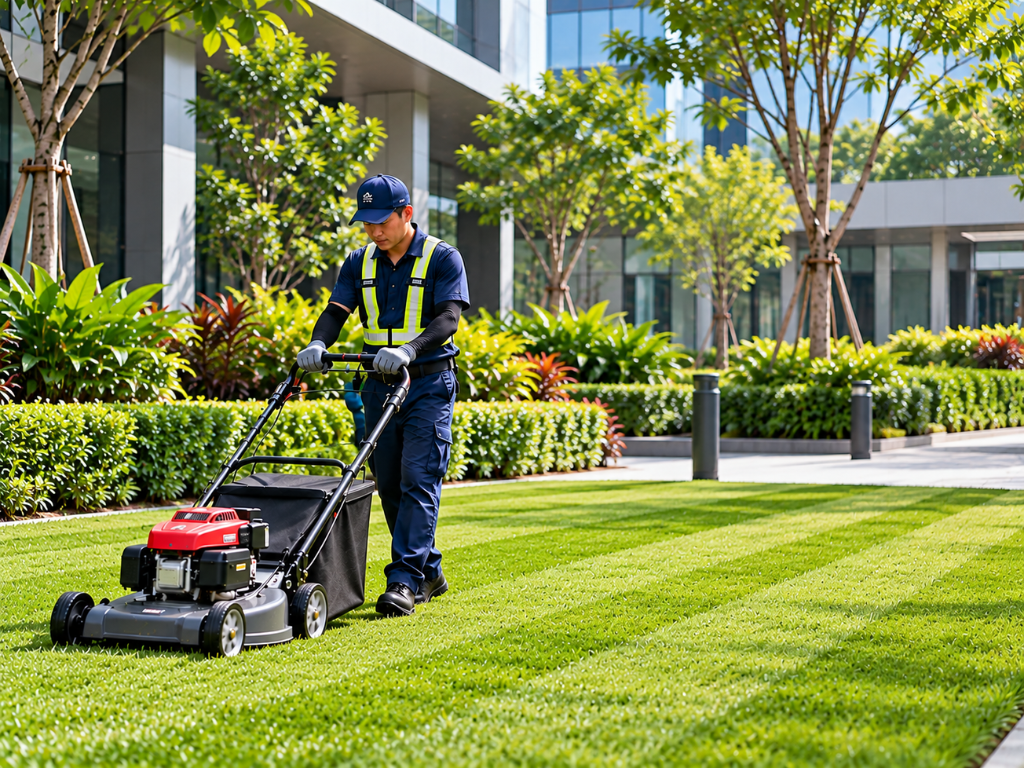
Commercial lawns planted with cow grass should be mowed every two weeks all year, which works out to 26 cuts a year. Slower grasses such as Manila grass hold their quality on four to six week cycles, so the right frequency depends first on what is planted. Singapore turf never goes dormant. There is no winter slowdown, so the schedule that suits March also has to hold in December. The weather only decides which day the cut happens. A contractor who stretches a two-week cycle to three during the wet months saves one visit and creates a harder, messier cut on the next one. The two-week cycle for cow grass is the working baseline across Singapore commercial frontages, business parks and industrial estates. Edging and trimming along kerbs, planter edges and paths belong in the same visit, because an untrimmed edge is what tenants notice first. How often should commercial lawns be mowed in Singapore?

Why does turf type change the mowing schedule?

Turf type changes the schedule because Singapore’s common grasses grow at very different vertical rates. NParks’ Centre for Urban Greenery and Ecology tested five warm-season species at 20 mm cutting height on two, four and six week cycles, and only Manila grass (Zoysia matrella) kept good quality on all three. The CUGE research note by Vivek Govindasamy and Nithin Padmanabhan found cow grass and centipede grass performed well only when cut every two weeks. Pearl grass did the opposite, performing poorly at two weeks but well at four and six. St Augustine grass held up at four weeks and declined at six. The authors noted that mowing “incurs the most cost due to its frequency of application, fuel consumption and manpower requirement.” That makes species a cost decision. Cow grass on a two-week cycle needs 26 cuts a year; Manila grass on a six-week cycle needs about nine. For a low-traffic slope or a back-of-house verge, re-turfing with a slow-growing species pays back in cutting visits. For a heavily walked frontage, cow grass stays the practical choice because it tolerates trampling and recovers quickly.

What height should commercial turf be cut to?

Commercial cow grass should be kept at roughly 30 to 50 mm, with no single cut removing more than a third of the leaf. The CUGE trials used 20 mm, which suits test plots, but fast growers such as cow grass scalp at low heights, leaving bare patches that weeds fill. The one-third rule is why missed cycles hurt. Grass left for four weeks in the wet season grows past the point where one cut can restore it, so the crew either scalps it or makes two visits.

How does the Northeast Monsoon change grass cutting?

The Northeast Monsoon, from December to early March, splits into a wet phase and a dry phase, and each needs a different approach. The wet phase from December to early January brings monsoon surges with days of continuous rain; the dry phase from late January to early March is the best cutting window of the year, with February usually the driest month. During the wet phase, each monsoon surge can bring several days of widespread continuous rain over Singapore, according to NEA’s Meteorological Service Singapore advisories. Turf keeps growing through it. Build one rain contingency day into every two-week cycle from December to mid-January, so a lost day moves the cut to the next dry day within the cycle. Clipping removal matters most in this phase, because wet clippings mat on turf and wash into drains. The dry phase is catch-up time. Growth continues, but crews can reach every zone on schedule, restore edges and repair ruts left by any wet-season work before the inter-monsoon storms arrive in late March.

How do inter-monsoon thunderstorms and lightning affect mowing?

Inter-monsoon thunderstorms, from late March to May and from October to November, arrive mostly in the afternoon, so mowing should be scheduled for the morning in those months. They also bring Singapore’s lightning peak, and a crew on open turf with metal equipment is exposed. Singapore is among the world’s most lightning-prone countries. In a 2026 parliamentary reply after a fatal lightning strike off Pasir Ris Beach, the Ministry of Sustainability and the Environment said NEA’s Changi Climate Station observes lightning on about 176 days a year. The myENV app sends alerts when cloud-to-ground lightning is detected or thundery showers are forecast within 6 km of a chosen location over the next two hours. MSS data shows about half the year’s lightning days fall in April, May, October and November. The cause is predictable. Associate Professor Koh Tieh Yong of the Singapore University of Social Sciences explained that during the inter-monsoon, “strong solar radiation leads to higher surface temperatures”, which builds afternoon storm clouds. Crews should stop work when a myENV alert arrives and wait for the all-clear, sent after 30 minutes with no lightning detected. A lawn on a two-week cycle absorbs a lost afternoon easily if the morning has done the cutting.

What changes during the Southwest Monsoon?

The Southwest Monsoon, from June to September, is Singapore’s comparatively drier season, but it brings Sumatra squalls, lines of thunderstorms that usually reach Singapore before dawn or in the early morning. Mowing shifts later in the day, once the squall has passed and the turf has drained. That later window runs into heat. MOM’s heat stress measures for outdoor work require an hourly rest of at least 10 minutes for heavy physical work once the wet bulb globe temperature reaches 32°C, and at least 15 minutes at 33°C. Workers must rehydrate at least hourly, with 300 ml an hour recommended, and employers must reschedule outdoor physical work to cooler parts of the day where feasible. Operating a brushcutter or pushing a pedestrian mower up a slope counts as heavy physical work in practice. From June to September, start mid-morning after any squall, plan breaks around WBGT readings from the myENV app, and keep the hottest trimming work out of the early afternoon.

Should grass be cut when it is wet?

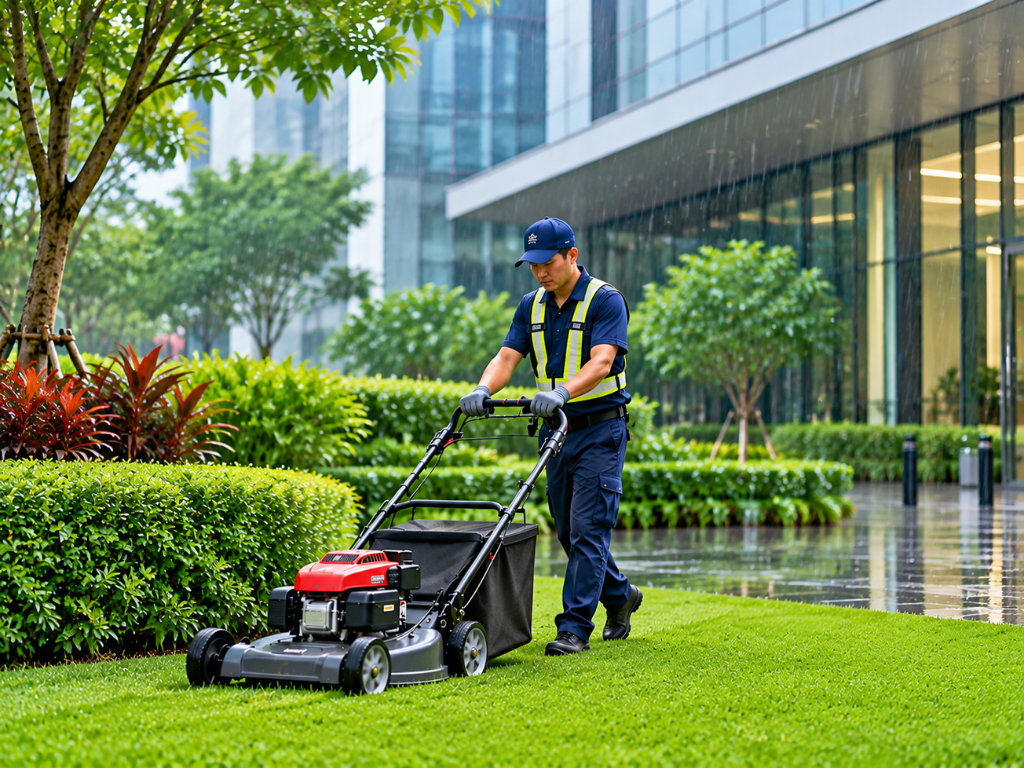
Wet grass should not be cut on a commercial site when the turf is saturated. Mowing waterlogged cow grass tears the leaf, clumps the clippings, and leaves ruts that last for weeks, and wet slopes are a slip risk for the operator. Light surface water after a short shower is different. Once the turf drains, usually within an hour or two in Singapore’s heat, cutting can resume. Wet-weather access and equipment selection decide the rest. A ride-on mower on saturated turf compacts the soil and cuts ruts, so wet-phase work on soft ground should use pedestrian mowers or wait for a contingency day. Slopes and embankments need brushcutters in any season. The problem is a contract that pays per cut on a fixed date. The crew arrives on the scheduled day, mows wet turf to hit the date, and the owner pays for the damage later.

What should happen to clippings, edging and trimming?

Clippings should be blown or swept off paths, kerbs and drain gratings on every visit, and collected from the turf itself when the cut is heavy or the grass is wet. Edging and trimming around kerbs, planters, poles and tree bases belong in the same visit as the mowing. Clippings left in drains block scuppers and hold water, which is the opposite of what NEA’s dengue guidance asks for during the May to October peak. Alternating the mowing pattern each visit, cutting in a different direction, stops the grass leaning one way and reduces wear lines from repeated wheel tracks. Tree bases should be trimmed by hand or with a guarded strimmer, since strimmer line damage to bark is a common entry point for rot on young trees. Blocked drains and standing water also feed straight into a site’s pest control programme, so the two scopes should share findings.

How should a mowing schedule handle rain days?

A mowing schedule should build in rain contingency days and judge performance by turf height, letting the cutting date move. Any cut missed to rain moves to the next dry day within the same cycle, and the site log records why. The contract clause is simple. State the target cycle (every 14 days for cow grass), the maximum interval before a cut becomes overdue (for example 18 days), the target height range, and the contingency days allowed in the Northeast Monsoon wet phase. The same principle of writing each recurring task with a frequency and a written variation process applies to any facility service contract. Hong Ye Group’s landscaping services for facilities include routine lawn care, edging and pruning as part of grounds maintenance. When comparing providers, ask how each one handles a lost week in December and who records it; the checks for choosing a commercial contractor apply here too. 

Cut to the weather, measure by the height

In Singapore the grass species sets the cutting cycle and the weather sets the day. Cow grass needs cutting every two weeks all year. What moves with the season is the time window: dry February days, inter-monsoon mornings and post-squall starts from June. A contract that measures turf height and allows rain days keeps the lawn healthy through all of it. Book a turf and mowing schedule review with Hong Ye Group. The team maps your turf by species and traffic, then sets cutting cycles, monsoon time windows and rain contingency days for each zone. Request a mowing schedule review.

Frequently asked questions

How many times a year is commercial grass cut in Singapore?

Cow grass, the most common commercial turf in Singapore, is cut about 26 times a year on a two-week cycle. Manila grass can hold quality on a six-week cycle, around nine cuts a year, based on NParks CUGE trials. Contingency days for the December monsoon surges should be included on top.

What is the best time of day to cut grass in Singapore? 

Morning is best from late March to May and October to November, before inter-monsoon afternoon thunderstorms. From June to September, start mid-morning after any Sumatra squall has passed. MOM’s heat stress rules apply once the wet bulb globe temperature reaches 32°C, so plan rest breaks for late-morning work.

Does grass grow faster during the monsoon in Singapore? 

Grass grows year-round in Singapore with no dormant season, and rain combined with warm temperatures keeps growth steady through the Northeast Monsoon from December. The monsoon mainly reduces cutting days, so a two-week cycle for cow grass needs rain contingency days in December and January to stay on track.

Is cow grass or Manila grass better for commercial property? 

Cow grass suits heavily walked frontages because it tolerates trampling and recovers quickly, but it needs cutting every two weeks. Manila grass (Zoysia matrella) kept good quality on two, four and six week cycles in NParks CUGE trials, making it the better choice for low-traffic verges and slopes.  
To top