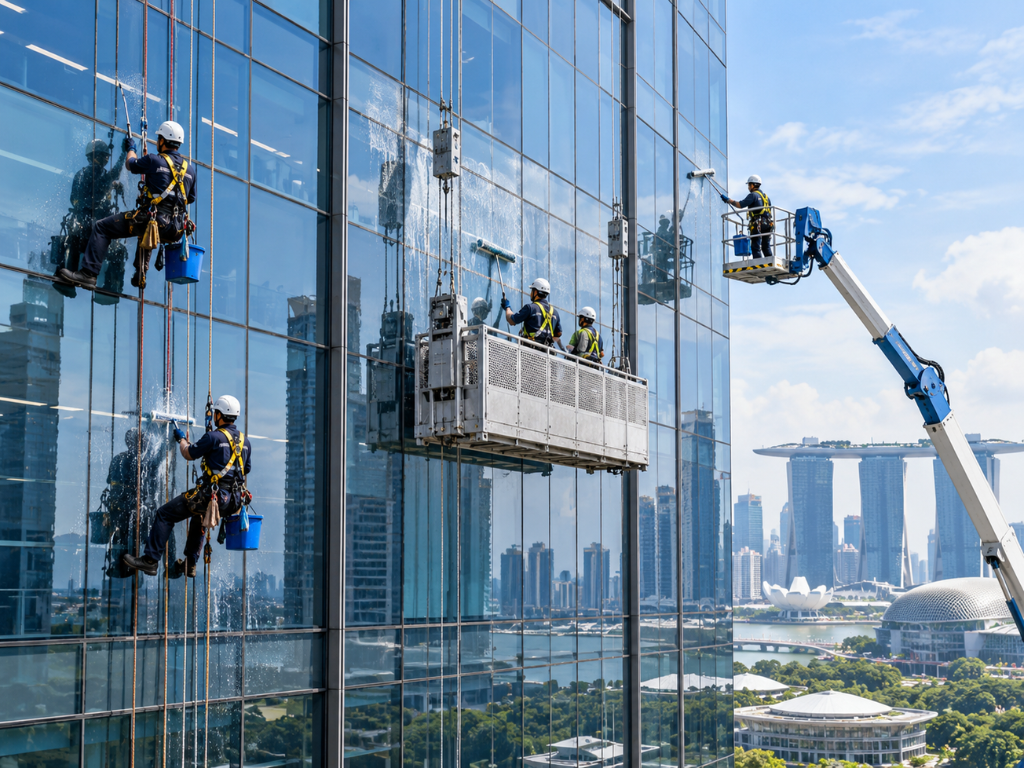
Rope access facade cleaning in Singapore uses IRATA-certified technicians on two independent ropes anchored at roof level, with no cradle, track or machine. It competes with gondolas and boom lifts on most facade tenders, and falls from height sat among MOM’s top three causes of 36 workplace deaths in 2025. Below, we compare the three on reach, set-up, wind limits and cost per drop. All three sit within our specialist commercial cleaning services.
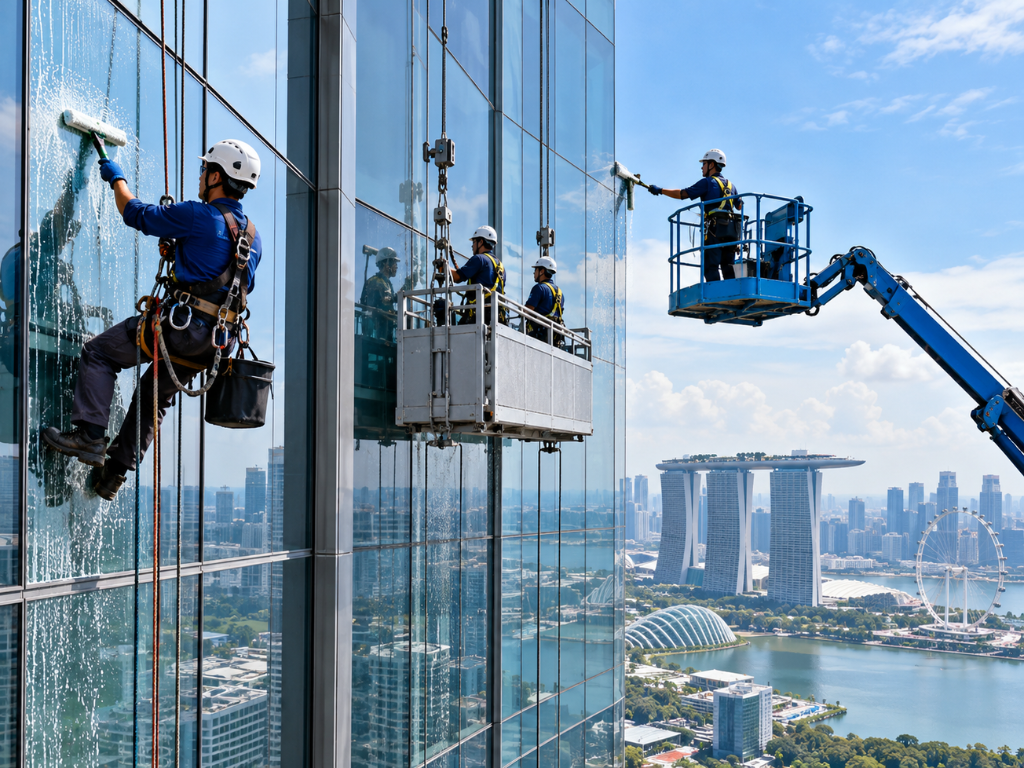
Set-up is the row that decides cost.
How are skyscraper windows cleaned in Singapore?
Skyscraper windows in Singapore are cleaned from one of three platforms: a cradle hung from the roof, a technician on ropes, or a boom lift working from the ground. A building maintenance unit (BMU) is a permanent roof machine that lowers a cradle on steel wire ropes. A temporary gondola does the same job from outriggers bolted or weighted on the roof. Both count as suspended scaffolds, and SS 598:2014, the Singapore code of practice for suspended scaffolds, covers permanent and temporary equipment alike. Rope access is a work-positioning method governed by IRATA’s two-rope system and by SS 588, the Singapore Standard for rope access systems. A boom lift is a mobile elevating work platform (MEWP) under SS 616. Older commercial blocks often have neither a BMU nor rated anchors, and they are the same buildings now entering inspection. BCA estimated about 30,000 buildings would fall within the first seven-year Periodic Facade Inspection cycle that started on 1 January 2022. Inspectors need the same access as cleaners, which is why facade upkeep as a risk management duty belongs in the same budget line as inspection.
How do rope access, gondola and boom lift compare side by side?
Rope access wins on awkward geometry and quick set-up, and a gondola wins on large runs of repetitive glass. A boom lift is the narrower tool: it only works where the ground can carry it within reach of the facade.| Attribute | Rope access | Gondola / BMU | Boom lift (MEWP) |
| Height range | Any height with rated roof anchors | Mid to high-rise; BMU only where installed | Platform height up to 56.57 m on the largest self-propelled unit (JLG 1850SJ) |
| Best facade type | Recesses, fins, curves, canopies, balconies | Flat, repetitive curtain wall | Podiums, canopies, low-rise cladding, atrium edges |
| Set-up | Anchor checks, two lines per technician, exclusion zone below | Temporary: PE-designed outriggers, PE inspection, AE test, Approved Scaffold Contractor install | Delivery, ground or slab check, stabilised machine |
| People certification | IRATA Level 1 to 3, Level 3 supervising | ASC erectors and supervisor, trained cradle operator | Operator trained by an MOM Accredited Training Provider for that MEWP type |
| Wind limit | Set in the method statement and supervisor’s judgement | Manufacturer’s in-service limit on the data plate | 12.5 m/s (45 km/h) at the platform for outdoor-rated units under EN 280 |
| Ground footprint | Small, plus a barricaded drop zone | Roof rigging plus a landing zone for the cradle | 27-tonne class machine on hard standing |
| Main weakness | Slow on very large flat elevations | Cannot reach recesses; high rigging cost | Limited reach; ground loading |
When does rope access facade cleaning make the most sense?
Rope access facade cleaning makes the most sense when the building has no working BMU, when the facade has recesses, fins or curves a cradle cannot follow, or when the job is too small to justify rigging a gondola. In Singapore that describes many mid-rise offices, older hotels and mall frontages with feature cladding. Anchors are the constraint. Under SS 570, a single-point anchor device is designed for one person, and each technician works on a working line plus a separate safety line. A team of four therefore needs at least eight rated anchors in position, plus a rescue anchor that nobody is hanging from. Malls add a second problem: podium roof rigging. A drop from the tower roof often ends on the podium, where the team re-rigs from podium anchors to reach street level. Our Orchard Central exterior cleaning project lists rope access and water-fed poles among the methods used on a mixed-height frontage. Where this breaks down is a large, flat curtain wall: one technician cleans one vertical strip at a time, and a cradle carrying two cleaners covers more glass per hour.What certification should a rope access team hold in Singapore?
A rope access team in Singapore should hold IRATA certification, with at least one IRATA Level 3 technician supervising on site, and each worker needs the work-at-height training the WSH (Work at Heights) Regulations 2013 require. Ask for certificate numbers and check them on the IRATA register. IRATA also publishes incident data. The IRATA Work and Safety Analysis 2025 covers 33,665,594 hours worked by member companies in 2024 and 279 incident reports. The leading immediate cause was falling or dropped objects, at 59 reports. David Thomas, the report’s independent reviewer, described the persistent causes as a sign of “a gap between published guidance and frontline adoption.” On a Singapore mall or tower, that means tethered tools and a barricaded zone under every drop, including covered walkways.When is a gondola or BMU the better choice?
Gondola cleaning in Singapore is the better choice when the building already has a certified BMU that reaches every face, or when the facade is large, flat and repetitive enough that one cradle can work for days without re-rigging. The cradle also gives workers a guardrailed platform. Temporary gondolas got more expensive to do properly in 2025. The joint MOM and BCA circular on outriggers for suspended scaffolds, MOM/OSHD/2025-02 dated 10 January 2025, requires a Professional Engineer to design every outrigger or overhead support, with calculations. Outriggers cannot sit on brick or block parapets, thin walls or sloping parapets unless the PE has verified them. Tie-backs must anchor to roof beams or internal columns, and never to solar panels or M&E plant. The PE then issues a Certificate of Inspection for each outrigger design on each worksite, and the Authorised Examiner will not certify a gondola without that PE design. On an older block with brick parapets and a rooftop solar array, those rules can turn a cheap temporary gondola into an engineering project.How high can a boom lift reach for facade cleaning?
The largest self-propelled telescopic boom lift, the JLG 1850SJ, reaches a platform height of 56.57 m with 24.38 m of horizontal outreach, but most Singapore facade jobs use far smaller machines on the lower storeys. The limits that bite first are ground loading and site access. The 1850SJ weighs about 27,350 kg with a maximum ground bearing pressure of 8.38 kg/cm². On a driveway over a basement car park, that load needs a structural check before the machine drives on. Each operator needs training from an MOM Accredited Training Provider for the specific MEWP type, and the machine needs periodic examination by an Authorised Examiner. Boom lifts are most useful on podium canopies, atrium glass, low-rise cladding and the first 15 to 20 metres of a tower. A boom lift also needs a plan for what happens at the top. The WSH Council’s advisory on fatal falls in the second half of 2025 describes a worker who reached a roof by boom lift on 30 August 2025, worked with his harness unclipped because the roof had no suitable anchor points, and fell through a skylight.What are MOM’s working at height requirements for facade cleaning?
MOM’s working at height requirements for facade cleaning come from the WSH (Work at Heights) Regulations 2013: avoid work at height where reasonably practicable, run a site-specific fall prevention plan, train and supervise workers, and use a permit-to-work for hazardous work where a person could fall more than 3 metres. Breaches carry fines of up to S$20,000 or imprisonment. The first rule shapes method choice. The regulations start with avoidance, and the WSH Council’s code of practice then favours platforms with guardrails over personal fall protection. Rope access relies entirely on personal equipment, so the method statement should justify it by geometry. On complex facades it passes that test, because no platform reaches safely. The MOM Workplace Safety and Health Report 2025 records 36 workplace fatalities in 2025, with vehicular incidents, falls from height and structural collapse accounting for 78% of them. In construction alone, falls from height caused 43 fatal and major injuries that year. Those facade cleaning safety requirements explain why the risks of unqualified high-rise contractors fall on the building owner as well as the firm on the rope.Does facade cleaning need a permit to work?
Facade cleaning legally needs a permit-to-work when it happens at a workplace listed in the First Schedule of the Work at Heights Regulations, mainly factories, and a person could fall more than 3 metres. Factories and construction worksites are inside that list; occupied office towers and malls usually are not. Building managers of occupied towers can impose their own permit system by contract. We recommend a permit on every drop, whatever the legal trigger: the supervisor applies, a WAH Safety Assessor checks anchors, weather and exclusion zones, and an Authorised Manager signs. For factory facades, the same logic sits inside the broader WSH rules for factory cleaning.How does wind loading change the choice in Singapore?
Wind sets a hard stop for every access method, and Singapore’s Sumatra squalls regularly blow past the limit for boom lifts. An outdoor-rated MEWP under EN 280 is designed for 12.5 m/s, about 45 km/h, measured at the platform. The Meteorological Service Singapore describes Sumatra squalls as bringing gusts of 40 to 80 km/h, usually in the predawn hours and morning, and most often between April and November. On 24 October 2025, a squall produced a gust of 83.2 km/h at Semakau Island, the highest of the year to that date according to NEA. IPAF notes that wind at 20 metres can be 50% stronger than at street level, and gaps between towers funnel it. Cradles act as sails in those gusts and rope technicians swing. No method has a single legal wind limit in Singapore, so the number belongs in the method statement, measured by anemometer at working height. Morning starts suit Singapore’s heat but overlap with squall timing, so the supervisor checks the MSS forecast at the rigging briefing.Which method costs less per drop?
Rope access usually has the lowest access cost per drop on small or complex facades, while a gondola or BMU wins on large repetitive elevations once rigging is paid for. A boom lift is charged by the day, however many panels it reaches. A drop is one vertical strip cleaned from a single rig position, usually one or two glass panels wide. Access cost per drop is the fixed cost of getting people onto the facade (anchor inspection, gondola design and certification, machine hire and transport) divided by the number of drops cleaned. For a temporary gondola, that now includes PE outrigger design, a PE Certificate of Inspection and an Authorised Examiner test. If that set-up costs the same as ten rope drops, the gondola only pays back on elevations with well over ten drops of uniform glass. A building with a certified BMU has already paid its capital cost, so its reachable faces are almost always cheapest by BMU. Ask for quotes that separate access cost from cleaning labour; bundled quotes hide the difference between a brick-parapet block and a tower with a working BMU.How should a building manager choose a facade access method?
A building manager should choose the method by answering five questions in order, starting at the roof and ending at the pavement. Price comes last.- Is there a BMU with a current Authorised Examiner certificate, and does it reach every elevation?
- Is the facade flat and repetitive, or broken up by recesses, fins, canopies and balconies?
- Can the roof take anchors or outriggers, given the parapet construction, solar panels and M&E plant?
- What sits under the drop: a podium roof, a covered walkway, a taxi stand, or a driveway over a basement slab?
- When can the work run, given tenant hours, security and the squall season?