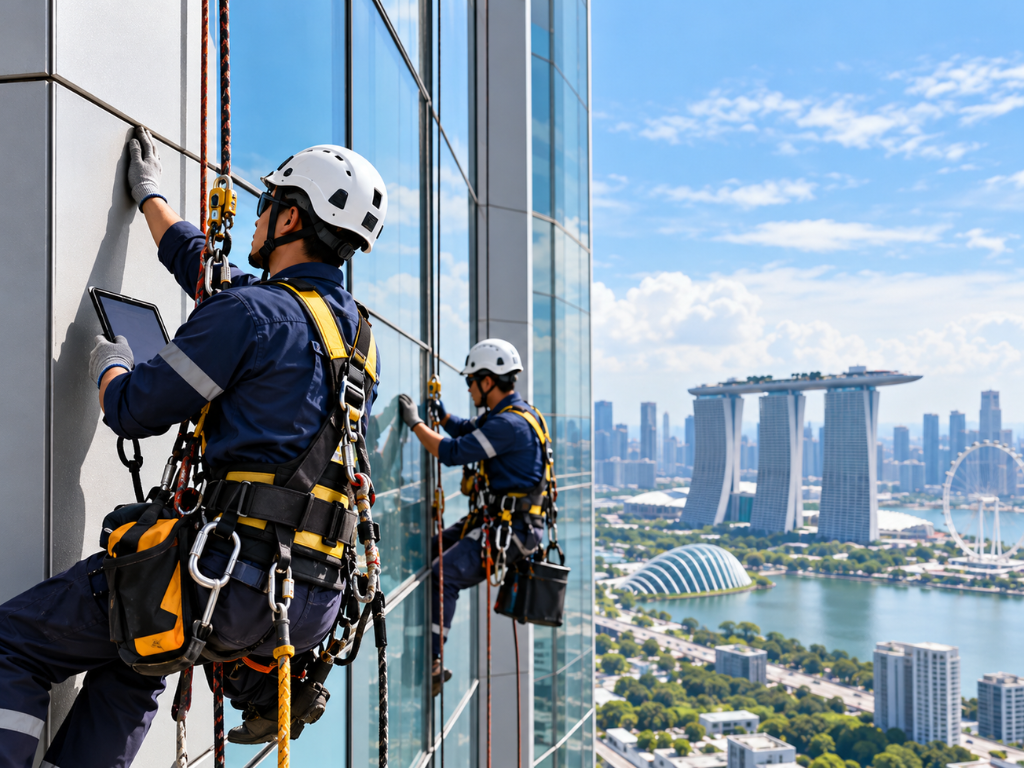
The BCA periodic facade inspection is a mandatory check, every seven years, of any Singapore building taller than 13 metres and older than 20 years, carried out by a Competent Person who must hand-test at least 10% of each elevation. About 30,000 buildings fall into the first cycle, which began in January 2022. Below, we set out what the inspection requires and where commercial facade cleaning services fit.

Which buildings need a BCA periodic facade inspection, and how often?
Every building more than 20 years old whose highest point sits above 13 metres needs a periodic facade inspection every seven years. Detached, semi-detached and terraced houses used as homes are exempt, and so are temporary buildings. The duty comes from Part 5 of the Building Control Act 1989 and the Building Control (Periodic Inspection of Buildings and Building Facades) Regulations 2021. BCA serves a PFI notice on the owner when the building falls due, and it sends an advisory about a year earlier so management corporations can budget. After the notice arrives, the owner has two months to appoint a Competent Person. Missing that deadline carries a fine of up to S$20,000. The seven-year interval was a deliberate choice. When the regime went to Parliament in March 2020, then Minister of State for National Development Zaqy Mohamad said it matched the expected lifespan of some facade materials and the typical Repair and Redecoration cycle of HDB estates and condominiums. The risk shows up in BCA’s own FAQ, which records more than 20 fallen facade incidents reported every year.
Who is allowed to carry out the inspection?
Only a Competent Person can carry out a periodic facade inspection: a Professional Engineer or Registered Architect who has passed the Certificate in Facade Inspection course run by BCA Academy and IES Academy. The owner picks one from the list BCA publishes. The Competent Person can bring in an accredited Facade Inspector, usually a Resident Engineer or Resident Technical Officer, but that inspector works under the Competent Person’s direct supervision and control. The Competent Person must be present, plans the inspection methodology and risk assessment, and signs the report. A Competent Person who fails to inspect in line with the Act and Regulations faces a fine of up to S$50,000. No cleaning contractor, rope access team or gondola supplier can sign off a PFI, however experienced the crew. Their job is access, preparation and observation. Done well, each of those saves the Competent Person time on site.What does a periodic facade inspection actually involve?
A periodic facade inspection has two mandatory stages: a full visual inspection of every elevation, followed by a close-range inspection with physical contact covering at least 10% of the surface area of each elevation. Where those stages show systemic defects, a third stage, the full facade investigation, follows with BCA approval. The visual stage uses binoculars and cameras from ground level or vantage points. Drones need the Commissioner of Building Control’s approval and follow TR 78, with BCA urging owners to use accredited UAS service providers; infrared thermography follows TR 119:2024. The BCA PFI Guidelines for Competent Persons recommend a photo ground sampling distance of 0.15 cm per pixel, which is fine enough to show hairline cracks. The close-range stage is hands-on. Inspectors tap plaster and tiles with a tapping rod or rubber mallet to find hollowness, and push a borescope behind cladding to check concealed brackets. Recessed areas count towards each elevation’s surface area, and so do the undersides of sky-bridges and cantilevered floors. The Competent Person spreads the sample around the perimeter, weights it towards areas above heavy footfall, and picks different areas from the previous cycle.Which defects does the Competent Person look for?
The Competent Person looks for anything that could let a facade element fall: spalling concrete, bulging or hollow plaster, loose tiles and bricks, sealant failure, corroded brackets and railings, and missing or loose fixings. Water ingress behind any of these speeds the damage up. BCA’s recent research on Singapore’s climate sharpens the priority list. The PFI Guidelines report that tile adhesive has a lower-bound service life of only 10 years under projected climate stress, a reduction of up to 30%, and aluminium rivets drop to about 22 years. Weather sealant and plaster showed little degradation in the same study. A 25-year-old block with a tiled facade deserves more attention than its age alone suggests.What happens after the inspection report is submitted?
After the inspection, the Competent Person submits the report to BCA through CORENET, BCA vets it, and the owner must carry out any rectification works within the period BCA specifies. The Competent Person then certifies completion using BCA’s Completion of Remedial Works report template. If the Competent Person finds an unsafe defect at any point, the Commissioner of Building Control must be told immediately and the area made safe, usually with a cordon or temporary hoarding. Repairs that touch structural elements need a Professional Engineer and a permit to commence works. BCA’s PFI FAQ is blunt that owners cannot be exempted from the repairs once a notice is served. Rectification is where facade budgets break, and BCA’s June 2025 circular to owners notes that early intervention through routine maintenance is often more cost-effective. A loose tile logged in year three costs less to fix than the same tile found in year seven.Does facade cleaning count towards the periodic facade inspection?
Facade cleaning does not count as a periodic facade inspection, and no amount of washing replaces the Competent Person’s report. Cleaning is still a legal duty in its own right, and it shares the most expensive part of the inspection: access. Since 1 October 2025, maintenance duties sit in Part 4A of the Building Control Act. Section 25E lets the Commissioner of Building Control issue a notice to maintain where a building has not been kept in good and serviceable repair “or in a proper and clean condition”, so a dirty facade is an enforceable maintenance failure. The government framed cleaning this way from the start. Introducing the PFI regime in 2020, Zaqy Mohamad said the general maintenance already carried out on facades “can include simple rectifications, general cleaning as well as painting of external walls.” Access is the practical link. BCA’s PFI FAQ tells owners to provide the access system for the close-range inspection, whether a gondola, a mobile elevating work platform or scaffold. We recommend booking facade cleaning, inspection and repair on the same rigging, so the building pays for one set of gondola certification or rope access set-up. Shared access is the main argument for treating facade cleaning as risk management.Should a building facade be cleaned before the inspection?
A building facade should be cleaned before the close-range inspection, but only after the Competent Person or a drone survey has seen the facade dirty. Grime hides hairline cracks, while some staining is itself evidence. Algae, soot and water marks make fine cracks invisible at 0.15 cm per pixel, so a washed facade gives the Competent Person better photographs and cleaner tapping surfaces. The exception is staining that points to a defect: rust streaks below corroding brackets, white efflorescence where water is getting through, and dark runs under failing sealant joints. Washing those off before anyone records them erases the clues. The sequence that works is a first visual pass on the dirty facade, a cleaning crew that photographs and logs tell-tale stains by drop, then the wash, then close-range work. Cleaning methods matter as much as timing. BCA’s February 2026 facade maintenance seminar showed damaged fixtures on a list of common defects and noted they could be caused by cleaning works. High-pressure jets on sealant joints and tile grout do real damage, which is one of the risks of unqualified high-rise contractors that shows up in the next inspection report.How often should a building facade be cleaned in Singapore?
No Singapore regulation sets a facade cleaning frequency, so the schedule should follow exposure and building age. Glass on an expressway frontage or beside a construction site soils faster than a tiled facade facing a park. BCA has given a clear signal on age. Its November 2025 advisory told Town Councils to self-inspect at least once every six months, especially for buildings 30 years or older. We recommend matching that rhythm on commercial buildings of the same age: two cleaning cycles a year, with the crew on the facade logging cracks, loose tiles and sealant gaps as they go, so each wash doubles as an off-cycle visual check. Newer glass towers can run a cleaning schedule set by appearance, with at least one full wash timed ahead of each seven-year inspection. The building exterior cleaning schedule should also avoid clashing with Repair and Redecoration. Zaqy Mohamad’s 2020 speech tied the seven-year PFI cycle to typical R&R cycles, which makes the year before R&R the natural point for a deep facade clean and a defect log.What facade maintenance requirements apply between inspections in Singapore?
Between inspections, owners must keep exterior features securely fixed and the building in a proper and clean condition under Part 4A of the Building Control Act, and must report any fallen exterior feature to BCA within six hours. Failing to keep an exterior feature securely fixed carries a fine of up to S$20,000, up to 12 months’ jail, or both. The six-hour rule comes from the Building Control (Reportable Matters) Regulations 2025, in force since 1 October 2025. The owner calls BCA’s safety incident hotline, then files the FormSG report within 24 hours. BCA has also pushed owners towards inspections between PFI cycles. Its June 2025 circular to building owners singled out buildings 30 years or older, where moisture ingress speeds carbonation and spalling, and asked owners to keep maintenance records. BCA’s high-risk zones for these off-cycle checks are roof edges, tile, board, brick and stone cladding, corners where facade systems meet, and anything above entrances and covered walkways. A facade cleaning crew passes every one of those zones on every drop.How should facade cleaning fit the seven-year PFI cycle?
Facade cleaning fits the seven-year cycle at five points, from routine washes through to post-repair handover. Treat the cleaning contract as part of the inspection programme and the costs of access, preparation and documentation fall.- Years 1 to 6: routine cleaning cycles, with the crew logging defects by drop and photograph.
- Advisory year: BCA’s advisory arrives about 12 months ahead, so book the Competent Person and agree the pre-inspection cleaning plan with them.
- Inspection year, first pass: the Competent Person or an accredited drone provider surveys the facade before washing, while the cleaning crew records staining.
- Inspection year, close-range: wash the elevations, then run close-range work from the same gondola or rope rigging.
- Rectification: clean repaired areas and supply completion photographs for the Competent Person’s Completion of Remedial Works report.