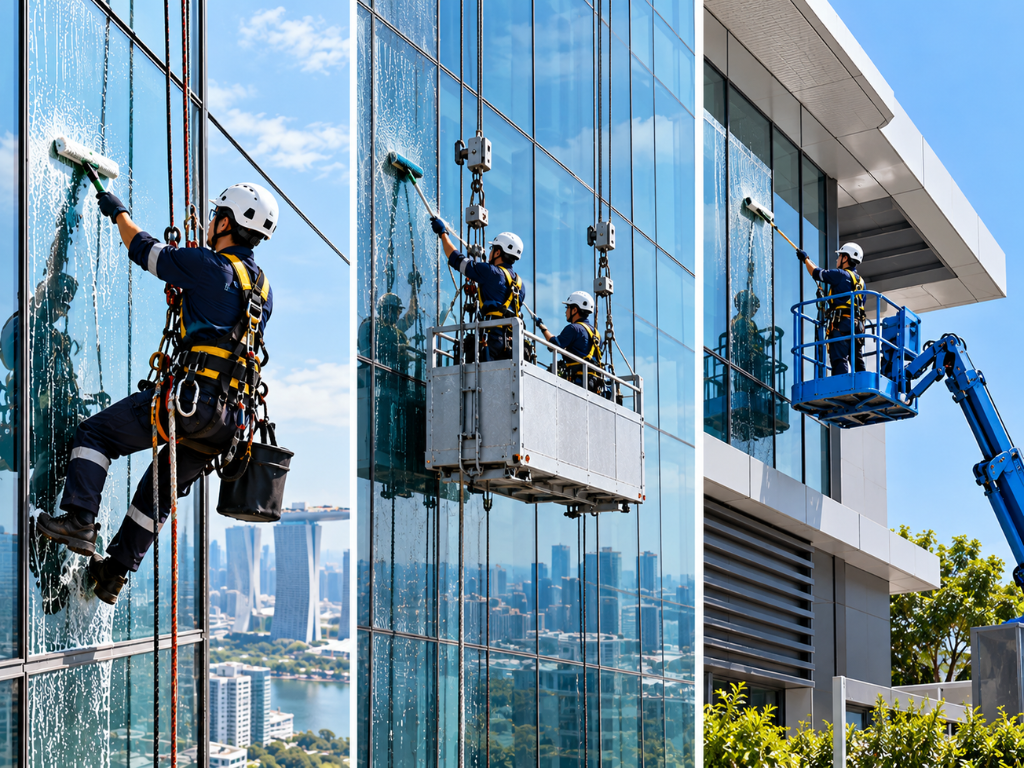
Glass facade cleaning in Singapore removes soot, mineral spotting and biofilm from curtain wall glass with purified water, pH-neutral detergent and tools matched to the coating, frame and silicone sealant around each pane. Singapore tap water carries 72 to 354 mg/L of dissolved solids, so rinse water alone can leave spots. Below, we set out the method for glass, cladding and concrete used in our commercial facade cleaning services.
The table gives the limits. The sections below explain when a crew should stop.

Which cleaning method suits each facade surface?
Each facade surface needs its own water, chemistry and pressure: glass takes purified water and soft tools, aluminium cladding takes pH-neutral detergent at low pressure, and concrete takes biocide with a controlled rinse. Most buildings combine all three, so the method changes drop by drop.| Surface | Water and tools | Detergent | Pressure | Main risk |
| Glass curtain wall | DI water through a water-fed pole, or strip washer and squeegee from rope or BMU | Mild, non-abrasive glass solution | Rinse only | Scratched heat-treated glass, spotting, damaged coatings |
| ACM and painted aluminium (PVDF) | Soft brush or low-pressure rinse, top down | pH 6 to 7, no more than 10% dilution (ALUCOBOND guidance) | Max 50 bar (ALUCOBOND guidance) | Blemishes on panels above 40°C, solvent damage to sealant |
| Anodised aluminium | Soft brush, clean water rinse | Mild, pH-neutral; no alkaline cleaners | Moderate rinse | Etching from alkaline run-off |
| Painted concrete and render | Biocide application, dwell, brush, rinse | Biocide plus neutral detergent | Low; no direct jet at cracks | Stripping the biocide-bearing paint film, driving water into cracks |
| Tiled and stone facades | Brush and rinse | pH-neutral; no acid on grout or stone | Low; no jet at grout lines | Loosening tiles on ageing adhesive |
How is a glass curtain wall cleaned in Singapore?
A glass curtain wall in Singapore is cleaned top down with a mild, non-abrasive solution applied by strip washer or brush, then squeegeed or rinsed with purified water, working from a BMU, gondola, rope access or a water-fed pole on lower levels. The crew identifies the glass type first, because reflective and low-e coatings scratch far more visibly than clear glass. The industry’s glass cleaning bulletin, first issued by GANA in 2000 and updated by the National Glass Association in December 2023, asks cleaners to check whether glass is clear, tinted or reflective before starting, to keep metal parts of equipment off the glass, and to dry cleaning solution off gaskets, sealants and frames. The GANA and IWCA version of that guidance treats twice-yearly cleaning as generally sufficient, with more frequent cleaning where pollution is heavy. Expressway-facing towers in Singapore sit firmly in that second group. Heat-treated glass needs the most care. Scraping tempered panels with a blade has caused so many scratch disputes that the International Window Cleaning Association funded studies at Penn State University on the cause. Paul West, IWCA past president and chair of its glass committee, said the industry is now better placed to educate contractors and owners on “proper storage, protection during all phases of construction, and initial cleaning techniques.” On occupied buildings, our rule is simple: no blades on heat-treated glass during routine maintenance.Why does facade glass stay spotty after cleaning?
Facade glass stays spotty when rinse water dries with minerals in it or when detergent residue is left behind. PUB’s 2023 drinking water quality report puts total dissolved solids in Singapore tap water at an average of 110 mg/L, and every drop that evaporates on glass leaves that load behind. Deionised (DI) water fixes this. A water-fed pole system filters tap water through reverse osmosis or resin until almost nothing is dissolved in it, so the glass dries clear without squeegeeing. DI water works best on routine soil. Cement splash, sealant smears and paint overspray still need hand treatment by a trained crew.How do you clean ACM and aluminium cladding without damaging the finish?
ACM cladding is cleaned with clear water and a pH-neutral detergent, by soft brush or a pressure washer set no higher than 50 bar, working from the top down and rinsing all residue away. Those are the limits in 3A Composites’ ALUCOBOND guidance, which also caps detergent at 10% and bans cleaning on panels heated by the sun above 40°C. The 40°C rule matters more in Singapore than almost anywhere. A dark PVDF-coated panel on a west elevation reaches that temperature quickly on a clear afternoon, and fast-drying detergent leaves marks that do not wash out. Clean the shaded elevations and follow the shade around the building. AAMA 609 and 610, the aluminium cleaning guide from what is now the Fenestration and Glazing Industry Alliance, gives the same instruction and was reissued as the 609 and 610-25 edition in 2025. Anodised aluminium reacts differently. AAMA warns that mortar, cement and other alkaline materials corrode anodic coatings quickly if they dry on the metal, so alkaline run-off from concrete above is the real threat to anodised mullions. The same guide notes that solvents damage sealants, gaskets and painted finishes, and that sheltered soffits and the undersides of fascia panels soil fastest because rain never reaches them.How do you clean a concrete or painted facade?
A concrete or painted facade is cleaned by applying a biocide, letting it dwell, brushing, then rinsing at low pressure, with no direct jet on cracks or failing paint. The paint film is part of the protection, so the method must clean it without stripping it. Most Singapore concrete facades are rendered and painted. MND’s February 2023 written answer on mould at Anchorvale Parkview and Matilda Court states that HDB blocks use one coat of water-based sealer to Singapore Standard 579 and two coats of algae-resistant emulsion paint to SS 345, and that the paint contains biocide. MND notes the same system is common on public and private projects. High pressure strips that film and shortens the repaint cycle. The recommended Repair and Redecoration schedule for Town Councils is seven years, and a facade cleaned too hard reaches the end of its paint life well before that. Tiled facades need extra restraint. BCA’s research, published in its PFI Guidelines for Competent Persons, found that tile adhesive has a lower-bound service life of only 10 years under projected climate stress, and jetting water at grout lines on an ageing tiled facade is how loose tiles become fallen tiles.How do you remove algae and black streaks from a facade?
Black and green streaks on Singapore facades are mostly cyanobacteria, algae and fungi growing in a biofilm, and water alone will not remove them for long. They need a biocide, time to work, then a gentle rinse. A study of 230 building biofilms across Europe and Latin America, published by Christine and Peter Gaylarde in 2005, found cyanobacteria were the main biomass in tropical Latin America, while fungi were far more common on painted surfaces (40%) than on other substrates (12%). Singapore’s climate matches the tropical pattern. Pressure-washing biofilm off render without a biocide gives a clean-looking wall for a few weeks, then the growth returns from spores left in the pores.Is high pressure water jet cleaning safe for building facades?
High pressure water jet cleaning is safe on some facade surfaces and damaging on others: it has no place on glass, is capped at 50 bar on ACM under ALUCOBOND guidance, and must never be aimed at silicone sealant joints, grout lines or cracked concrete. Pressure should be set per surface, drop by drop. The damage is not always visible on the day. Water forced past a weather seal ends up behind the cladding, and a jet across a failing sealant joint opens it further. BCA’s February 2026 seminar on facade maintenance listed damaged fixtures among common facade defects and noted they could be caused by cleaning works. That risk is why unqualified high-rise contractors cost owners more than their quote suggests. Our Orchard Central exterior cleaning project lists soft washing for delicate surfaces alongside high-pressure washing for this reason: a mixed-material frontage needs both.How do you stop streaking and run-off damage on a facade?
Streaking and run-off damage stop when the crew sequences surfaces correctly and rinses lower areas the moment cleaner runs down onto them. AAMA’s guide recommends cleaning from the bottom up and rinsing from the top down, and flushing each drop with water at the start and end. Sequence matters on mixed facades. Concrete, render and stone produce alkaline run-off, and glass guidance from the National Glass Association singles out concrete or mortar slurry on glass as especially damaging. Clean concrete bands, cladding and stone first, then finish each drop on the glass, with a rinse crew below catching run-off before it dries. Wind moves solution sideways too, so work downwind of cleaned glass. Finish every drop with a DI water rinse on the glass once the run-off has been cleared, so the final water to dry on the pane carries no minerals and no detergent.