Cleaning Services

Commercial Grounds Maintenance Singapore: 2026 Scope & Costs

Commercial Grounds Maintenance Singapore: 2026 Scope & Costs
Commercial grounds maintenance in Singapore is the scheduled care of a property’s softscape and hardscape, from turf, shrubs and trees to paths, drains and irrigation, by a horticultural team working to fixed frequencies. From 1 July 2026, the Progressive Wage Model sets that team’s entry wage at S$2,095 a month. Below, we set out the scope, frequencies and contract terms. Grounds work often sits alongside our commercial cleaning and facility services.
What does commercial grounds maintenance cover in Singapore?

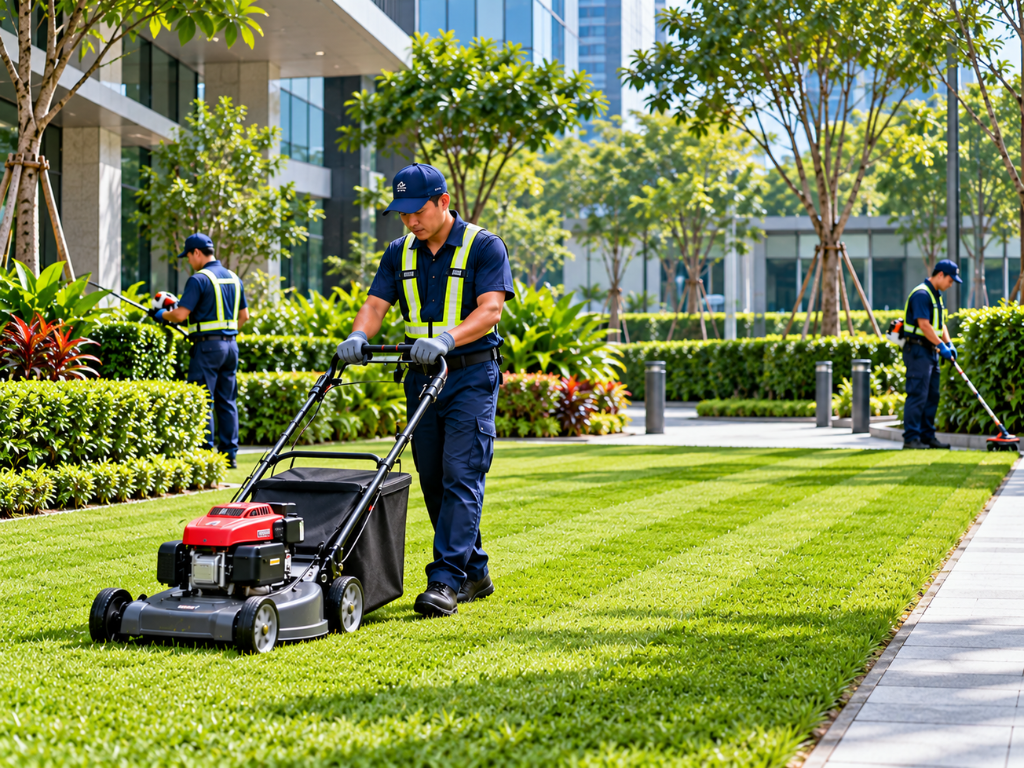
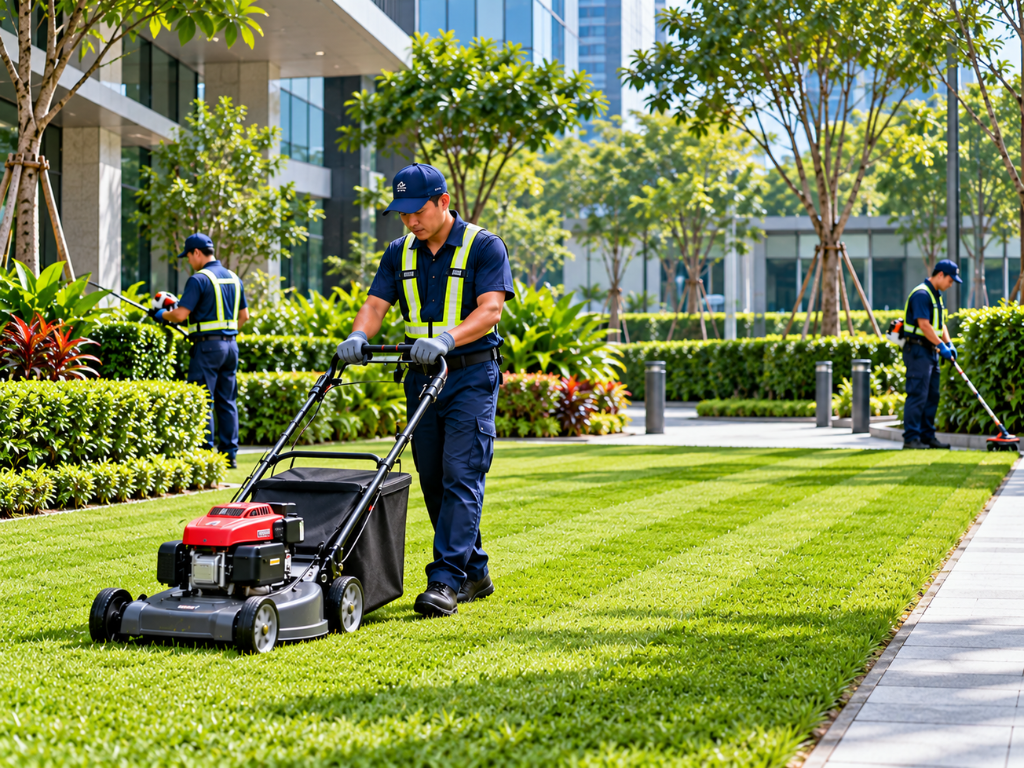
Commercial grounds maintenance covers the softscape, meaning turf, shrubs, groundcover, planter boxes and trees, and the hardscape around it, meaning paths, drains, scupper gratings, water features and irrigation lines. Most contracts add debris clearance, horticultural waste disposal, and pest and disease control for plants. The work splits by skill. Watering, weeding, basic pruning, soil aeration and clearing horticultural waste are general landscape duties. Fertiliser and pesticide treatment and operating motorised equipment such as mowers and hedge trimmers sit one level up; MOM’s Progressive Wage Model job descriptions assign them to landscape technicians. Tree work above basic pruning needs an arborist, and any felling of a large tree in a Tree Conservation Area needs NParks approval. What falls outside a maintenance contract matters as much. Major replanting, new landscape installation and large tree removal are projects, priced separately. Trouble starts with a contract that says “general landscape maintenance” and nothing more. The first dead hedge becomes an argument about whether replacement plants were included. Hong Ye Group’s landscaping services for facilities cover grounds maintenance, irrigation management, seasonal planting, and pest, weed and disease control as four separate lines for that reason. What does commercial grounds maintenance cover in Singapore?

How often should each grounds maintenance task be done?

Grounds maintenance in Singapore runs year-round because tropical plants have no dormant season: debris clearance daily, turf cutting every two to three weeks, shrub pruning monthly, fertilising quarterly, and tree pruning at least once or twice a year ahead of the monsoons. Irrigation needs a weekly check and a monthly functional test. The tree timing follows NParks practice. NParks told Parliament in 2018 that roadside trees are pruned at least once or twice a year before the monsoon seasons, depending on species, and it advises Town Councils to step up tree checks before each monsoon. Commercial sites face the same wind loads from the Northeast Monsoon starting in December and Sumatra squalls from April to November.
Task Recommended frequency Done by
Debris and leaf litter clearance Daily on frontages; weekly elsewhere Landscape worker
Turf cutting and edging Every 2 to 3 weeks Landscape technician (motorised equipment)
Shrub and hedge pruning Monthly Landscape worker or technician
Fertilising schedule Quarterly Landscape technician
Pest and disease control for plants Monthly inspection, treatment as needed Landscape technician
Irrigation check Weekly visual, monthly functional test Landscape technician
Tree pruning Once or twice a year, before monsoons Arborist-led team
Tree inspection Yearly by a certified arborist; after storms Certified arborist
These are Hong Ye Group’s recommended baselines for commercial frontages. Exposure and planting design change them, and a contract should name the frequency for each zone.

Who is responsible for trees on commercial property, and when do you need NParks approval?

The property owner is responsible for trees on private commercial land, and NParks approval is needed before cutting any tree with a girth above one metre, measured half a metre from the ground, if it stands in a Tree Conservation Area or on vacant land. Cutting or damaging such a tree without approval carries a fine of up to S$50,000 under the Parks and Trees Act. The two Tree Conservation Areas cover about 4,700 hectares in the south-central region and 200 hectares in Changi, and the rule applies to private land even when no development work is under way. Owners can check whether a site falls inside either TCA on NParks’ trees.sg map before approving any pruning plan for a large tree. NParks manages public trees only, so its inspection regime is a benchmark for private owners to match. Trees on public land are inspected every six to 24 months by trained inspectors, with trees near heavy pedestrian or traffic areas checked most often. Tree failures on NParks land fell to 430 in 2023, 65% below the 1,250 recorded in 2014, according to a written parliamentary reply from Desmond Lee. After a fatal tree failure in 2021, Lee told Parliament that any death or injury from a fallen tree is “one too many”. A commercial owner should hold at least a yearly arborist inspection on record for every mature tree near a walkway, car park or drop-off.

What should a landscape maintenance contract include?

A landscape maintenance contract should include a scope schedule by zone, a frequency for every task, the job level and headcount deployed, a named site supervisor, horticultural waste disposal, plant replacement terms and a variation clause. Anything left unwritten becomes an extra later. The job level line matters most. Under the Progressive Wage Model, a landscape worker handles basic duties, while fertiliser, pesticide and machinery work belongs to a landscape technician or above. A contract that prices four “landscape workers” and then expects mowing and pesticide application has either misstated the team or underpriced it. Write the deployment as a table: job level, headcount, days and hours. Plant replacement is the second fault line. State which plants the contractor replaces at its own cost, usually losses caused by neglect or its own equipment, and which the owner pays for, such as losses from storms, vandalism or construction. Horticultural waste needs its own line too, since disposal is charged by weight. The logic mirrors how periodic works and contract variations should be written into a cleaning contract: every recurring task gets a frequency, and every change goes through a written variation.

What does commercial grounds maintenance cost in 2026, and why did it rise?

Grounds maintenance costs rose in 2026 because the Progressive Wage Model raised landscape wage floors on 1 July 2026, and labour is the largest line in any maintenance contract. The new floor is S$2,095 a month for a landscape worker, S$2,490 for a landscape technician, S$2,685 for an assistant landscape supervisor and S$3,060 for a landscape supervisor. MOM’s landscape sector wage schedule raises those floors every July until 2028, when the worker floor reaches S$2,385. Eligible employees also receive a PWM bonus of at least two weeks’ basic wages each year. The model is a registration condition for NParks’ Landscape Company Register, so a registered contractor cannot pay resident staff below it. Two quotes for the same site often differ by the job level mix. A quote built on landscape workers at S$2,095 undercuts one built on technicians at S$2,490, but only the second matches the PWM job description for mowing and pesticide work. The same wage floor logic drives office cleaning costs in 2026. 

How do you choose a landscape maintenance contractor in Singapore?

Choose a landscape maintenance contractor registered on NParks’ Landscape Company Register, paying PWM wages, with a certified arborist on staff or on call, and a site supervisor who reports on a fixed schedule. Registration, wages and arborist access are all checkable before you sign. Ask for the LCR registration, the PWM job levels of the proposed team, the arborist’s certification, and sample monthly reports with photographs. Check public liability insurance covers tree work and work near vehicles, because a falling branch on a tenant’s car is a common claim on commercial grounds. The broader checks for choosing a commercial contractor, such as bizSAFE status and licence validity, apply here too. The lowest monthly quote often leaves out the arborist. Pruning large trees without one is how rain trees end up lopsided and storm-prone, and the repair costs more than a year of arborist visits.

How does grounds maintenance help prevent dengue on commercial premises?

Grounds maintenance prevents dengue by removing the stagnant water that Aedes mosquitoes breed in: clogged drains and scuppers, flowerpot plates, hardened soil, tree holes and leaf litter trapping rainwater. A grounds team that clears these on every visit is the first line of vector control on a commercial site. The risk is current. NEA’s inspections in 2025 found 20,469 mosquito breeding habitats, Singapore recorded over 4,000 dengue cases that year, and NEA’s dengue case data shows 2026’s weekly high of 119 cases in the week ending 13 June. The traditional peak season runs from May to October. NEA’s B-L-O-C-K steps start with breaking up hardened soil and emptying flowerpot plates, both routine grounds tasks. Write dengue checks into the grounds scope, with a weekly breeding check logged by zone, and to link it to the site’s pest control programme so a found habitat triggers treatment the same week.

Should grounds maintenance sit with your cleaning contractor?

Grounds maintenance works best under the same contractor as cleaning when that contractor has its own LCR-registered horticultural team, because debris, drains and hardscape sit on the boundary between the two scopes. Split contracts leave leaf litter in the drains and nobody responsible for it. The boundary items cause most disputes: leaves swept off paths into planters, scuppers clogged with horticultural waste, water features, and bin areas beside landscaped beds. One contractor with one site supervisor removes the handover. The risk is a cleaning company that subcontracts the horticulture without saying so, so the owner never sees who is actually on site. Ask who employs the gardeners, and ask for their LCR number. A combined scope should still list horticultural and cleaning tasks separately, each with its own frequency and PWM job level, so the owner can check both halves against the right wage schedule. [HYG to confirm whether its landscaping team is in-house and LCR-registered.]

One schedule for everything that grows

Grounds maintenance fails at the edges: the tree nobody inspected, the drain between two contractors, the technician’s work priced at a worker’s wage. Most of it can be checked against Singapore’s rules: NParks approvals for large trees, PWM wage floors and NEA’s dengue checks. Book a grounds maintenance scope review with Hong Ye Group. The team maps your softscape and hardscape by zone, then returns a task schedule with frequencies, PWM job levels and dengue checks built in. Request a grounds maintenance scope review.

Frequently asked questions

What is the difference between softscape and hardscape maintenance? 

Softscape maintenance covers living elements such as turf, shrubs, trees and planters, while hardscape maintenance covers paths, drains, walls, water features and paving. In Singapore, softscape work falls under the landscape Progressive Wage Model job levels, and hardscape cleaning often overlaps with the site’s cleaning contract.

How often should trees be pruned in Singapore? 

Trees on commercial property should be pruned at least once or twice a year, timed before the Northeast Monsoon from December and the inter-monsoon storm periods. NParks prunes public roadside trees on that cycle, and large species such as rain trees need an arborist to set the pruning plan.

What is the Landscape Company Register? 

The Landscape Company Register is NParks’ registry of landscape companies in Singapore. Registration requires compliance with the landscape Progressive Wage Model, which sets a minimum wage of S$2,095 a month for landscape workers from 1 July 2026 and requires PWM training for resident employees.

Is horticultural waste disposal included in a grounds maintenance contract? 

It should be, as a named line with a disposal method and frequency. Horticultural waste from pruning and grass cutting is charged by weight at disposal, and contracts that omit it produce variation claims after the first major pruning round before the Northeast Monsoon each December.  
To top