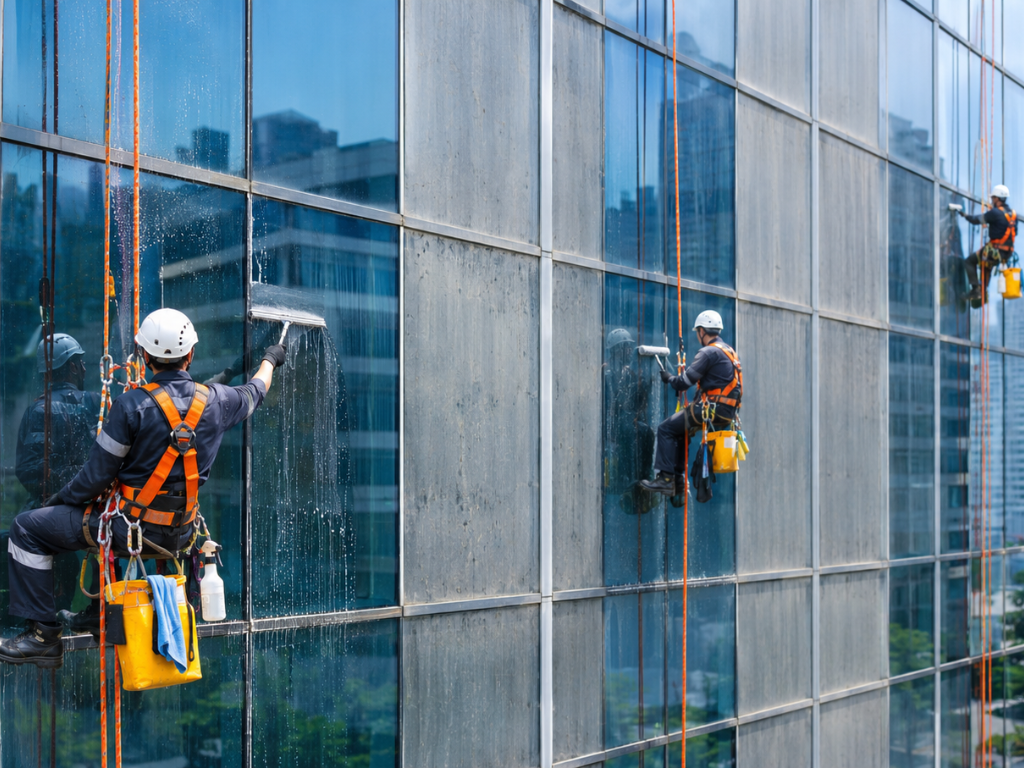
Facade cleaning cost in Singapore is the price of access set-up, the number of vertical drops cleaned, the surface and soiling on each drop, and the working hours and weather windows the site allows. Labour floors rose on 1 July 2026, when the Progressive Wage Model lifted outdoor cleaners to S$2,495 a month. Below, we break down each cost line. Facade work sits within our specialist commercial cleaning services.
What sets the price of facade cleaning in Singapore?
Five lines set the price of facade cleaning: access set-up, the number of drops, the surface and how dirty it is, the working-hour and weather constraints, and the contract term. Access and drops usually decide most of the quote, which is why two buildings with the same facade area can receive very different prices.
| Quote line | What drives it | What to ask the contractor |
| Access set-up | BMU on site, temporary gondola, rope access anchors or boom lift hire | Is access priced separately from cleaning labour? |
| Drops | Facade perimeter, drop width, recesses, podium re-rigging | How many drops per elevation, and what width? |
| Surface and soiling | Glass, cladding or concrete; algae, soot, cement splash | Which method and chemical per surface? |
| Working constraints | Tenant hours, by-law hours, heat stress breaks, lightning stops | How many working days, and what contingency days? |
| Term | One-off wash or a contract with set frequency | Is the access set-up spread across visits? |
A drop is one vertical strip cleaned from a single rig position, usually one or two glass panels wide. Contractors price by the drop, whether or not the quote shows it.
Why do per-square-metre prices mislead?
Per-square-metre prices mislead because facade area does not tell you how many drops a crew has to rig, or how hard each one is to reach. Two facades of identical area can differ in drop count by a factor of two.
Take a 20-storey office block about 70 metres tall with a 160-metre perimeter. Its facade area is about 11,200 square metres. At a drop width of 2 metres, the crew cleans about 80 drops. A 10-storey block with a 320-metre perimeter has the same facade area and twice the drops, each half as tall. Every extra drop means another rig, another anchor check and another barricade at the base.
Height pushes the other way. A taller drop takes longer to descend, and wind at height stops work more often. Ask every contractor for a drop count per elevation, then compare quotes per drop.
How does the access method change the quote?
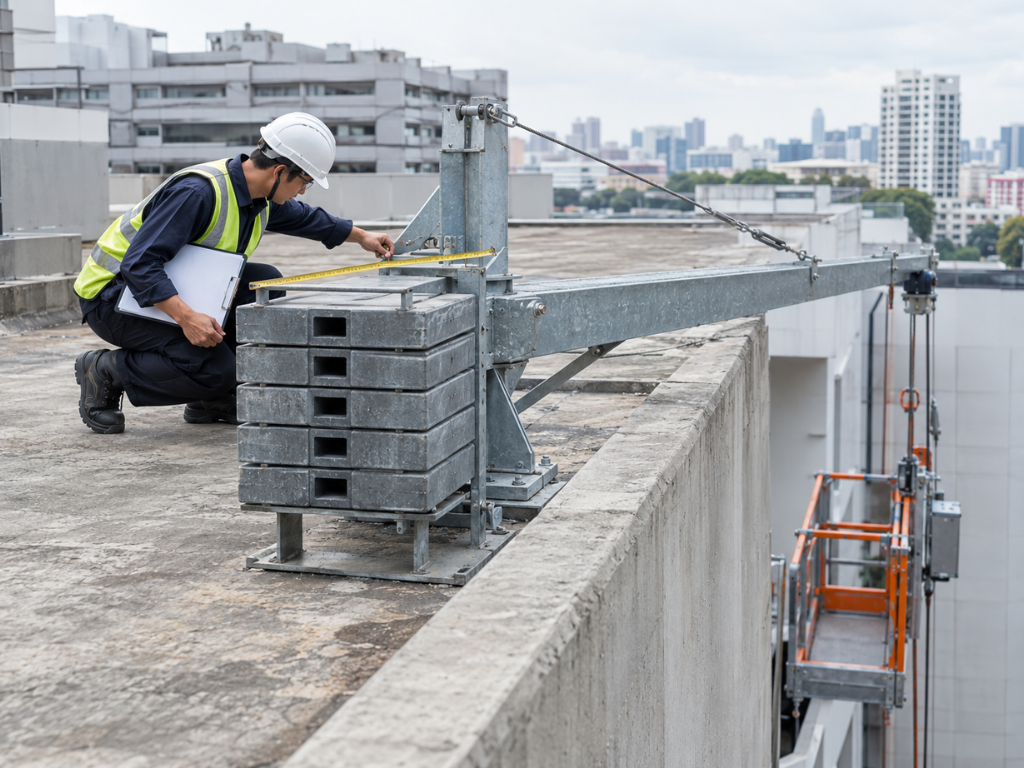
A building with a working building maintenance unit (BMU) pays the least per clean, because the owner has already bought the machine. A temporary gondola costs the most to set up, rope access sits between them, and a boom lift is charged by the day however many panels it reaches.
BMUs are capital equipment. Public tender awards show the scale: the Urban Redevelopment Authority awarded S$759,455 in 2021 to modernise and maintain the gondola systems at the URA Centre, and the Supreme Court awarded S$565,888 in 2023 to replace a gondola monorail. A building that carries that cost already cleans its reachable faces cheaply.
Rigging a temporary gondola has cost more since 2025. The joint MOM and BCA circular on outriggers for suspended scaffolds, dated 10 January 2025, requires a Professional Engineer to design every outrigger with calculations and inspect it on each worksite. Outriggers cannot sit on brick parapets or tie back to solar panels unless the PE verifies them. That engineering now sits inside every temporary gondola quote.
Rope access avoids outriggers but needs rated roof anchors, two per technician plus one kept free for rescue. On recessed or curved facades it is often the only method that reaches. Hong Ye Group’s Orchard Central exterior cleaning project combined rope access with water-fed poles on a mixed-height frontage.
How do glass, cladding and concrete change the cost?
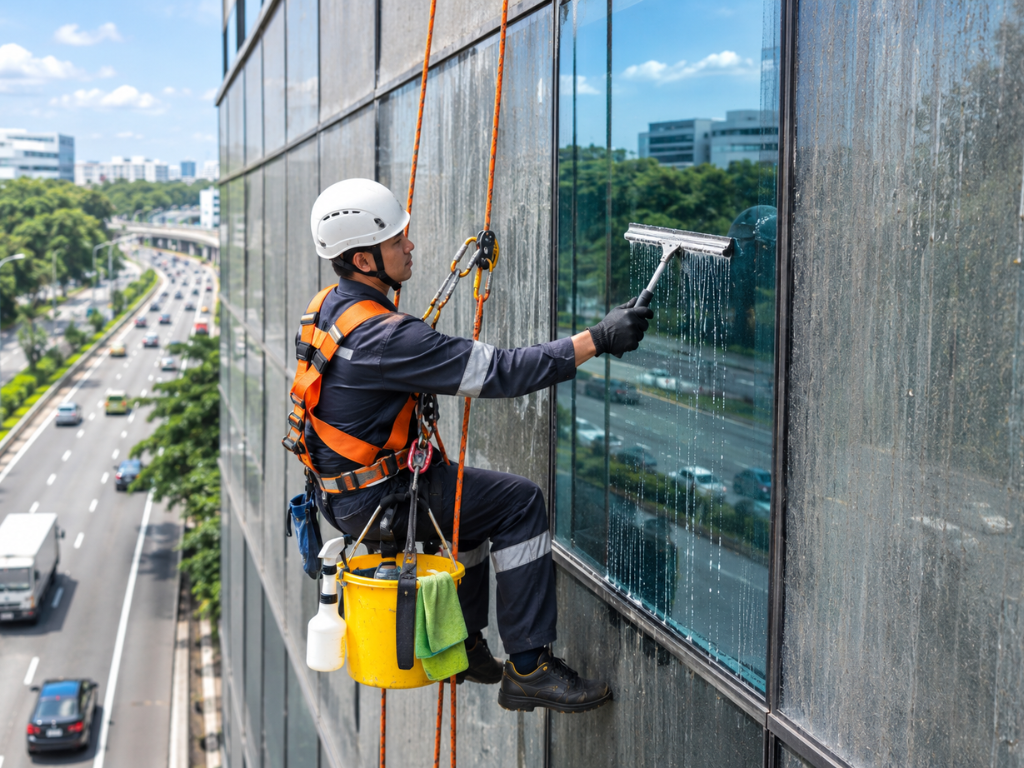
Glass is the cheapest surface per drop, aluminium cladding costs more because it needs slower, gentler work, and painted or tiled concrete costs the most when algae has set in. Heavy soiling raises the price on any surface.
Glass takes purified water and soft tools and moves quickly. Aluminium composite cladding needs pH-neutral detergent at low pressure, and manufacturer guidance such as 3A Composites’ ALUCOBOND instructions bars cleaning panels hotter than 40°C. On a west elevation in Singapore, that pushes work into shaded hours and stretches the job.
Concrete with algae and black streaks needs a biocide, dwell time, then a rinse, so each drop is visited twice. Tiled facades need low pressure near grout lines. A facade left for two or three years also costs more per drop than one on a regular cycle, because the crew is removing build-up instead of maintaining a clean surface.
How do working hours, heat and weather affect the price?
Working hours, heat and weather set how many days the job takes, and days are what the contractor prices. A facade that can only be worked before 9 am on weekdays costs more than the same facade worked all day.
Occupied offices restrict work near entrances during peak hours, and condominium by-laws set when contractors can work near residents. Heat adds rest time. MOM’s heat stress measures require hourly rest of at least 10 minutes for heavy physical work when the wet bulb globe temperature reaches 32°C, and its framework sets 15 minutes at 33°C and above.
Lightning stops work. NEA’s Changi Climate Station records lightning on about 176 days a year, and myENV alerts flag lightning or thundery showers forecast within 6 km. A fair quote names its contingency days for the inter-monsoon months of April, May, October and November, so the price does not rise when the weather turns.
What did the 2026 wage changes do to facade cleaning prices?
The 2026 wage changes raised the labour floor under every facade cleaning quote. From 1 July 2026, MOM’s Progressive Wage Model for the cleaning sector sets monthly basic wages of at least S$2,495 for outdoor cleaners, S$2,700 for multi-skilled cleaners and machine operators, and S$2,870 for supervisors at office and commercial sites, which include condominiums.
The floors rise every July to 2029, when the outdoor cleaner floor reaches S$2,835. Rope access technicians and gondola operators carry certification and work-at-height training, so their pay sits above these floors.
A multi-year facade contract signed today crosses at least two wage increases. Ask how the price adjusts each July. A contract with no adjustment clause either prices the rises in up front or leaves the contractor squeezed in year two, and squeezed contractors cut crew size.
How often should a building facade be cleaned?
No Singapore regulation sets a facade cleaning interval, but owners must keep the building in a proper and clean condition. Part 4A of the Building Control Act, in force since 1 October 2025, lets the Commissioner of Building Control issue a notice to maintain where a building falls short of that standard.
Exposure sets the frequency. Glass towers beside expressways, construction sites or the coast soil fastest. Hong Ye Group recommends cleaning glass facades at least twice a year, with exposed elevations on a quarterly cycle, and cleaning painted concrete whenever algae returns.
Frequency changes the unit cost. Each visit to a clean facade is faster than a visit to a dirty one, and a contract spreads the fixed access set-up across several visits.
How does the BCA Periodic Facade Inspection affect cleaning budgets?
The BCA Periodic Facade Inspection adds a cost every seven years for buildings taller than 13 metres and older than 20 years, and the cleaning budget should be planned around it. The two jobs need the same access, so booking them together saves one round of rigging.
The inspection must be carried out by a Competent Person, a Professional Engineer or Registered Architect with BCA’s Certificate in Facade Inspection, who checks every elevation visually and hand-tests at least 10% of each one. BCA’s PFI guidance makes the owner responsible for providing the access, whether gondola, boom lift or scaffold. BCA estimated about 30,000 buildings would fall within the first cycle, which began in 2022. Owners who schedule facade cleaning around inspection pay for access once.
The government framed cleaning as part of the same upkeep. Introducing the regime in 2020, then Minister of State Zaqy Mohamad said routine facade maintenance “can include simple rectifications, general cleaning as well as painting of external walls.”
Wash the facade after the Competent Person’s first visual survey and before close-range work, from the same rigging. A dirty facade hides hairline cracks, and the risks of unqualified high-rise contractors include washing off the staining that points to a defect.
Facade cleaning contract vs one-off: which costs less?
A contract costs less per clean for any building cleaned twice a year or more, because the access survey, anchor checks and method statement are done once and spread across visits. A one-off wash suits a building preparing for an inspection, a repaint or a sale.
The contract also fixes the drop plan and the crew, so the second visit runs faster than the first. The weak point is a vague scope. “Facade cleaning twice a year” with no drop count, surface method or contingency days leaves every variation open to argument.
Government buyers bundle the work. Of 18,464 tenders awarded on GeBIZ between April 2021 and March 2026, in the government procurement dataset on data.gov.sg, none was a standalone facade cleaning contract. The National Library Board’s 2021 award of S$33.6 million covered cleaning, facade cleaning, pest control, horticulture and building maintenance in one contract. Private owners can apply the same logic by placing facade cleaning inside their wider cleaning contract.
How should MCSTs and managing agents budget and compare quotes?
MCSTs should budget recurring facade cleaning as routine maintenance and plan larger washes alongside repainting and inspection. BCA’s strata living guide places repairs and maintenance of common areas in the management fund and repainting of the estate in the sinking fund, and external walls are common property under the Building (Strata Management) Act.
A managing agent comparing quotes should line them up on the same basis: drop count per elevation, access method per elevation, access cost shown separately from labour, contingency days, and the wage adjustment clause. Ask each contractor for its bizSAFE level and NEA cleaning business licence, using the checks for choosing a commercial cleaning company.
Ask how completed drops are recorded, since a paid drop that nobody can verify is a common dispute. Hong Ye Group records task completion through Smart iClean task records. The same line-by-line approach applies to office cleaning costs in 2026.
Price the drops, then the hours
Most of a facade cleaning quote comes from the roof and the calendar. Access sets the set-up cost and the drop count sets the labour. Working hours, heat and lightning then decide how many days you pay for. The cheapest building to clean has a working BMU and a written drop plan, and shares its rigging with the seven-year inspection.
Book a facade access survey with Hong Ye Group. The team counts the drops per elevation, checks your BMU or roof anchors, and returns a quote with access, labour and contingency days shown as separate lines. Request a facade cleaning quote
Frequently asked questions
Who pays for facade cleaning in a condo in Singapore?
The MCST pays, because external walls shared by two or more lots are common property under the Building (Strata Management) Act. BCA’s strata guide puts routine repairs and maintenance in the management fund and repainting in the sinking fund, so a recurring wash is budgeted as maintenance and a wash planned with repainting sits with the sinking fund works.
Does facade cleaning count as the BCA periodic facade inspection?
No. The Periodic Facade Inspection must be done by a Competent Person, a Professional Engineer or Registered Architect with BCA’s Certificate in Facade Inspection. A cleaning crew can share the same gondola or rope rigging and log visible cracks or staining, which cuts the access cost of both jobs.
Is rope access cheaper than a gondola?
Rope access is cheaper on small, recessed or curved facades and on buildings without a BMU, because it needs no outriggers. Since the January 2025 MOM and BCA circular, every temporary gondola outrigger needs a Professional Engineer’s design and inspection, which adds a fixed cost before the first drop.
Why did my facade cleaning quote go up in 2026?
Labour floors rose on 1 July 2026, when MOM’s Progressive Wage Model set outdoor cleaners at S$2,495 and machine operators at S$2,700 a month. Since January 2025, temporary gondolas have also carried the cost of Professional Engineer outrigger design. Ask the contractor to show access, labour and contingency as separate lines.