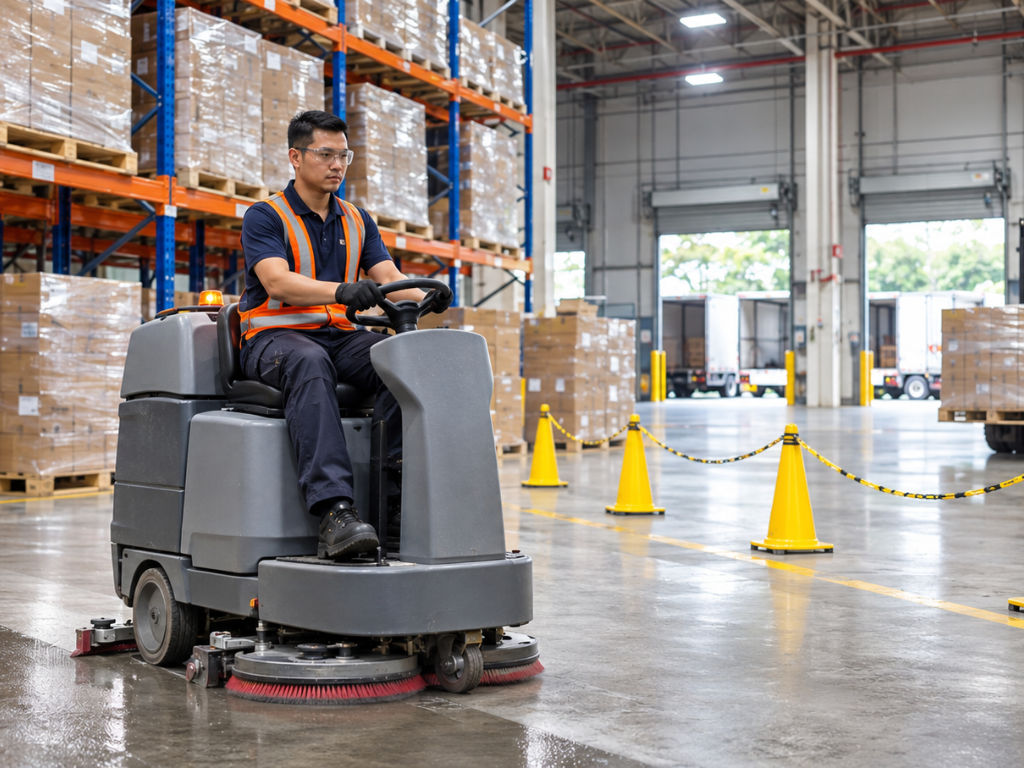
Warehouse cleaning services in Singapore keep floors, racking, loading bays, forklift charging areas and staff amenities clean and safe, timed around inbound and outbound windows so cleaning never blocks a dock. Demand peaks in November: online sales rose to 16.9% of Singapore retail in November 2025, from 14.5% in October. Below, we set out scope, timing and contract terms for the peak. Warehouse work sits within our specialist commercial cleaning services.
What do warehouse cleaning services cover?
Warehouse cleaning covers six zones: aisle and open floors, racking and high-level structures, loading bays and dock areas, forklift charging and maintenance areas, offices and amenities, and the external yard with its drains. Each zone needs its own method and frequency.
| Zone | Main task | Normal frequency | Peak season (Nov to Dec) |
| Aisle and open floor | Ride-on scrubbing, debris sweep | Daily sweep, weekly scrub | Sweep every shift change, scrub twice weekly |
| Racking and high level | Dusting of beams, tops of stock, lights | Twice a year | One full pass before 1 November |
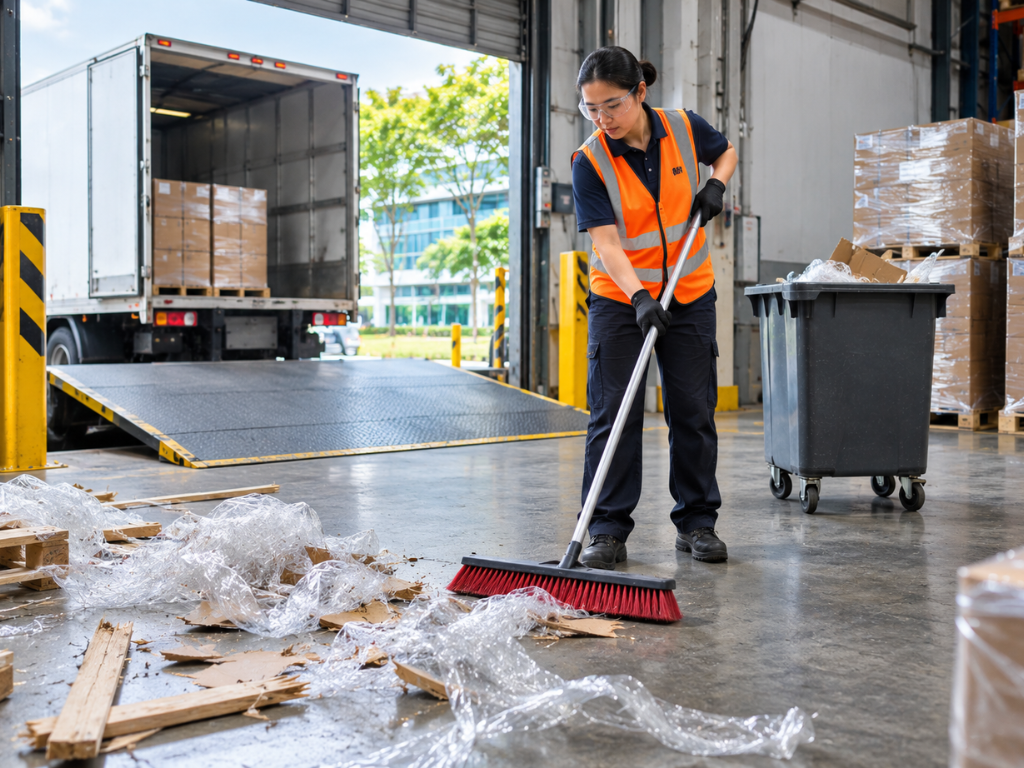
| Loading bay and dock | Sweep, degrease, clear stretch wrap and pallet debris | Daily | Every inbound and outbound window |
| Forklift charging area | Spill clean-up, floor degreasing | Weekly, plus on call | On call within the shift |
| Offices and amenities | Washrooms, pantry, rest areas | Daily | Daily, with extra washroom rounds for temporary staff |
| Yard and drains | Litter, drain and scupper clearance | Weekly | Weekly, plus after heavy rain |
These are Hong Ye Group’s recommended baselines. A cross-dock running three shifts needs more; a bulk store with slow-moving stock needs less.
How does peak season change warehouse cleaning?
Peak season raises the cleaning load because more parcels mean more packing waste, more forklift trips and more people on the floor. The volume jump is measurable: Singapore’s online share of retail sales rose by about 2 percentage points between October and November in each of the last two years.
According to the Department of Statistics, the online share went from 12.6% in October 2024 to 14.6% in November 2024, and from 14.5% in October 2025 to 16.9% in November 2025. SingStat’s November 2025 retail sales release put total retail sales that month at S$4.4 billion. Parcel networks feel it first. SingPost said in September 2025 that parcel volumes can rise by as much as 60% during major shopping events.
“Peak seasons present unique challenges for logistics providers,” SingPost Group Chief Operating Officer Neo Su Yin said at the time. On the warehouse floor, those challenges arrive as cut stretch wrap, broken pallets, carton dust and temporary staff who do not yet know where the spill kits are. The cleaning plan has to scale with throughput.
What is the 2026 warehouse peak season calendar?
The 2026 peak runs from 11.11 on Wednesday 11 November to the year-end stocktake, then picks up again before Chinese New Year 2027 on 6 and 7 February. Cleaning work should be planned around each date.
| Date | Event | Cleaning action |
| Before 1 November | Pre-peak | Full racking dust, floor deep scrub, drain clearance, spill kit restock |
| Wed 11 November | 11.11 | Shift-change sweeps, dock clearance every window |
| Fri 27 November | Black Friday | Same, plus extra amenity rounds for temporary staff |
| Mon 30 November | Cyber Monday | Same |
| Sat 12 December | 12.12 | Same; plan weekend crew in advance |
| Late December | Year-end stocktake | Clean aisles and racking faces before counting starts |
| January | Post-peak | Deep scrub and damage check before the pre-CNY surge |
Finish every high-level job before November. Once 11.11 arrives, a MEWP in an aisle blocks picking for hours, and no operations manager will give up that time.
How should warehouse floor scrubbing be scheduled?
Warehouse floor scrubbing should run in the gaps between inbound and outbound windows, with the floor dry before forklift traffic returns. A ride-on scrubber covers open floor quickly; timing decides whether the plan works.
Tennant’s specification for its T7 ride-on scrubber, on the 810 mm cleaning path, lists a theoretical 5,230 square metres an hour and an estimated actual 2,760 square metres an hour using ISSA cleaning-time standards. On that estimate, 10,000 square metres of open floor takes about 3.6 hours of scrubbing. Narrow aisles, pallet stacks and dock plates slow that down, so most warehouses scrub in zones across several windows.
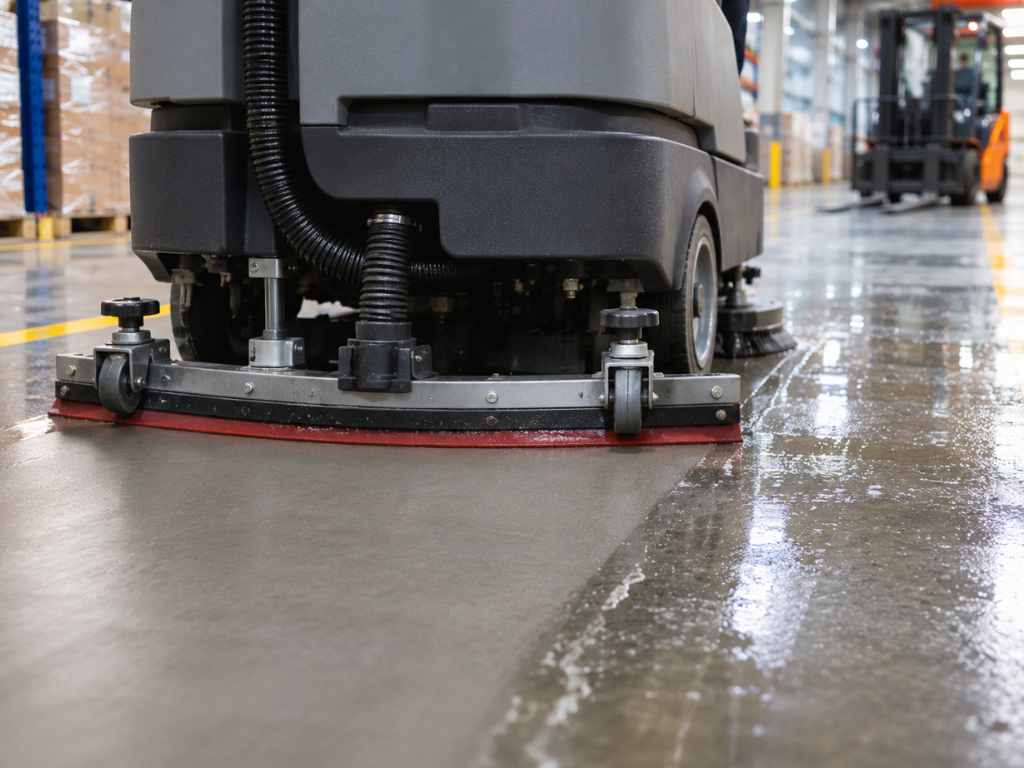
Wet floors are the main risk. A scrubber that leaves water in a forklift lane creates a hazard MOM lists as a root cause of warehouse injuries. Operators of ride-on machines sit at the multi-skilled cleaner and machine operator level of MOM’s Progressive Wage Model, with a basic wage floor of S$2,700 a month from 1 July 2026.
How is racking dust cleaned safely?
Racking dust is cleaned from a mobile elevating work platform (MEWP) or another approved access method, by trained operators, with the aisle closed below. Cleaners should never climb racking, and any damage found while dusting goes to the site’s racking inspector the same day.
Dust on beams and stock tops falls onto pickers and product every time a pallet moves. MOM’s 2025 report lists struck by falling objects as the second most common cause of fatal and major injuries in transportation and storage, with six cases. Work above 3 metres falls under the Workplace Safety and Health (Work at Heights) Regulations 2013, and the method statement should show the fall prevention plan and the exclusion zone.
If the warehouse stores powders such as flour, sugar or plastic pellets, the WSH Council’s November 2025 Guidelines on Combustible Dust rule out dry sweeping and compressed air. Use wet methods or an explosion-proof vacuum. The same high-level dust controls apply in production floor deep cleaning.
How do cleaners work safely around forklift traffic?
Cleaners work safely around forklifts when cleaning and vehicle movement are separated by time, by barriers or by both. The default is time: clean a zone when no forklift is scheduled through it, and barricade it when that is not possible.
The MOM Workplace Safety and Health Report 2025 shows why. In transportation and storage, vehicular incidents, including forklifts, caused 13 fatal and major injuries in 2025. Slips, trips and falls caused 21 major injuries, the sector’s most common. MOM names poor housekeeping as a root cause, including cables and materials left on passageways and failure to keep floors dry.
Under the Workplace Safety and Health Act, the warehouse occupier and the cleaning contractor both carry duties for the cleaner’s safety. MOM advises reviewing risk assessments at least every three years, and whenever processes change. A peak season that adds temporary pickers, new shift patterns and extra forklifts is that change, so review the cleaning risk assessment in October. Our guide to WSH rules for industrial cleaning sets out the duties in full.
What should a warehouse spill response include?
A warehouse spill response should put a stocked spill kit within reach of every charging area and dock, name who responds on each shift, and set a response time measured in minutes. Hydraulic oil, battery electrolyte and burst product all turn a forklift lane into a slip hazard.
Write the response time into the contract and log every call-out. A spill that sits for 40 minutes during an outbound window becomes either an injury or a stopped dock.
What should a warehouse cleaning contract include?
A warehouse cleaning contract should list each zone with its normal and peak frequency, the shift windows cleaning can use, a peak surge clause, the machines supplied, the WSH documents provided and a spill response time. A contract that only states headcount and hours falls apart in the first week of November.
The surge clause matters most. Set the extra crew or hours for November and December, the notice period for activating them, and the rate. Name who disposes of cardboard and stretch wrap, since recyclable packaging volumes rise sharply in peak and the bin contract often belongs to the warehouse operator.
Write verification into the contract too: a zone checklist signed per shift, with photographs for racking and dock work. Pest control belongs alongside, because spilled product and packaging at dock doors attract rodents, so findings should feed the site’s pest control programme. The same rule of a written frequency for every recurring task applies to an office cleaning contract.
How should you choose a warehouse cleaning contractor?
Choose a warehouse cleaning contractor that can show a separate method statement for the operational floor, trained machine and MEWP operators, and a peak-season staffing plan. An office cleaning team scaled up for a warehouse misses the forklift and racking risks.
Ask for bizSAFE status, NEA cleaning business licence, the risk assessment for your site, and the names of the supervisors on each shift. A contractor running warehouse and admin cleaning together should keep them on two scopes in one contract, as covered in our guide to factory office cleaning.
Ask how the contractor covers absence in December, when temporary staff turnover is highest, and whether relief cleaners are inducted on your site before peak or on the day. Ask which machines are owned and which are hired, since hired scrubbers are scarce in November.
Clean ahead of the peak
Put the high-level and deep work before November. Once 11.11 arrives, fit short cleans between dock windows and keep the floor dry whenever a forklift returns. MOM’s data shows what happens otherwise: slips and vehicle strikes lead the injury list in storage. Write the zones, windows and surge clause into the contract, so nobody has to renegotiate the plan in December.
Book a peak-season cleaning review with Hong Ye Group. The team walks your floor, maps cleaning zones against your inbound and outbound windows, and returns a schedule and surge plan for 11.11 to the year-end stocktake. Request a warehouse cleaning review
Frequently asked questions
How often should a warehouse floor be scrubbed?
A busy warehouse floor should be swept daily and scrubbed at least weekly, rising to twice weekly from 11.11 to the year-end stocktake. A Tennant T7 ride-on scrubber covers about 2,760 square metres an hour on open floor, so most sites scrub in zones between inbound and outbound windows.
Can warehouse cleaning happen during operating hours?
Yes, if cleaning and forklift traffic are separated by time or barriers. Sweeping and dock clearance run between windows; scrubbing and racking dust need a closed zone. MOM’s 2025 data recorded 13 fatal and major vehicular injuries in transportation and storage, so the separation plan belongs in the risk assessment.
Who is responsible for a cleaner’s safety in a warehouse?
Both parties. Under the Workplace Safety and Health Act, the warehouse occupier must make the workplace safe and the cleaning contractor must protect its own employees. MOM advises reviewing risk assessments at least every three years and whenever processes change, which includes the start of each peak season.
When should racking be cleaned before peak season?
Racking should be dusted in October, before 11.11 on 11 November. Once peak starts, a mobile elevating work platform in an aisle blocks picking for hours. Work above 3 metres falls under the Work at Heights Regulations 2013, so plan the access, permit and exclusion zone in advance.