
Your lobby marble is the first handshake your property offers. Your ceiling vents tell a story about your operational standards before anyone reads your signage. In hospitality, retail, and healthcare environments, public areas don’t just house foot traffic; they broadcast brand credibility to every visitor who walks through your doors.
Yet most facility managers face the same frustrating reality: standard cleaning contracts treat public areas like any other space. The result? Dull marble that undermines your premium positioning. Dust accumulation on high surfaces that triggers compliance flags. Cleaning schedules that disrupt guest experiences. And zero visibility into whether the work is actually getting done.
For operations leaders managing hotels, shopping centres, hospitals, and mixed-use developments, this isn’t an aesthetic problem. It’s a business risk that affects reputation, safety liability, and operational efficiency.
The Hidden Costs of Generic Public Area Maintenance

Most cleaning vendors approach public areas with the same playbook they use for back-of-house spaces: send in a team, run through a checklist, hope for the best. This works fine for storage rooms. It fails spectacularly for spaces where brand perception is formed in seconds.
Consider what’s actually at stake:
In retail environments, shoppers make split-second judgments about a mall’s quality based on floor appearance and cleanliness. A luxury mall with cloudy marble or visible dust on fixtures immediately contradicts its premium positioning. Hotel guests photograph lobbies before they photograph their rooms. A dated appearance in public spaces colours their entire stay experience, regardless of room quality.
Healthcare facilities face different but equally critical pressures. Dust accumulation on ceiling infrastructure isn’t just unsightly; it’s a clinical risk. High surfaces harbour allergens and particulates that compromise air quality in environments where immune-compromised patients navigate daily. Compliance standards for medical institutions demand systematic cleaning of these hard-to-reach areas, not occasional attention when someone remembers to look up.
The operational implications compound over time:
Generic maintenance approaches create reactive cycles. Marble floors lose their polish gradually until the deterioration becomes visible, forcing costly emergency restoration. High dusting gets deferred because it’s inconvenient, until a safety inspection flags violations. Each deferred intervention costs more than systematic preventative care, but standard contracts don’t include the specialized equipment or expertise required for proper public area maintenance.
Most facility managers intuitively understand this. What they lack is a vendor model that actually addresses the unique requirements of public spaces.
Why Marble Polishing Isn’t Standard Floor Cleaning
Marble surfaces in commercial lobbies, hotel entrances, and retail concourses face conditions that residential marble never encounters. Foot traffic volumes that would take a luxury residence ten years to accumulate happen in high-traffic commercial spaces within weeks. Chemical exposure from tracked-in substances, cleaning products, and environmental factors creates etching and staining patterns that require specialized knowledge to address.
The physics of marble degradation in public spaces
Marble is porous calcium carbonate. This means two things: it absorbs substances that contact it, and it reacts chemically with acids. In public areas, both vulnerabilities get tested constantly. Coffee spills in hotel lobbies. Cleaning chemicals selected for speed rather than stone compatibility. Environmental pollutants tracked in from urban streets. Each interaction either maintains the stone’s integrity or degrades it, depending on how quickly it’s addressed and what products are used.
Standard cleaning contracts typically specify “floor cleaning” without distinguishing between vinyl, tile, and natural stone. The crew arrives with whatever products work fastest on the majority of surfaces. For marble, this often means exposing it to pH-imbalanced chemicals that etch the surface over time. The damage isn’t visible immediately, which is precisely the problem. By the time cloudiness or dullness becomes apparent, surface damage has progressed to the point where basic cleaning can’t restore it.
What proper marble maintenance actually requires
Effective marble care in commercial environments starts with understanding that different interventions serve different purposes. Daily maintenance using pH-neutral cleaners prevents immediate damage and removes surface soil. This is the baseline that should happen every day in high-traffic areas.
Regular sealing creates a protective barrier that buys time when spills occur. For commercial marble in lobbies or retail spaces, sealing intervals should be measured in months, not years. The porous nature of marble means that sealants wear away under foot traffic. A properly sealed commercial marble floor gives facility teams time to clean up spills before they penetrate the stone and create permanent stains.
Periodic polishing restores the surface finish that foot traffic inevitably dulls. This isn’t cosmetic work; it’s material preservation. As marble surfaces accumulate micro-scratches from daily use, they lose reflectivity and begin trapping soil in those surface imperfections. Professional polishing removes the damaged surface layer and restores both appearance and the stone’s ability to shed dirt.
Specialized restoration addresses deeper damage when prevention and maintenance aren’t sufficient. Etching from acidic substances, deep stains, or physical damage require diamond grinding and re-polishing techniques that standard cleaning crews don’t possess.
The business case for specialized marble maintenance
Operations directors evaluating vendor proposals should consider total cost of ownership, not just service contract pricing. A generic cleaning contract might appear less expensive initially, but it doesn’t include the specialized capabilities that preserve marble installations. When marble deteriorates to the point where restoration becomes necessary, the costs dwarf what systematic preventative care would have required.
More significantly, the opportunity cost of degraded public spaces is substantial. A hotel lobby with dull, clouded marble sends signals about property maintenance that influence guest perceptions throughout their stay. A retail mall with tired-looking floors becomes the discount option in consumers’ mental categorization, regardless of the actual tenant mix.
High Dusting: The Compliance Issue Most Vendors Ignore

Ceiling infrastructure, exposed ductwork, light fixtures, and high ledges present a category of cleaning challenge that generic maintenance contracts rarely address adequately. These surfaces accumulate dust, debris, and contaminants that create both aesthetic and functional problems. Yet they remain largely invisible to standard cleaning routines because they require specialized equipment and safety protocols to access.
Why high surfaces matter more than most facility managers realize
Dust doesn’t stay where it lands. Particulates that accumulate on ceiling surfaces eventually become airborne again through air movement, vibration, or HVAC operation. In retail and hospitality environments, this creates a constant low-level degradation of air quality that affects visitor comfort. In healthcare settings, it becomes a clinical concern.
The safety implications are equally significant. Dust is combustible. Heavy accumulations on high surfaces represent fire load that accelerates flame spread in the event of a fire. For facilities that handle food service, manufacturing, or medical procedures, this isn’t theoretical risk. It’s a compliance issue that safety inspectors will flag during audits.
Building systems performance also suffers when dust accumulates on infrastructure. HVAC efficiency drops when vents and returns are coated with debris. Lighting effectiveness diminishes when fixtures accumulate dust layers that block lumens. These performance degradations translate directly to higher operational costs, but they develop gradually enough that the connection often goes unrecognized.
The equipment and expertise gap
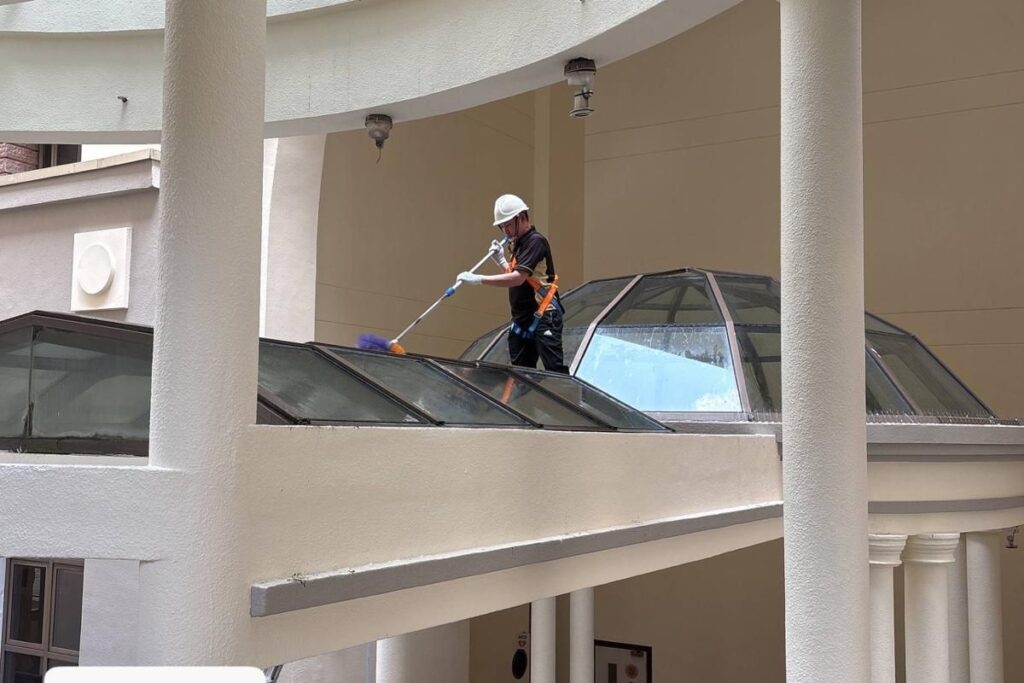
Accessing high surfaces safely requires more than ladders. Commercial spaces with ceiling heights exceeding four metres demand specialized equipment: scaffolding systems, electric lifts, or boom platforms. Each piece of equipment requires operator training and safety protocols. Generic cleaning crews typically aren’t equipped or trained for this type of work.
The cleaning techniques themselves differ from standard surface cleaning. High dusting isn’t about applying cleaning solutions; it’s mechanical removal of accumulated dust using specialized vacuum systems and tools designed to capture particulates rather than disperse them into occupied spaces. HEPA-filtered backpack vacuums prevent captured dust from being re-released into the air during the cleaning process.
Frequency requirements that standard contracts miss
Commercial and institutional facilities should schedule high dusting on a systematic basis, not as an occasional deep-clean. Quarterly intervals work for most environments. Manufacturing facilities or spaces with higher particulate loads may require monthly attention. Healthcare environments should consider even more frequent schedules for clinical areas.
Standard cleaning contracts rarely include high dusting in regular scope, treating it instead as an occasional add-on service. This approach fails to prevent the accumulation patterns that create problems. By the time dust buildup becomes visible or triggers compliance issues, remediation is more difficult and expensive than systematic prevention would have been.
What Operations Leaders Actually Need from Cleaning Vendors
The gap between standard cleaning contracts and what public areas actually require creates predictable problems for facility managers. Operations leaders need vendor partners who understand that public spaces demand different capabilities, not just more frequent service.
Transparency in execution
The chronic complaint among facility managers is lack of visibility into whether contracted work is actually happening. Traditional cleaning contracts rely on trust: the vendor says the work was completed, and the facility team assumes it was done properly unless problems become visible.
This model breaks down for specialized services. Marble maintenance and high dusting happen on intervals measured in weeks or months. By the time quality issues become apparent, multiple service intervals may have been missed or performed inadequately. Without real-time verification, facility managers have no way to catch problems before they escalate.
Specialized equipment and trained personnel
Generic cleaning crews equipped with mops and general-purpose chemicals can’t maintain marble properly or access high surfaces safely. Operations leaders should expect vendors serving public areas to demonstrate specific capabilities:
For marble maintenance: pH-neutral stone care products, professional buffing equipment, diamond polishing systems for restoration work, and proper sealing materials. More importantly, crews should understand the chemistry of natural stone and recognize the difference between cleaning that preserves material integrity versus cleaning that causes long-term damage.
For high dusting: Equipment appropriate to the specific facility (scaffolding, boom lifts, or specialized extension tools), HEPA-filtered vacuum systems, and documented safety training for working at height. In Singapore’s regulatory environment, this includes certification that personnel are trained in working at height safety protocols.
Predictable service delivery
Public areas can’t be cleaned during peak occupancy hours. Hotel lobbies need maintenance during overnight periods when guests aren’t navigating the space. Retail concourses require work schedules that don’t disrupt shopping hours. Healthcare facilities demand cleaning protocols that don’t interfere with patient care activities.
Vendors serving commercial public areas need operational flexibility that standard cleaning contractors may not offer. This includes the ability to mobilize crews during non-peak hours, coordinate with facility operations calendars, and scale service intensity during seasonal traffic fluctuations.
The Technology Advantage: How Real-Time Data Transforms Service Delivery
Forward-thinking facility management companies are moving beyond trust-based service models toward verifiable, data-driven cleaning operations. This shift addresses the core problem that has plagued commercial cleaning for decades: the inability to confirm service delivery without physical inspection.
Digital verification systems
Modern cleaning operations can now generate timestamped records of service delivery. When marble maintenance crews complete scheduled polishing work, digital systems capture exactly when the service occurred, which team members performed the work, and what specific procedures were executed. For facility managers overseeing multiple properties, this means real-time visibility into service delivery across their entire portfolio without dispatching staff to conduct physical inspections.
The same capability applies to high dusting schedules. Rather than assuming quarterly services happened because the vendor invoiced for them, facility managers receive verification that crews accessed specific areas, completed the prescribed procedures, and documented the work photographically.
Predictive maintenance approaches
Data collection over time enables predictive rather than reactive maintenance. When marble floors in a hotel lobby show traffic pattern data indicating accelerated wear in specific zones, maintenance intervals can be adjusted for those areas before visible deterioration occurs. High-traffic pathways get more frequent attention. Lower-traffic areas can be serviced less frequently, optimizing resource allocation.
Similarly, high dusting schedules can be refined based on actual accumulation rates rather than generic quarterly intervals. Facilities with higher air exchange rates or outdoor pollutant exposure might require more frequent service. Spaces with advanced filtration systems might safely extend intervals. Data-driven approaches optimize both outcomes and costs.
Integration with broader facility management systems
For operations directors managing integrated facility management across commercial properties, cleaning data becomes part of the broader operational intelligence framework. Marble maintenance schedules coordinate with property event calendars. High dusting activities align with HVAC maintenance windows. Service delivery verification integrates with compliance documentation requirements.
This level of integration requires vendors who think beyond the cleaning contract as an isolated service delivery. It requires technology infrastructure that can interface with property management systems and produce documentation in formats that facility managers actually use.
Why Hong Ye Group’s Approach Differs
Singapore’s commercial property market demands service partners who understand both the technical requirements of specialized cleaning and the operational realities of managing high-profile public spaces. Hong Ye Group’s evolution from cleaning contractor to integrated facilities management partner reflects this market reality.
Technology-enabled service verification
Hong Ye Group’s Smart iClean platform addresses the visibility problem that frustrates facility managers. Real-time dashboards show exactly when crews are on-site, what specific services are being delivered, and verification that scheduled work is completed. For operations directors managing properties where public area appearance directly impacts business outcomes, this visibility changes the vendor relationship from trust-based to verification-based.
The practical implications matter: hotel general managers can confirm that lobby marble maintenance happened overnight before the morning guest arrival peak. Mall facility teams can verify that high dusting was completed in specific retail wings without dispatching supervisors for physical inspections. Healthcare administrators get documentation that clinical area cleaning meets institutional standards without pulling clinical staff into verification roles.
Specialized capabilities for public area environments
Equipment investments reflect Hong Ye’s focus on commercial public spaces. Professional marble polishing systems and diamond restoration equipment enable the full spectrum of stone care, from routine maintenance to deep restoration when required. High-reach equipment appropriate to Singapore’s commercial building stock ensures that ceiling infrastructure, exposed systems, and elevated surfaces receive proper attention.
Training protocols go beyond generic cleaning procedures. Crews working on marble maintenance understand the chemistry of natural stone, the interaction between cleaning products and porous surfaces, and the difference between maintenance approaches that preserve material integrity versus those that cause long-term damage. High dusting teams hold certifications for working at height and operate within safety protocols appropriate to Singapore’s workplace safety regulations.
Integration across facility management disciplines
For operations directors managing mixed-use developments or large commercial portfolios, the complexity isn’t just cleaning; it’s coordinating multiple facility services in ways that minimize operational disruption. Hong Ye’s integrated facilities management model means that marble maintenance schedules coordinate with broader property activities. High dusting in retail concourses happens during periods when scaffolding can be positioned without interfering with shopper traffic. Service delivery in hotel back-of-house areas aligns with food service operations to avoid workflow conflicts.
This integration extends to compliance documentation. Healthcare facilities working with Hong Ye receive cleaning verification in formats that satisfy infection control audits. Commercial properties pursuing BCA Green Mark certification get service documentation aligned with sustainable facilities management requirements.
Portfolio approach to service delivery
Hong Ye’s client relationships across Singapore’s commercial property market inform service delivery in practical ways. Experience maintaining marble in ION Orchard’s high-traffic retail environment provides reference points for approaching similar environments elsewhere. Protocols developed for healthcare facilities like Sengkang General Hospital translate to other medical institutions. Hospitality experience from properties like Sofitel creates operational frameworks applicable to hotel environments generally.
This accumulated operational knowledge matters when facility managers are selecting service partners. The questions operations directors should ask vendors aren’t just about pricing; they’re about demonstrated capability in similar environments. Has the vendor maintained marble in spaces with comparable foot traffic? Can they show reference installations where high dusting has been systematically maintained over multi-year periods? Do they understand the operational constraints of working in occupied hospitality, retail, or healthcare environments?
Moving from Reactive Cleaning to Strategic Facility Management
Operations leaders evaluating cleaning vendors for commercial public areas should reframe the decision. The question isn’t “who can clean these spaces most affordably?” It’s “which vendor partner understands that public areas require specialized capabilities and can deliver verifiable service that protects our operational and reputational interests?”
What to look for in vendor proposals
Detailed service specifications that distinguish between marble maintenance and generic floor cleaning. Separate line items for high dusting that indicate the vendor understands this isn’t standard cleaning scope. Equipment inventories that include specialized tools appropriate to the specific services being proposed.
Technology infrastructure that provides service verification, not just invoicing. Operations directors should expect vendors to demonstrate how they’ll prove service delivery occurred as specified.
Reference installations in similar environments. A vendor’s track record in comparable facilities (hotels, retail malls, healthcare institutions) indicates whether they understand the operational constraints and service requirements specific to those environments.
Safety and training documentation showing that personnel are qualified for the specialized work they’ll be performing. For Singapore-based operations, this includes certifications aligned with local workplace safety regulations.
The true cost comparison
Price per square metre comparisons between vendor proposals miss the point when services aren’t comparable. A generic cleaning contract that treats marble floors like vinyl and ignores high surfaces entirely might appear less expensive initially. But it doesn’t include the capabilities required to maintain public areas properly. When marble degradation requires emergency restoration or safety inspections flag dust accumulation violations, the deferred costs exceed what proper preventative maintenance would have required.
Operations directors should evaluate proposals based on total cost of ownership: what will it cost to maintain public areas at the standard our brand positioning requires, including the preventative maintenance that avoids costly interventions down the road?
Building strategic vendor partnerships
Commercial properties benefit when facility management vendors function as strategic partners rather than transactional service providers. This means open communication about operational challenges, collaboration on service scheduling that minimizes business disruption, and vendor accountability for outcomes rather than just task completion.
For Hong Ye Group, this partnership approach is reflected in how service relationships develop over time. Initial contracts might focus on specific cleaning scopes. As operational trust builds and facility managers see value in the technology-enabled service model, relationships often expand into integrated facilities management where Hong Ye coordinates multiple building services under a unified operational framework.
Taking Action: From Service Contract to Strategic Asset Protection
Facility managers reading this article likely recognize these challenges from their own operational experience. The question is what to do differently.
Audit your current service delivery
Walk your public areas during off-peak hours and honestly assess what you see. Is your lobby marble as pristine as it was six months ago? A year ago? Look up. When were ceiling surfaces, exposed ductwork, and high fixtures last properly cleaned? Not touched with an extension duster, but actually cleaned with equipment designed to capture particulates?
If the honest answers raise concerns, your current service model isn’t adequate for your facility’s needs.
Evaluate vendor capabilities, not just pricing
Request detailed capabilities statements from prospective vendors. Ask to see their equipment inventory. Request reference installations in similar facility types. Inquire about their technology infrastructure for service verification. If vendors can’t demonstrate specialized capabilities for public area environments, their proposals may not be comparable even if pricing appears competitive.
Consider integrated facilities management
For operations directors managing multiple building systems, coordinating separate contracts for cleaning, maintenance, and building services creates complexity. Integrated facilities management models consolidate these services under unified operational frameworks. The efficiency gains and improved coordination often offset any perceived premium in service pricing.
Hong Ye Group works with facility managers across Singapore’s commercial property sectors to develop customized service frameworks appropriate to specific facility types. Whether you’re managing hotel properties where guest experience is paramount, retail environments where appearance directly impacts commercial performance, or healthcare facilities where clinical standards demand verified cleaning protocols, specialized public area maintenance should be part of your facility management strategy.
Start the conversation
Operations leaders concerned about whether their current service model adequately protects public area investments should start by having frank conversations with prospective vendors about capabilities, not just costs. Hong Ye Group offers facility assessments that identify gaps between current maintenance approaches and what specialized public area environments actually require.
The goal isn’t to sell you the most expensive service package. It’s to ensure that your public areas receive the specialized attention they require, with verification systems that give you confidence the work is happening as specified. For commercial properties where first impressions matter and compliance obligations carry liability implications, that assurance has measurable business value.
About Hong Ye Group
Hong Ye Group is Singapore’s award-winning integrated facilities management provider, serving hospitality, retail, healthcare, and commercial property sectors. Recognized with the Singapore Quality Award and SGID Techblazer Award, Hong Ye combines specialized cleaning expertise with technology-enabled service verification through the Smart iClean platform. The company maintains public area environments for high-profile Singapore properties including ION Orchard, Orchard Central, Sofitel, and Sengkang General Hospital.
Contact Hong Ye Group to schedule a facility assessment and discuss how specialized public area maintenance can protect your property investment and support your operational objectives.
reference sources:
https://www.buddgroup.com/top-4-reasons-to-implement-a-specialized-high-dusting-service-plan/
https://www.gsa.gov/real-estate/historic-preservation/historic-preservation-policy-tools/preservation-tools-resources/technical-procedures/cleaning-and-repolishing-of-interior-historic-marble
https://bostonstonerestoration.com/marble-floor-polishing-care-tips-from-bostons-trusted-experts/
https://www.olsoncleaning.com/post/maintaining-marble-in-commercial-spaces-overcoming-unique-challenges