Cleaning Services

Guest Room Cleaning Standards Hotel Guide: Credits & Checks

Guest Room Cleaning Standards Hotel Guide: Credits & Checks
Guest room cleaning standards in a hotel are the documented steps, time allowances and inspection checks that decide when a room is clean enough to sell. In Singapore they carry real volume: STB recorded 81.9% average occupancy across about 73,358 rooms in 2025, roughly 60,000 occupied rooms a night. Below, we set out attendant workflow, room credits and inspections, drawing on our commercial cleaning and hotel housekeeping services.
What are the guest room cleaning standards in Singapore hotels?

No Singapore regulation prescribes how a guest room must be cleaned; the standard is whatever the hotel writes down in its brand standards and room SOPs, then times and inspects. The Hotels Licensing Board licenses hotels, and a contractor cleaning rooms needs an NEA cleaning business licence, but neither sets a room-by-room method. A usable standard has four parts. Each room type and status gets an SOP listing every step in sequence, with photographs of the finished room. Each SOP gets a time allowance, expressed as room credits. Each finished room passes an inspection before release to the front office. And each result gets recorded, so the standard can be checked against itself next month. Standards usually fail at the second part. Hotels copy a brand checklist, skip the time allowance, and then wonder why the 3 pm check-in queue grows when occupancy passes 90%. A checklist without a time budget is a wish list. At 81.9% average occupancy, a 300-room Singapore hotel sells about 246 rooms on an average night, and every one of them needs a timed, inspected clean before the next guest arrives. What are the guest room cleaning standards in Singapore hotels?

What does a hotel room attendant do on a shift?

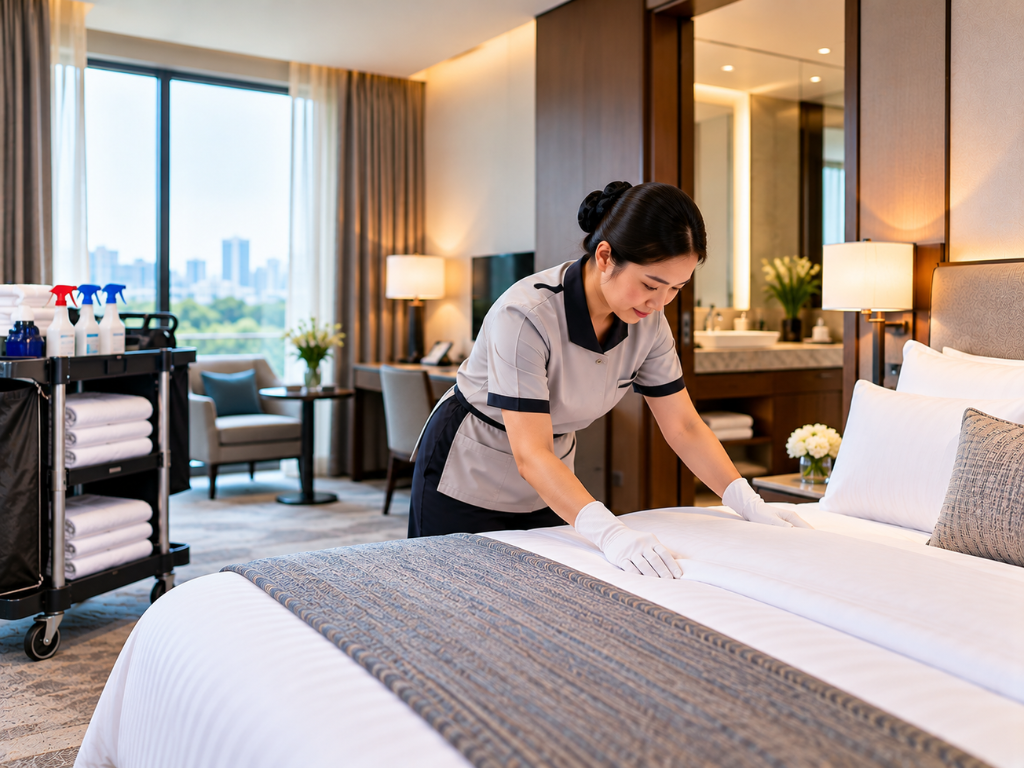
A hotel room attendant receives a room assignment at the morning briefing, stocks the trolley to linen and amenity par, cleans departures and stayovers in priority order, reports maintenance faults and lost property, and releases each finished room for inspection. The shift ends when the last assigned room is released. Priority order matters more than speed. Rooms for early arrivals, VIPs and room moves come first, then remaining departures, then stayovers once guests have left. Do-not-disturb rooms get a documented second attempt in the afternoon and a note to the supervisor. Linen par level, usually three sets per bed across room, laundry and store, decides whether the trolley can be stocked at the start of the shift or the attendant waits for linen mid-morning. Hotel room attendant duties also include the checks nobody else makes: minibar counts, safe status, damage and missing items. The room attendant is the last person in the room before the next guest, which makes the maintenance report as important as the clean.

What is the difference between a departure and a stayover clean?

A departure clean prepares a room for a new guest: full linen strip and remake, bathroom deep clean, amenity reset, full vacuum, and a check of every drawer and surface. A stayover clean services an occupied room: bed make-up, bathroom refresh, towel and amenity replenishment, rubbish removal and a spot vacuum, with the guest’s belongings left as found. Timed on the same floor, a departure runs close to double a stayover. That gap is why hotels count work in credits.

How are room credits calculated in hotel housekeeping?

Room credits convert each room type and status into a time-weighted unit: a stayover standard room counts as 1 credit, a departure as 1.5, and a suite departure as 2 or more. Attendants work to a credit target per shift, typically 15 to 17 credits in an eight-hour shift at a full-service hotel. Rooms per attendant per shift is the figure most people quote, and it settles nothing. University of Houston researchers presenting to the American Society for Microbiology in 2012 cited US attendants cleaning 14 to 16 rooms in an eight-hour shift at about 30 minutes each. That number only holds for a particular departure and stayover mix. A shift of 14 departures is a different job from a shift of 14 stayovers. The credit table should sit in the contract or the SOP manual, with extras priced separately: rollaway beds, connecting rooms, deep cleans and room moves. Anything above 20 credits a shift is a standard problem waiting to surface in guest reviews. Hong Ye Group’s credit-based productivity comparison shows how the same unit settles pricing between in-house and outsourced teams.

How long should a hotel room turnaround take?

A standard room departure should take about 45 minutes of attendant time and a stayover about 30 minutes, based on a 16-credit shift of eight hours. Total room turnaround, from guest check-out to the room showing as clean and inspected, has to fit inside the gap between check-out and check-in, usually noon to 3 pm in Singapore hotels. The maths is straightforward. Sixteen credits over 480 minutes gives 30 minutes per credit, so a 1.5-credit departure gets 45 minutes and a 2-credit suite gets an hour. Inspection adds five to ten minutes per room. A floor with 12 departures and three attendants clears in about three hours only if checkouts arrive early enough to start. The late-checkout cluster is where it fails. Twenty rooms leaving at 12:30 cannot all be ready by 3 pm with a normal team. The fix is a live room-status board shared with the front office, so housekeeping pulls early checkouts forward and the front desk assigns arrivals to rooms already released.

What should a housekeeping quality inspection check?

A housekeeping quality inspection should check the high-touch surfaces first, then presentation, then maintenance: light switches, the TV remote, bedside surfaces, phone and clock docks, door handles, taps and the toilet, followed by bed presentation, amenity layout, and anything broken or missing. Each item is scored against the SOP photograph, which keeps two inspectors consistent on the same room. The research supports that order. A study published in NEHA’s Journal of Environmental Health in March 2025 sampled hotel room surfaces before and after cleaning with ATP meters and plate counts. Nightstands and bedside clocks or phone docks carried the highest contamination in the bedroom before cleaning, followed by lamp switches, pillowcases and TV remotes, and those surfaces still averaged above 1.0 log CFU per square centimetre after cleaning. The toilet bowl had the highest ATP reading of all surfaces sampled. Visual checks alone miss that. Katie Kirsch, who presented the 2012 University of Houston hotel study, noted that hotels validate cleanliness through “a visual assessment, which has been shown to be ineffective in measuring levels of sanitation.” The same study found some of the highest bacterial counts on sponges and mops in housekeeping carts, which carry contamination from room to room.

When should hotels use blacklight or ATP testing?

Hotels should use fluorescent marker and blacklight checks monthly, and ATP swabs quarterly or after a complaint, as verification on top of daily visual inspection. Both give a measurable result where a visual check gives an opinion. A fluorescent marker test works simply: a supervisor dots invisible gel on the remote, switches and bedside table before the attendant enters, then checks with a UV torch after release. A dot still glowing means the surface was missed. ATP meters read organic residue in relative light units within 15 seconds, which makes them useful for toilets, taps and cart equipment. Colour-coded cloths, a separate toilet cloth set and a solution change every few rooms deal with the cart problem the 2012 study found.

How many room attendants does a hotel need at peak occupancy?

Divide the forecast credits for the day by the credit target per attendant, then add a relief factor for rest days and absence. A 300-room hotel at 90% occupancy with 40% departures needs about 20 attendants on the floor that day, before relief. The worked example: 270 occupied rooms produce 108 departures at 1.5 credits and 162 stayovers at 1 credit, a total of 324 credits. At 16 credits per attendant, that is about 20 attendants. Peak occupancy staffing in Singapore concentrates around event weeks such as the Singapore Airshow and the Formula 1 weekend, when departures spike on the same morning. Relief factors of 15% to 20% cover rest days, leave and medical absence; below that, the credit target quietly rises and quality falls. The link between absence cover and quality is covered in solving absenteeism in hospitality. Guest room staffing also depends on public area coverage. When room attendants are pulled to the lobby at checkout peaks, both standards slip, which is why common area attendant coverage should be staffed as its own line.

Is turndown service still part of the standard?

Turndown service remains standard in Singapore’s luxury and upper-upscale hotels and is usually optional or on request elsewhere. It runs in the evening and covers bed preparation, curtain closing, towel replenishment, rubbish removal and amenity touch-up. Turndown should carry its own credit value, commonly a fraction of a stayover, and its own evening roster. Hotels that fold it into the day shift’s target without adding hours end up with rushed stayovers the next morning. Price turndown as a separate line in the credit table and count it only for rooms that request or are entitled to it. Turndown also doubles as a second daily check of the room: a turndown attendant who finds a dripping tap or a missing towel at 7 pm saves a complaint at checkout the next morning, provided the finding goes into the same maintenance log the day shift uses.

How is guest room housekeeping changing in Singapore?

Guest room housekeeping in Singapore is moving towards redesigned workflows and more technology, pushed by labour constraints and the physical cost of the job. Speaking at Hospitality Exchange 2025, Minister of State Alvin Tan cited an STB, WSG and Pan Pacific Hotels Group project that “redesigns workflows and integrates tech for key job roles such as housekeeping”, reporting higher efficiency, higher wages and better guest satisfaction. The physical side is well documented. A study of 50 US hotels published in the American Journal of Industrial Medicine in 2010 found housekeepers had the highest injury rate of any hotel job at 7.9 per 100 worker-years, and the highest rate of musculoskeletal disorders at 3.2. Heavier mattresses, more pillows and larger bathrooms add to that load. Fitted sheets, long-handled tools, lighter trolleys and team cleaning for suites all reduce it, and they belong in the SOP alongside the cleaning steps. Task-level records through Smart iClean task verification help show where the time goes.

Standards you can time and test

A guest room standard holds up when every step has a time allowance and every room gets a check that measures something. Credits keep the time allowance fair between a stayover and a suite departure. Blacklight and ATP checks catch what a glance at the TV remote misses. None of it survives 90% occupancy without staffing to forecast credits and a real relief factor. Book a guest room standards review with Hong Ye Group. The team times your room types, builds a credit table and sets an inspection and verification plan for your floors. Request a housekeeping standards review.

Frequently asked questions

How many rooms does a hotel room attendant clean per day in Singapore? 

A room attendant at a full-service Singapore hotel typically cleans 15 to 17 credits in an eight-hour shift, which means about 11 departures, 16 stayovers, or a mix in between. Hong Ye Group recommends counting work in credits because a departure takes about 1.5 times the work of a stayover.

What is a linen par level in a hotel? 

Linen par level is the number of complete linen sets a hotel holds per bed. Most hotels work to three par: one set on the bed, one in the laundry and one in store. Below three par, room attendants wait for linen mid-shift and departure cleans slip past the 3 pm check-in time.

How often are hotel rooms deep cleaned? 

Hotel guest rooms should be deep cleaned about once a quarter on a floor-by-floor rotation, with carpet extraction four times a year, following Shaw Contract’s heavy-traffic band for hotel rooms. A 300-room hotel on that rotation deep cleans about 23 rooms a week without taking inventory out of sale for long.

Do hotel room cleaners in Singapore need a licence? 

A cleaning company supplying room attendants to a hotel needs a cleaning business licence from NEA, and its resident cleaners fall under the Progressive Wage Model. A hotel’s own in-house housekeepers are hotel employees and do not need that licence, though the hotel itself is licensed by the Hotels Licensing Board.  
To top