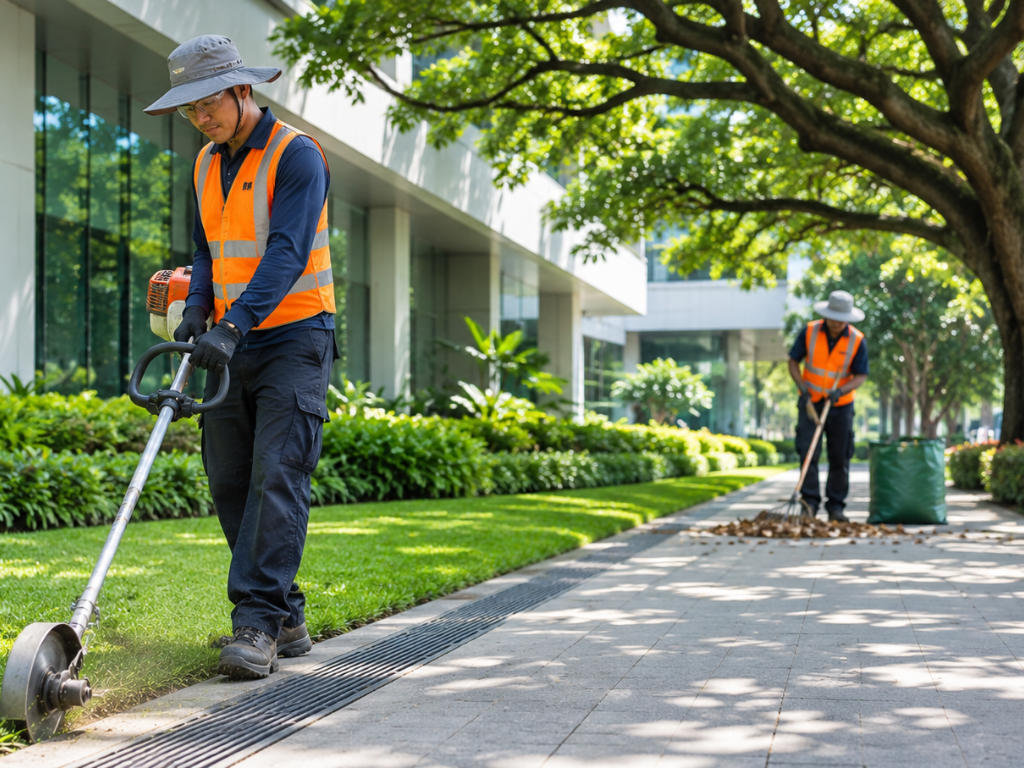
Commercial grounds maintenance in Singapore is the scheduled care of a property’s softscape and hardscape by a horticultural team: turf cutting, pruning, fertilising, irrigation checks, tree care and green waste removal, on fixed visit frequencies. From 1 July 2026, landscape workers on that team earn at least S$2,095 a month. Below, we cover scope, visit frequency and price. Grounds work often sits alongside our specialist commercial cleaning services.
What does a commercial grounds maintenance contract cover?
A grounds maintenance contract covers the softscape (turf, shrubs, groundcover, planter boxes and trees) and the hardscape around it (paths, drains, scupper gratings, water features and irrigation lines). Most contracts add green waste removal and pest and disease control for plants.
Skill level splits the work. Watering, weeding, sweeping leaf litter and basic pruning are general landscape duties. Fertiliser and pesticide application and motorised equipment such as ride-on mowers and hedge trimmers sit at technician level on MOM’s Progressive Wage Model ladder. Tree work above routine pruning needs an arborist.
Projects sit outside the contract. Replanting a whole bed, installing new landscape and removing large trees are priced separately. Trouble starts with the phrase “general landscape maintenance” with nothing under it: the first dead hedge becomes an argument about who pays for new plants. Hong Ye Group’s landscaping services for facilities list grounds maintenance, irrigation, seasonal planting and pest, weed and disease control as separate lines for that reason.
How often do grounds maintenance teams visit?
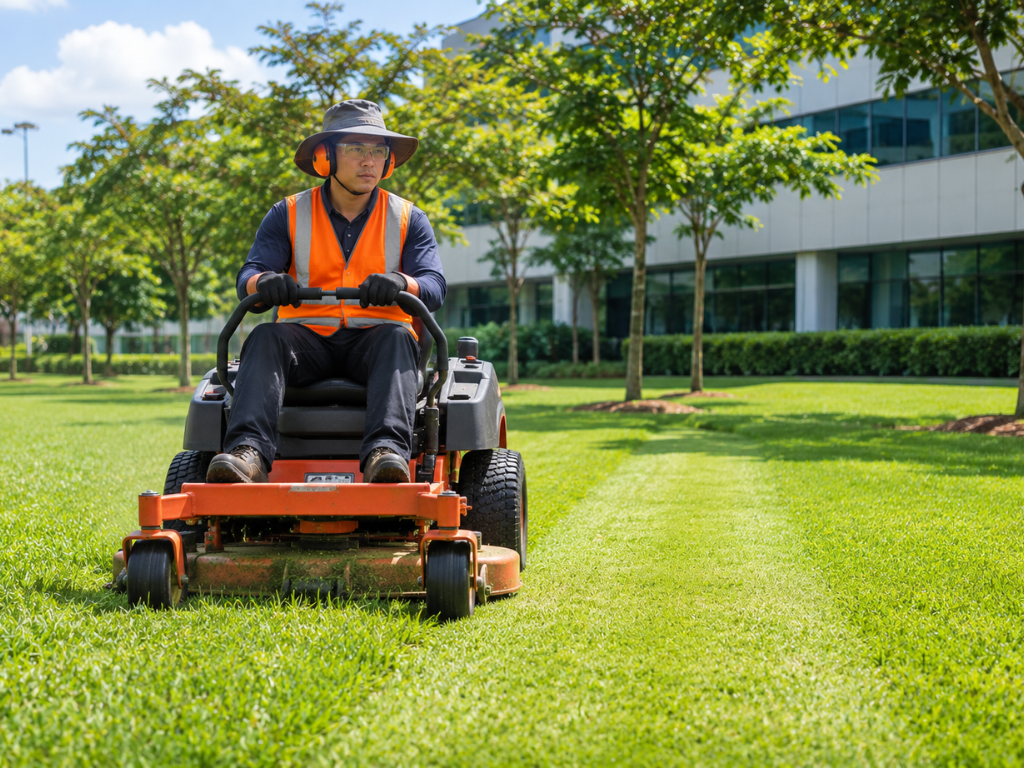
Grounds teams in Singapore visit year-round because tropical plants have no dormant season. A typical commercial schedule clears debris daily on frontages, cuts cow grass every two weeks, prunes shrubs monthly, fertilises quarterly and prunes trees once or twice a year before the monsoons.
| Task | Recommended frequency | Done by |
| Debris and leaf litter clearance | Daily on frontages, weekly elsewhere | Landscape worker |
| Turf cutting and edging (cow grass) | Every 2 weeks | Landscape technician |
| Shrub and hedge pruning | Monthly | Worker or technician |
| Fertilising | Quarterly | Landscape technician |
| Plant pest and disease checks | Monthly, treatment as needed | Landscape technician |
| Irrigation check | Weekly visual, monthly function test | Landscape technician |
| Tree pruning | Once or twice a year, before the monsoons | Arborist-led team |
| Tree inspection | Yearly, and after major storms | Certified arborist |
These are Hong Ye Group’s baselines for commercial frontages. Exposure, footfall and planting design change them, and the contract should state the frequency for each zone.
How often should grass be cut in Singapore?
Cow grass, the most common commercial turf in Singapore, should be cut every two weeks, about 26 cuts a year. Slower species hold their quality on much longer cycles, so the grass species sets the cutting frequency before anything else does.
NParks’ Centre for Urban Greenery and Ecology tested five turf species at a 20 mm cutting height on two, four and six week cycles. Cow grass performed well only on the two-week cycle. Manila grass (Zoysia matrella) held good quality on all three, which means about nine cuts a year on a six-week cycle.
The researchers, Vivek Govindasamy and Nithin Padmanabhan, noted that mowing “incurs the most cost due to its frequency of application, fuel consumption and manpower requirement.” For a low-traffic verge or slope, re-turfing with Manila grass pays back in visits saved.
Who is responsible for trees on commercial property?
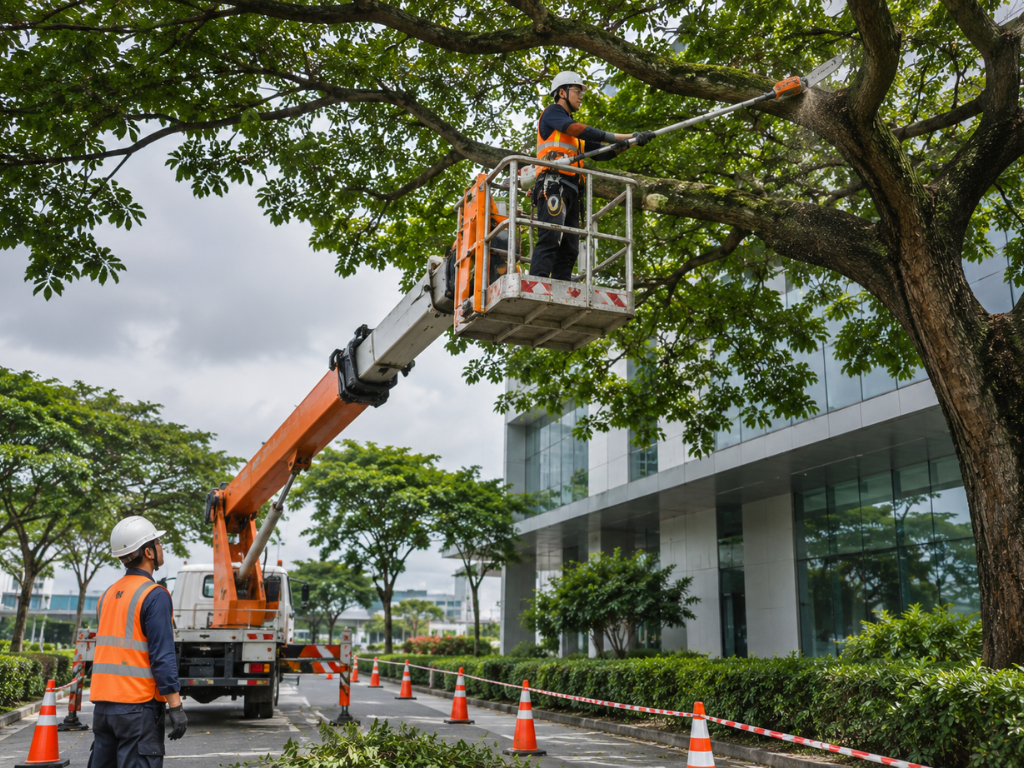
The property owner is responsible for trees on private commercial land, including their inspection, pruning and safe condition. Inside a Tree Conservation Area, cutting any tree with a girth of more than 1 metre needs written approval from the Commissioner of Parks and Recreation, whether or not development works are under way.
Singapore has two Tree Conservation Areas, gazetted in 1991: the Central TCA of about 4,700 hectares and the Changi TCA of about 200 hectares. Owners can check whether a site falls inside either one on NParks’ TreesSG map before approving any work on a large tree.
NParks manages public trees, so its own regime is the benchmark private owners should match. Public trees are inspected every six to 24 months, and tree failures on NParks-managed land fell to 430 in 2023 from 1,250 in 2014, according to a written parliamentary reply.
After a fatal tree failure in 2021, Minister for National Development Desmond Lee told Parliament that any death or injury from a fallen tree is “one too many”. A commercial owner should keep at least a yearly arborist report on record for every mature tree near a walkway, car park or drop-off point.
How does the Northeast Monsoon change the schedule?
The Northeast Monsoon, from December to early March, needs a different plan in each half. The wet phase from December to early January brings monsoon surges with several days of continuous rain; the dry phase from late January to early March is the best working window of the year, with February usually the driest month.
Tree pruning should finish in November, before the surges bring wind and heavy rain. NParks prunes roadside trees once or twice a year ahead of the monsoon seasons for the same reason.
During the wet phase, turf keeps growing, so build a rain contingency day into every two-week cutting cycle from December to mid-January. A missed cut then moves to the next dry day, and the turf never reaches a four-week gap that one visit cannot recover.
The inter-monsoon months add a second constraint. April, May, October and November bring afternoon thunderstorms on most days, and NEA’s Changi Climate Station records lightning on about 176 days a year. Crews on open turf with metal equipment should stop on the first myENV lightning alert, triggered within 6 km, and resume after the 30-minute all-clear. Mornings carry the heavy work in those months.
What sets the price of commercial grounds maintenance?
Visit frequency and crew wage level set most of a grounds maintenance price, because labour is the largest cost line. Area, planting density, the number of mature trees, green waste volume and how much irrigation the site runs decide the rest.
From 1 July 2026, MOM’s Progressive Wage Model for the landscape sector sets monthly basic wages of at least S$2,095 for a landscape worker, S$2,490 for a technician, S$2,685 for an assistant supervisor and S$3,060 for a supervisor. The floors rise every July until 2028, when the worker floor reaches S$2,385. Eligible employees also receive a PWM bonus of at least two weeks’ basic wages a year.
The PWM is a registration condition for NParks’ Landscape Company Register, so a registered contractor cannot pay resident staff below these floors. Two quotes for the same site often differ by the crew mix. A quote built entirely on landscape workers undercuts one with technicians, but only technicians match the PWM role for mowing machinery and chemical treatment.
Green waste is the cost owners forget. Pruning and grass cutting produce horticultural waste that is charged at disposal, and the heaviest loads come from the pre-monsoon tree pruning round. A contract without a green waste line produces a variation claim every November.
How do government agencies structure grounds maintenance contracts?
Government agencies buy grounds maintenance mostly on three-year terms and often bundle it with cleaning. In our review of GeBIZ awards from April 2021 to March 2026, we identified 74 domestic grounds and landscape maintenance tenders across 22 agencies; 41 of the 56 that state a term run three years.
Bundling is common. Twenty-five of the 74 tenders also cover cleaning or park cleansing, and NParks itself bundles cleansing into 21 of its 38 grounds contracts, under titles such as arboriculture, horticulture, turf management and cleansing services. Half of all 74 tenders name arboriculture or tree work in the scope, so tree care usually sits inside the grounds contract.
The data comes from the government procurement dataset on data.gov.sg, classified by keyword from tender descriptions. Private owners can borrow the same structure: a three-year term long enough for the contractor to learn the site, with trees and boundary cleaning written into one scope.
Should grounds maintenance sit with your cleaning contractor?
Grounds maintenance works best under the same contractor as cleaning when that contractor runs its own LCR-registered horticultural team. Leaf litter, drains, bin areas and hardscape sit on the boundary between the two scopes, and split contracts leave those items with nobody.
The disputes come from the same few places: leaves swept from paths into planters, scuppers clogged with green waste, and standing water in planter trays. That last one matters for health as well as appearance, because stagnant water breeds Aedes mosquitoes, and a grounds team that clears it every visit is the first line of control. Findings should feed the site’s pest control programme the same week.
The risk in a combined contract is a cleaning company that subcontracts horticulture without saying so. Ask who employs the gardeners and ask for the LCR registration number, using the same checks as for choosing a commercial cleaning company.
What should MCSTs and estate managers write into the contract?
The contract should list every zone, every task with its frequency, the PWM job level and headcount deployed, a named site supervisor, the green waste line, plant replacement terms, arborist cover and rain contingency days. Anything left unwritten becomes a variation later.
Plant replacement needs one clear clause. The contractor replaces plants lost to neglect or its own equipment at its cost; the owner pays for losses from storms, vandalism or construction. The deployment should read as a table of job level, headcount, days and hours, so an estate manager can check attendance against the PWM schedule.
Ask for a short monthly report with photographs of each zone, tree observations, irrigation faults and green waste removed. The same principle of a frequency for every recurring task and a written variation process applies to an office cleaning contract.
One schedule for everything that grows
Turf in Singapore never stops growing, so cutting runs every two weeks all year. The monsoon calendar decides when pruning and heavy work can happen, and a schedule built around both keeps trees safe and turf even. Price follows the crew’s PWM level and the visit count. For structure, public buyers offer a tested model: a three-year term with trees and boundary cleaning inside one scope.
Book a grounds maintenance scope review with Hong Ye Group. The team maps your softscape and hardscape by zone, then returns a visit schedule with frequencies, PWM job levels, green waste and monsoon contingency days set out line by line. Request a grounds maintenance scope review
Frequently asked questions
What is the difference between softscape and hardscape maintenance?
Softscape maintenance covers living elements such as turf, shrubs, trees and planters, while hardscape maintenance covers paths, drains, walls, paving and water features. In Singapore, softscape work falls under the landscape Progressive Wage Model, and hardscape cleaning often overlaps with the site’s cleaning contract, which is why the two scopes need one boundary list.
What is the Landscape Company Register?
The Landscape Company Register is NParks’ register of landscape companies in Singapore. Registration requires compliance with the landscape Progressive Wage Model, which sets a minimum basic wage of S$2,095 a month for landscape workers from 1 July 2026, rising to S$2,385 by July 2028, plus PWM training for resident staff.
Do I need NParks approval to prune a tree on my property?
Routine pruning does not need NParks approval, but cutting down any tree with a girth above 1 metre inside a Tree Conservation Area needs written approval from the Commissioner of Parks and Recreation. The Central and Changi TCAs cover about 4,900 hectares, so check the site on TreesSG before major tree work.
Is green waste removal included in a grounds maintenance contract?
It should be, as a named line with a disposal method and frequency. Green waste from grass cutting and pruning is charged at disposal, and the largest volume comes from the pre-monsoon pruning round each November. Contracts that leave it out produce variation claims before the Northeast Monsoon every year.