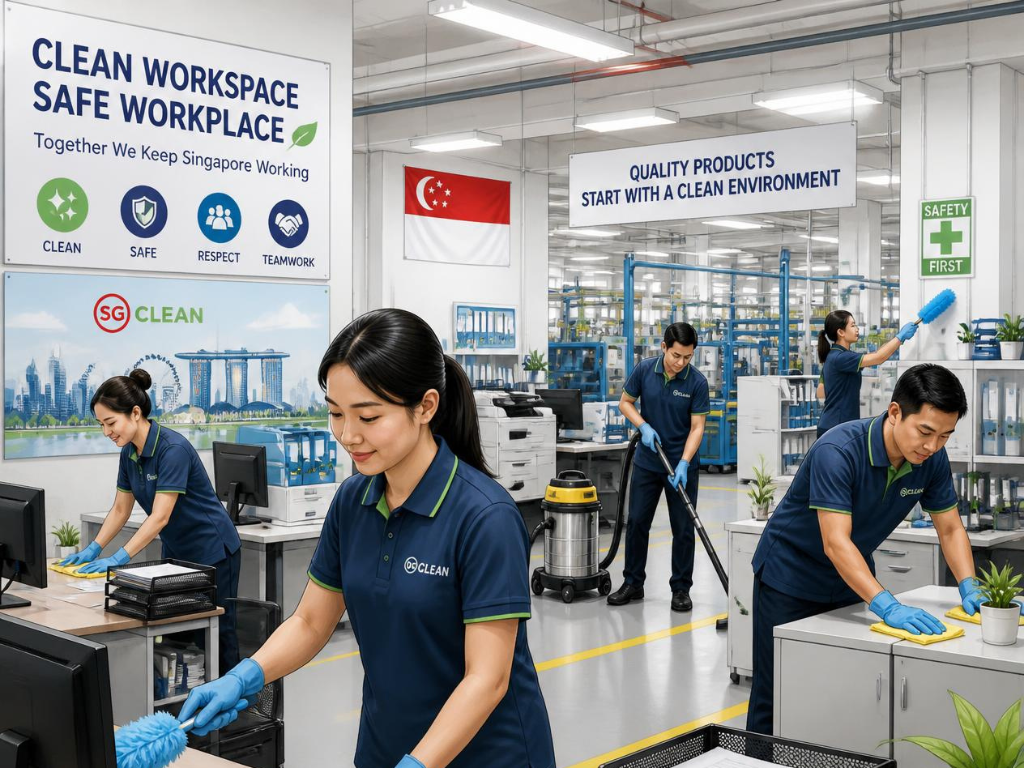
Factory office cleaning in Singapore goes wrong at the scope stage, long before anyone argues about standard. MOM recorded the manufacturing sector at an all-time low fatal and major injury rate of 28.8 per 100,000 workers in 2025, and the admin block sits inside that same premises under a different set of rules. Scope separation, dust control and shift scheduling decide whether the contract works, and Hong Ye Group splits industrial and office cleaning services along those lines.
What counts as factory office cleaning, and where does the scope stop?
Factory office cleaning covers the air-conditioned administrative areas inside an industrial premises: the office floor, meeting rooms, reception, pantry, canteen, locker and changing rooms, washrooms, and the corridors connecting them to the plant. It stops at the door to the production area.
That boundary is the whole specification. Everything on the office side runs on an office control regime with an office risk assessment. Everything on the plant side needs energy isolation, permits where applicable, and a risk assessment written against the machinery and chemicals actually present.
The two scopes belong in one contract and two schedules. A single provider covering both gives you one accountable party and one supervisor who understands the whole site. When you look at the categories of commercial cleaning a bidder offers, the question that matters is whether it can run both regimes without confusing them. A contractor quoting factory and warehouse cleaning alongside daily office work should be able to show you two separate method statements on request.
One thing gets overlooked here. The admin block is usually the part visitors, auditors and prospective customers actually see. It carries reputational weight out of all proportion to its floor area, and it is routinely the part specified last.
Why should the admin block sit on a separate scope from the production floor?
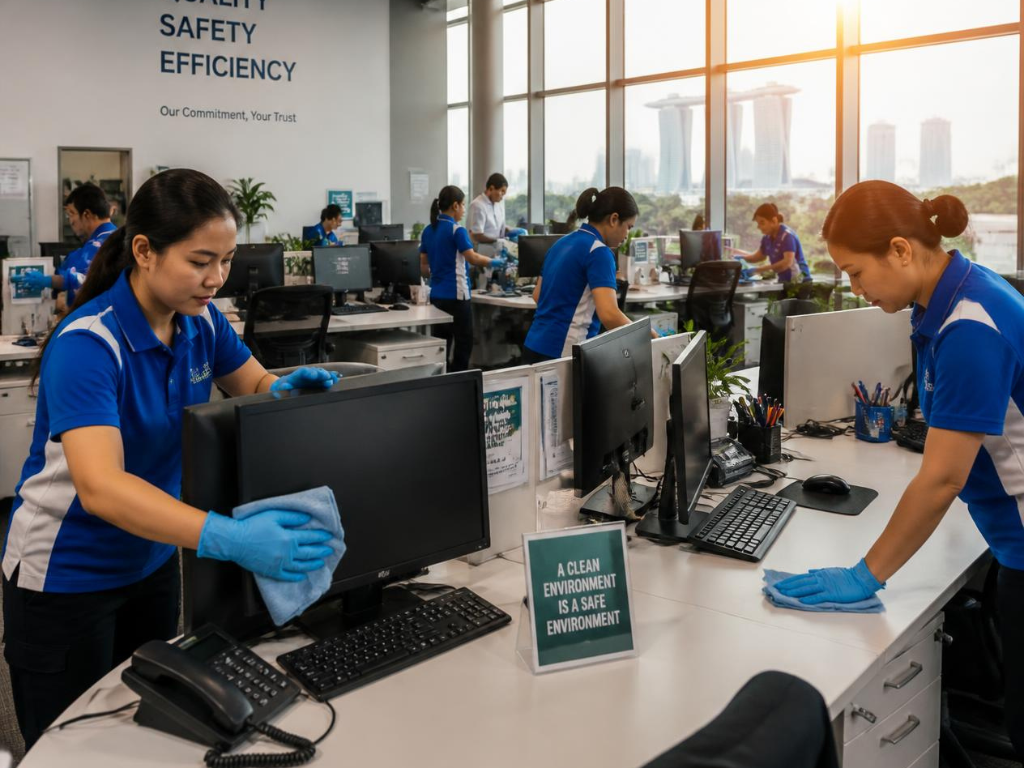
Because the two carry different control regimes, and merging them breaks in one of two directions. Either office cleaning gets dragged onto the plant’s permit and isolation process, which slows routine work that never needed it, or cleaners end up on the production floor under an office risk assessment.
The second failure is the expensive one. Under the Workplace Safety and Health Act 2006 the occupier holds duties it cannot delegate, so a factory whose contracted cleaners cross into a production area without a production-side risk assessment carries that exposure directly. A single-scope contract makes that crossing invisible, because nothing in the paperwork marks the line.
Separation also fixes the pricing argument. Admin areas price on deployed hours against a daily scope. Production areas price against shutdown windows, permits and equipment. Blending them produces a monthly figure neither party can defend when the specification changes.
Write the split as two annexes to one agreement: Annex A for the administrative block with daily and periodic frequencies, Annex B for production areas with the permit sequence and shutdown calendar. The office annex follows the same logic as running an office cleaning schedule anywhere else, with one difference covered in the next section.
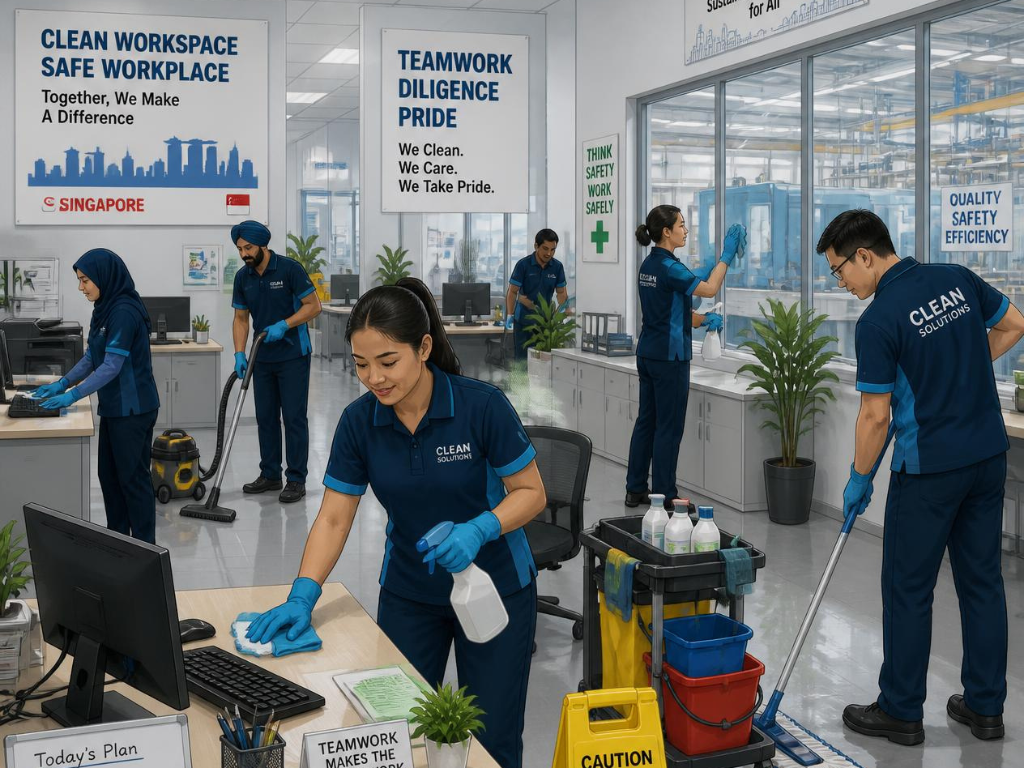
How does production dust get into an air-conditioned office?
On shoes, on clothing, and through doors that open onto the plant. Airborne migration matters far less than people assume, because the admin block is usually positively pressured and filtered.
The consequence is that dust load in a factory office tracks foot traffic across the threshold. Office headcount barely comes into it. A 4,000 square foot admin block with 30 staff and one door to the plant accumulates differently from an identical block with three doors and a shift change every eight hours. Metal swarf, wood dust, flour, resin and cement each behave differently once tracked onto carpet, and abrasive particulate does structural damage to floor finishes on top of looking dirty.
Cleaning method has to follow the contaminant. Dry sweeping and feather dusting redistribute fine particulate into the air, which is the opposite of what an air-conditioned office needs. Vacuum with a filtered unit, damp wipe instead of dry dusting, and use microfibre on horizontal surfaces. All three capture the particulate. Cotton and a dry cloth put it back into the air.
The highest-yield change on most factory sites is better capture at the threshold, which the next two sections deal with. More cleaning hours inside the office rarely moves the number.
What does SS 554 mean for a factory admin block?
SS 554, the Singapore Standard code of practice for indoor air quality in air-conditioned buildings, applies to enclosed air-conditioned premises with named exceptions: residential premises, factory production areas, hospitals, polyclinics and laboratories. Your air-conditioned admin block is not on that exclusion list. The production floor fifteen metres away is.
That asymmetry is useful. The office inside an industrial premises sits under an indoor air quality code that the plant does not, and the Workplace Safety and Health Council lists SS 554 alongside SS 553 in its indoor air quality guidance, directing employers to the WSH (Approved Codes of Practice) Notification for the full list.
The standard was revised in 2026, replacing SS 554:2016 with its 2021 amendment. The new edition introduces the equivalent clean airflow rate concept and a resilience mode covering infection risk management and haze operation, taking reference from ASHRAE Standard 241. Haze mode is a live concern in Singapore, and a factory admin block running recirculated air during a haze episode needs its filtration and its cleaning method aligned.
Cleaning controls the particulate reservoir that ventilation then has to handle. Air quality takes both, which is why filter changes, carpet extraction frequency and high-level dusting of supply diffusers belong in one conversation instead of three different budgets.
How should the transition zone between plant and office be cleaned?
Concentrate the frequency there and thin it elsewhere in the admin block. The threshold between production and administration does more work per square metre than anywhere else in the building, and on most sites it is treated as a corridor.
A working transition zone has three elements. The first is a walk-off matting run long enough to take six to eight footfalls, which in practice means 4.5 to 6 metres of matting in a scraper, wiper and finishing sequence. A single mat at the door does almost nothing. The second is a shoe-in shoe-out or shoe-cover station where the production process warrants it, with a physical bench that forces the sequence, since a sign asking for it will be ignored. The third is a cleaning frequency at that zone of two to three times per shift.
Matting only works if it is maintained. A saturated mat re-deposits what it captured, so the matting run needs vacuuming at every service round and extraction on the periodic calendar alongside the carpet.
Chemical selection at the threshold is worth specifying too, since the soil arriving there is industrial. Degreaser residue tracked onto office vinyl is a slip hazard, and buyers running sustainability reporting will want the chemical and waste data for products used on both sides of the door in the same return.
How do you schedule cleaning around a shift pattern?
Against the production roster. A three-shift plant running 06:00, 14:00 and 22:00 handovers loads its canteen, locker rooms and washrooms around those three points, and a single 18:00 clean on an office pattern catches one of them.
Split the schedule by zone. Office floor, meeting rooms and reception clean on an office pattern, typically after 18:00 when the admin staff leave. Canteen, locker rooms and the transition zone clean against shift handover, with a service round following each of the three peaks. Washrooms serving both populations need a frequency set by the higher of the two demands.
That produces a deployment table with two shapes in it, and it is the single most common thing missing from a factory cleaning specification. Most contracts inherit an office schedule and then absorb complaints about the canteen for two years.
Night deployment carries its own reliability problem. A single cleaner on a 22:00 round with nobody to notice an absence is where scope quietly stops being delivered, so ask any bidder how it verifies attendance and covers a no-show at that hour. The mechanics behind night shift cover reliability matter more on a 24-hour site than on any daytime office.
What do the canteen and locker areas actually need?
More than the office floor, and on a different clock. These two areas generate the majority of complaints on a factory cleaning contract and receive the minority of the specified hours.
A canteen serving three shifts needs a service round after each meal period covering table and bench wipe-down, floor sweep and mop, bin clearance and a check of the servery or vending area. Grease migration from a hot food line onto floor and skirting needs a degreasing step on a weekly cycle. Quarterly will not hold it. Bin centres and refuse rooms need daily clearance and a washdown frequency stated in the contract, because a factory canteen bin room in a tropical climate becomes a pest issue within days.
Locker and changing rooms carry the moisture problem. Shower areas need daily cleaning with a fungicidal or acid descaling product on a stated cycle. Floor drains need clearing, and a mop passed over the grate does not count. Bench and locker exteriors need wiping alongside the floor. Specify drain treatment separately or it will not happen.
Both spaces sit closer in character to shared and common area cleaning in a commercial building than to a private office, and pricing them on an office rate per square foot understates them every time.
What should meeting rooms and visitor areas get?
A reset standard, in place of a frequency. Meeting rooms in a factory admin block get used for audits, customer visits and supplier reviews, and what matters is the condition of the room when a meeting starts. How many times a week it was entered tells you nothing.
Specify the reset: table wiped, chairs squared, whiteboard cleared and cleaned, floor vacuumed, bin emptied, glass and partition marks removed, and any refreshment debris cleared. Attach a photographic reference so the standard has a picture attached to it.
Reception and the visitor route deserve the same treatment. In practice the route a customer walks, from car park through reception to the meeting room and back, is under 60 metres on most industrial sites, and specifying it as a named zone with a daily morning check costs almost nothing.
Audits are the case that justifies it. A quality or customer audit lands with limited notice, and a site that holds its visitor route to a daily standard does not need a scramble the night before.
What does factory office cleaning cost, and how is it priced?
On deployed hours, at roughly S$0.40 to S$0.55 per square foot per month for the administrative block. That sits above the S$0.30 to S$0.45 band for a standard commercial office, because canteen, locker and transition zone loading pull the average up.
The build is the same as any office contract. A resident general cleaner at the Group 1 Progressive Wage Model floor of S$2,080 a month from 1 July 2026 costs roughly S$2,535 in employment cost once the mandatory two-week bonus and employer CPF at 17 per cent are added. Machine work such as canteen floor scrubbing prices at the multi-skilled cleaner floor of S$2,700, and a site supervisor at S$2,870.
Two loadings are specific to this setting. Split shift deployment covering three handovers costs more than a single continuous shift, typically 10 to 20 per cent, because you pay multiple travel legs and hold a roster nobody wants. Periodic works run heavier than in a commercial office, since carpet in an admin block adjacent to production needs extraction quarterly instead of semi-annually.
Ask any bidder to price Annex A and Annex B separately and to show the deployment table by zone and shift. A single monthly figure covering both halves of an industrial site tells you nothing, and selecting a cleaning contractor on that basis means comparing two numbers with no idea what sits behind either.
Conclusion
The administrative block is the part of an industrial site that behaves like an office and is regulated like neither. It sits under an indoor air quality code the production floor is excluded from, it takes its dust load from foot traffic across a threshold, and it loads its canteen and locker rooms against a production roster that no office schedule anticipates. Specify it as its own annex with its own frequencies, and the rest of the contract stops absorbing complaints it was never scoped to prevent.
Send Hong Ye Group your site layout, shift pattern and headcount by zone, and get back two annexes: an administrative scope with daily and periodic frequencies by zone, and a production scope with its permit sequence, plus a deployment table showing which crew covers which threshold at which hour.
Frequently asked questions
Does a cleaning contractor need an NEA licence to clean a factory office?
Yes. General cleaning at any non-domestic premises requires a valid NEA Cleaning Business Licence under the Environmental Public Health Act 1987, and a factory office is non-domestic. A service buyer engaging an unlicensed provider faces a maximum fine of S$10,000 plus S$1,000 for each continuing day.
Can the same crew clean the office and the production floor?
Yes, provided each crew member is trained and inducted for both and the production tasks run under their own risk assessment and permits. One crew, two control regimes. What does not work is a crew inducted for office work being sent into a production area because the schedule slipped.
How often should a factory office be vacuumed?
Daily on traffic lanes and the transition zone, with the full floor vacuumed daily where production dust is abrasive. Carpet in an admin block adjacent to production needs hot water extraction quarterly, against the semi-annual cycle a commercial office runs, because tracked particulate reaches the backing faster.
Who cleans the locker rooms and shower areas?
The cleaning contractor, under the administrative annex, with drain clearing and descaling specified as separate line items. Left unspecified, showers get mopped and drains get mopped over. Set a daily clean with a fungicidal or descaling product on a stated weekly cycle and name who clears the floor traps.
Do cleaners need PPE in a factory administrative block?
Safety footwear and any zone PPE the site mandates for the corridors they cross, plus task PPE for chemicals. MOM’s WSH Report 2025 recorded 1,028 occupational disease cases nationally, and from 1 December 2025 the harmonised list of 38 occupational diseases broadened work-related musculoskeletal disorder coverage beyond the upper limbs.