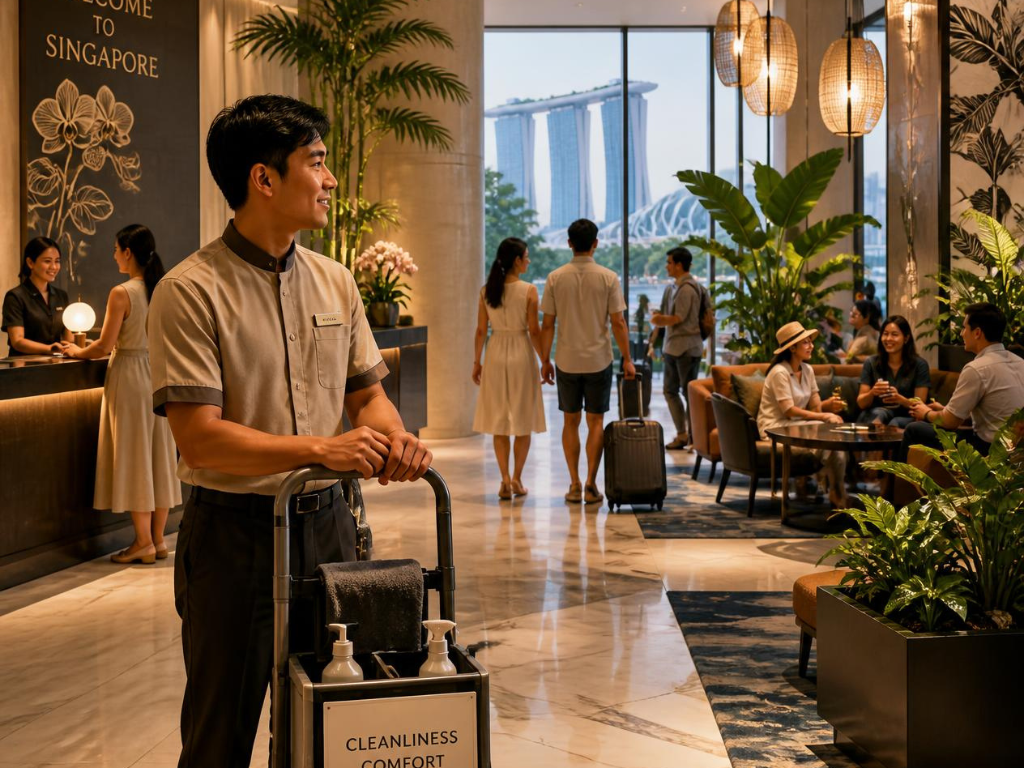
A Common Area Attendant in a Singapore hotel works public space full time, on a scope that has little in common with guest room cleaning. STB put average occupancy at 81.9 per cent across 73,358 rooms in 2025, and more people move through public space in a day than through any single guest floor. The sections below deal with scope, coverage standards and escalation protocol, taking Hong Ye Group’s split of hotel housekeeping and public area services as the working model.
What is a Common Area Attendant, and how does the role differ from a room attendant?
A Common Area Attendant, often written CAA and sometimes called a public area attendant, maintains the hotel’s shared and back of house space on a continuous presence basis. The unit of work is a zone held to standard across a shift. Rooms turned over and released are somebody else’s measure.
That single difference reshapes everything downstream. A room attendant works to a credit or room target, cleans behind a closed door, and finishes when the last room is released. A CAA works in front of guests for the whole shift, cleans the same surfaces repeatedly, and never finishes because footfall keeps arriving.
The skill profile diverges too. A CAA is visible, so presentation and guest interaction matter in a way they do not for a room attendant on a service corridor. Guests ask a CAA for directions before they ask the concierge, because the CAA is the person standing in the lobby.
The two roles get blended on smaller properties, and that blending is where public area standards slip first. The moment a CAA gets pulled to help with a late departure, the lobby is unattended for the busiest 40 minutes of the afternoon.
What does a Common Area Attendant actually cover?
Four zone families: guest-facing front of house, public washrooms, circulation and vertical transport, and back of house. Most contracts specify the first and forget how much of the labour sits in the other three.
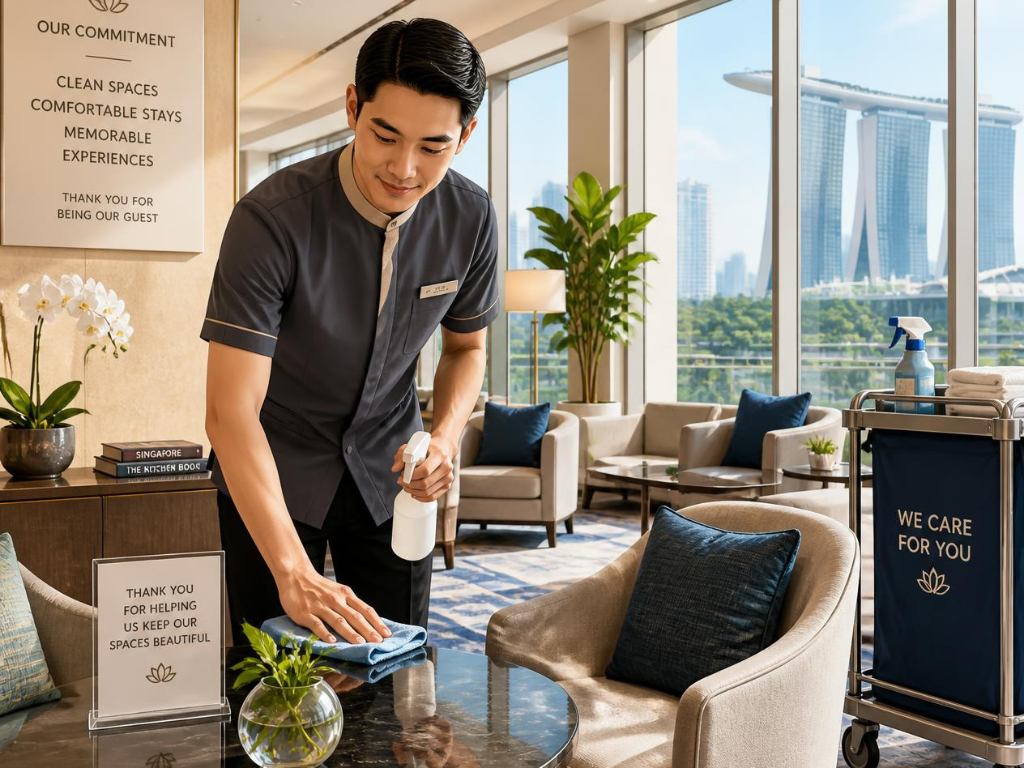
Front of house covers the lobby floor, seating, reception counters, entrance glass and door furniture, luggage areas and the porte cochere threshold. Circulation covers lift lobbies, lift cars including mirrors and control panels, escalators, staircases and guest corridors. Public washrooms cover the lobby, function floor and F&B outlet toilets, which carry the heaviest per-square-metre workload in the building.
Back of house covers service corridors, staff lifts, locker and changing areas, the staff canteen, linen and housekeeping stores, and bin rooms. It carries no guest presentation load and a high compliance load, so it needs its own frequencies written in. Left to absorb whatever time remains at the end of a shift, it gets nothing.
Function and event space sits across both. A ballroom flips between setups on a schedule the CAA has no control over, so it works to a reset standard triggered by the event calendar. The reasons why public areas differ from other cleaning scopes come down to this mix, and the broader commercial cleaning scope types a provider offers should be read against it, never against a service list.
How is public area coverage measured, if not in rooms?
By presence per zone against footfall. Square footage is the wrong unit for the same reason it is wrong in an office: a 200 square metre lobby with 900 daily arrivals is a different job from a 200 square metre function foyer used twice a week.
Three zone types carry three different presence rules. Dwell zones, where guests sit and linger, such as the lobby lounge and club floor, need continuous or near-continuous presence during peak hours because soil arrives constantly and visibly. Transit zones, such as corridors, lift lobbies and staircases, need scheduled rounds at a stated interval, with nobody standing in them between rounds. Event-driven zones, such as ballrooms, meeting foyers and F&B outlet perimeters, need a reset before and after each use, triggered by the event schedule.
Write the specification in those terms. One attendant on continuous lobby presence from 07:00 to 15:00, one on a 90-minute corridor and lift lobby round across floors 3 to 12, one on public washroom rounds at a stated frequency. That produces a deployment table you can audit against an attendance record.
A contractor quoting contracted hospitality cleaning on a lump sum with no zone-and-presence table behind it has given you a number and nothing to hold it against. Ask for the table before you ask for the rate.
What does touchpoint sanitisation mean in practice?
A named list of surfaces with a stated frequency and a verification method. A general instruction to wipe things down leaves touchpoint sanitisation as whatever the attendant happens to remember.
The list typically runs to lift call buttons and car panels, entrance door handles and push plates, escalator handrails, reception counter edges, public washroom door handles, taps and flush plates, and shared touchscreens at self check-in kiosks. Frequency follows footfall, so lift panels in a 400-room property need far more attention than a club floor door handle, and a uniform schedule across both wastes effort on one and starves the other.
Product and dwell matter as much as frequency. A disinfectant needs its stated contact time to work, and a surface wiped and immediately dried has been cleaned rather than disinfected. Match the product to the surface so that a daily disinfectant does not haze a brass handrail or strip a lacquered finish.
Chemical volume is now a reporting line. Minister of State Alvin Tan told Hospitality Exchange 2025 that on sustainability certification “the industry has exceeded expectations”, with 61 per cent of Singapore’s hotel room stock certified against a 60 per cent end-2025 target, about 42,700 rooms across 100 hotels. Providers who supply sustainability data from cleaning as dilution ratios and monthly volumes are the ones whose numbers survive that return.
How should back of house be handled differently from guest-facing areas?
On compliance frequencies, with presentation standards left to the front of house. Nobody photographs a bin room, and that is exactly why it is the area most likely to generate an inspection finding.
Service corridors and staff lifts need daily cleaning because they carry every trolley, every linen bag and every food delivery in the building. Staff canteens and locker rooms load against shift handover, not guest arrivals. Bin and refuse rooms need daily clearance and a stated washdown cycle, because in Singapore’s climate an unwashed bin room becomes a pest issue within days.
Pest management is where back of house connects to a separate regulatory regime. Scheduled treatment by a registered pest control operator under the Control of Vectors and Pesticides Act 1998 handles infestation. The CAA scope handles the harbourage and food sources that invite it. Neither substitutes for the other, and a contract that assumes the pest contractor covers housekeeping failures will find out otherwise.
Set back of house frequencies first when you write the specification. Front of house standards get defended by guests and general managers. Back of house standards only get defended by the contract.
How should shifts be rotated across a 24-hour public area?
In overlapping shifts anchored to arrival and departure peaks, with a handover that transfers open items instead of simply ending. A hotel lobby does not close, so the schedule has to cover the whole clock without leaving the busiest hours to a single attendant.
A workable pattern runs a morning shift covering the breakfast and checkout peak, an afternoon shift covering check-in from around 14:00, and an overnight shift handling work that cannot be done with guests present: floor machine work, brass and glass polishing, and carpet spotting. Overlap morning and afternoon across the changeover so the lobby is never held by nobody.
Overnight is where the specification earns its money and where it is most often thin. Machine work on a marble or terrazzo lobby is a night task by definition, and if the night scope has no named periodic works on a dated calendar, it defaults to sitting and waiting.
Continuity across that rotation comes down to staffing. A public area team that changes composition weekly relearns the property each time, and shift cover in hospitality matters more in public areas than in guest rooms, because an absent CAA is visible to every guest in the lobby within ten minutes.
What escalation protocol does a Common Area Attendant need?
A three-tier protocol with named recipients and stated response times, briefed at induction and posted where the attendant can see it. A CAA finds problems before anyone else, because they are the only person continuously present in public space.
Tier one covers what the attendant handles directly and logs: a spill, a full bin, a smudged panel, a missing amenity. Tier two covers what stops and gets reported immediately because it is a hazard: a wet floor with no signage, a broken tile, a lift car fault, a failed light in a stairwell. Tier three covers what goes to duty management: a guest complaint, a security concern, a suspected pest sighting, a flood or drainage backup.
Response time belongs against each tier. A spill in a dwell zone is a slip risk and needs signage within minutes, well before anyone writes it into a logbook. A pest sighting needs to reach the ECC and the pest contractor the same day, because reporting delay is what turns a sighting into an infestation.
The failure mode is predictable. Where escalation is undefined, attendants under-report, because reporting a problem they cannot fix feels like reporting their own failure. Say explicitly at induction that finding and flagging is the job.
How does the CAA scope interface with guest room cleaning?
At the corridor, the service lift and the linen chute, and all three boundaries need writing down. Guest floor corridors are public area work. The room is guest room work. The doorway is where contracts argue.
Draw the lines concretely. Corridor carpet, skirting, corridor lighting and lift lobby furniture belong to the CAA. The room interior and its threshold belong to the room attendant. Trolleys belong to whoever parked them, with a rule that corridors are cleared before a shift ends. Room service trays left outside doors need a named owner and a collection interval, because trays in a corridor are the most common guest complaint about a guest floor.
Service lifts and linen chute areas need shared frequencies and a single accountable party. A shared area with two owners has none.
On properties where both scopes sit with the same provider, supervision settles this. Where guest rooms are in-house and public areas outsourced, write the boundary into the annex, and hold both teams to the same guest room cleaning standards at the point they meet.
How do you write and verify a public area cleaning specification?
Borrow the structure NEA already publishes. The Environmental Sanitation Regime requires premises managers of specified premises to appoint a registered Environmental Control Coordinator and maintain an Environmental Sanitation Programme, and the ESP template is the best free public area specification structure available in Singapore.
Its sections map onto exactly what a CAA scope needs: scope and frequency of cleaning, disinfection and facility inspection; surfaces and fixtures requiring annual maintenance; inspection on cleanliness; a declaration covering manpower, equipment, amenities, cleaning methodology and cleaning agents used; and pest management. Check whether your property is a specified premises under the regime, and use the template either way.
Verify on outcomes, not on rounds completed. NEA’s Code of Practice for Environmental Control Coordinators references outcome-based cleanliness indicators and ATP meters, and swab-testing a lift handrail or a washroom tap gives you a number where a visual inspection gives you an opinion. Run a scored monthly walk with the provider’s supervisor alongside it.
Price it against the right job level. From 1 July 2026, MOM’s Progressive Wage Model Group 1 ladder sets a general cleaner at S$2,080 a month and a restroom cleaner at S$2,495. A CAA scope including public washroom rounds sits at the higher level, S$415 a month apart, and a quote built on the general cleaner floor while specifying washroom servicing is underpriced by construction. That is the first thing worth checking when assessing a cleaning provider on a public area tender.
Getting the unit right
Public area cleaning fails on units of measurement long before it fails on effort. Rooms and square feet describe a guest floor. Presence, interval and reset describe public space, and a contract written in the wrong unit cannot be enforced in the right one. Fix the zone map, the presence rule per zone and the PWM job level behind the rate, and the standard becomes something you can audit instead of something you notice going wrong.
Send Hong Ye Group your floor plans, public washroom count, function space schedule and arrival and departure curve, and get back a zone map with presence rules, a touchpoint list with intervals and verification methods, a 24-hour rotation with named handover points, and a rate built on the correct PWM job level.
Frequently asked questions
What does CAA stand for in housekeeping?
CAA stands for Common Area Attendant, the housekeeping role responsible for a hotel’s public and back of house areas. Guest rooms sit outside the scope. It covers lobby, corridors, lift lobbies, public washrooms, function space and service areas. Hong Ye Group runs Common Area Attendant services alongside guest room cleaning as separate deployments.
Is a common area attendant the same as a public area attendant?
Yes. The two titles describe the same role, with the choice usually following the brand’s own terminology. International chains lean toward public area attendant or PA attendant. Singapore operators and cleaning contractors more often use Common Area Attendant. Specify the scope in the contract and do not let the job title carry it.
What wage level applies to a hotel public area cleaner in Singapore?
The Progressive Wage Model Group 1 ladder applies. From 1 July 2026 a general cleaner sits at S$2,080 a month and a restroom cleaner at S$2,495, so a CAA scope including public washroom servicing prices at the higher level. Machine operators for overnight floor work sit at S$2,700.
Should hotel public area cleaning be outsourced or kept in-house?
Outsourced, for most properties testing the model. Public areas carry no linen chain, no property management system room status dependency and no in-room guest contact, which makes them the lowest-risk hotel scope to contract. Many Singapore properties outsource public areas permanently while keeping day-shift guest rooms in-house.
How many common area attendants does a hotel need?
Size it by zone and peak. Room count is a poor guide. A full-service property typically runs continuous lobby presence across morning and afternoon shifts, one attendant on corridor and lift lobby rounds per 8 to 10 floors, separate public washroom rounds, and an overnight attendant for machine work.